📖 Read more: Tesla Optimus Gen 3: When Is It Hitting the Market?
🏠 What Is the SwitchBot Onero H1?
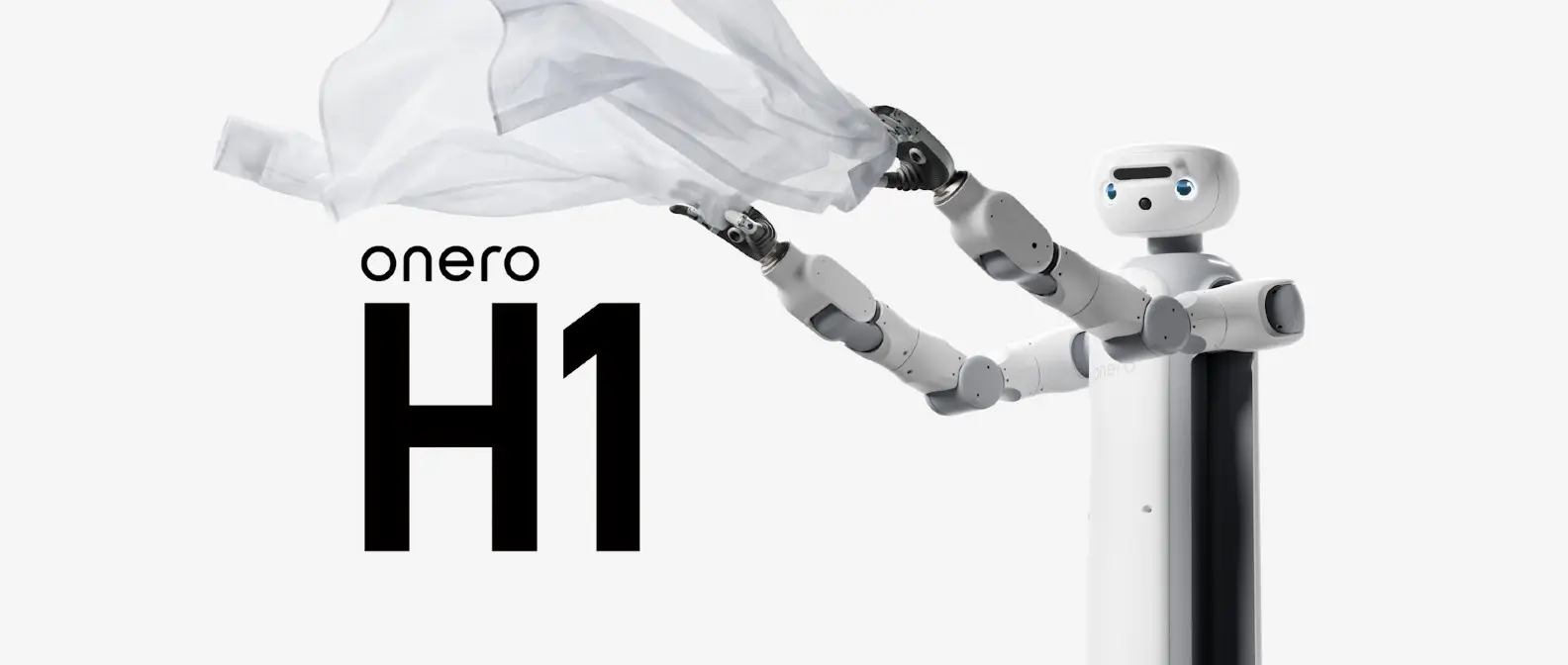
The SwitchBot Onero H1 isn't a simple Roomba-style vacuum or a cute companion robot. It's a fully-fledged humanoid home assistant — with two arms, two legs, a torso, and a “head” packed with sensors. Built from the ground up for the domestic environment, it's focused on the chores nobody wants to do: laundry, dishes, surface cleaning, and tidying up scattered objects.
SwitchBot, best known for its smart switches, thermometers, and security cameras, is now entering the humanoid robotics space — a field dominated by giants like Tesla (Optimus), Boston Dynamics (Atlas), Figure AI, and Unitree. The difference? SwitchBot is focusing exclusively on the home, not factories or warehouses.
📐 Technical Specifications
The Onero H1 was designed with modern home ergonomics in mind. Standing 1.2 meters tall and weighing roughly 45 kilograms, it can navigate between furniture, open doors, and use everyday objects — from a washing machine handle to a mop.
| Specification | Details |
|---|---|
| Height | ~120 cm |
| Weight | ~45 kg |
| Degrees of Freedom | 36+ (arms, legs, torso, head) |
| Sensors | LiDAR, stereo cameras, RGB-D, tactile sensors |
| AI Processor | On-board NPU + cloud processing |
| Battery | ~3–4 hours of autonomy |
| Hand Payload | Up to 5 kg per hand |
| Connectivity | Wi-Fi 6, Bluetooth 5.3, Matter |
Each hand features five fingers with pressure sensors at every fingertip, allowing it to grip delicate objects (like a wine glass) while also exerting enough force to wring a mop or turn a faucet. Until recently, this kind of tactile range was only possible in research robots costing hundreds of thousands of dollars.
🫧 How Does It Handle Laundry?
The headline capability of the Onero H1 — the one that sent shockwaves through CES 2026 — is laundry. But we're not talking about a robot that presses a button on the washing machine. We're talking about a complete workflow:
Collects the Clothes
Walks through rooms, identifies dirty clothes on the floor or in hampers, and gathers them with its hands.
Sorts by Color
Separates whites from colors using its RGB-D camera and color recognition algorithms.
Loads the Washer
Opens the washing machine door, loads the clothes, adds detergent, and selects the right program.
Hangs & Folds
After washing, it hangs clothes on a drying rack or loads the dryer, then performs basic folding.
According to SwitchBot, the full laundry cycle — from collection to folding — requires minimal human intervention. During the CES 2026 demo, the Onero H1 performed the entire process live in a fully furnished mock apartment, in front of thousands of spectators. It wasn't flawless — some movements were slow and one shirt wasn't folded properly — but the overall impression was stunning.
🧹 Other Household Tasks
Laundry is just the tip of the iceberg. The Onero H1 was built as a general-purpose home assistant, capable of performing a wide range of chores:
- Mopping floors: Holds a mop and follows cleaning patterns based on LiDAR mapping.
- Dishes: Clears plates from the table, loads the dishwasher, and adds soap.
- Tidying up: Picks up scattered items (shoes, toys, remotes) and places them where they belong.
- Drink service: Can carry glasses or a tray from the kitchen to the living room.
- Pet care: Refills food and water bowls on a set schedule.
- Security: Patrols at night using its night-vision cameras.
Each task is powered by a “skills” system — pre-installed activity templates that the robot learns through imitation learning and reinforcement learning. New skills can be added via OTA updates.
🧠 The AI Behind the Onero H1
A humanoid robot without a smart “brain” is just an expensive mannequin. SwitchBot developed a three-tier AI system:
The object recognition system uses a foundation model trained on millions of images of home interiors. It identifies over 200 categories of objects — from clothes and dishes to toys and remote controls. The Task Planner runs a local Large Language Model (LLM), enabling it to understand voice commands in English and Chinese (with European language support planned for a future update).
For example, if you say "Pick up the toys in the living room," the Onero H1 will:
- Identify which room it's in (via its home map)
- Scan the space for objects classified as “toys”
- Plan a collection path
- Pick them up one by one or in batches
- Place them in the toy box (if it knows its location)
🔗 Integration With the SwitchBot Ecosystem
The Onero H1's real power isn't just the robot itself — it's the seamless connection to SwitchBot's massive existing ecosystem. With over 10 million devices sold worldwide, SwitchBot has a smart home network that few competitors can match.
It also supports the Matter and Thread protocols, meaning it can integrate into an Apple HomeKit, Google Home, or Amazon Alexa ecosystem. Going forward, SwitchBot plans to open an API for third-party developers, so any smart home device maker can teach the Onero H1 new interactions.
⚔️ The Competition: Who Are the Rivals?
The humanoid robot market is experiencing explosive growth. 2025 was a landmark year, with companies unveiling robots capable of real-world tasks — not just lab demos. According to Wikipedia's humanoid robot timeline, 2025 was marked by the Figure 03, AgiBot models that walked 100 kilometers, and robots performing front flips.
| Robot | Company | Focus | Status |
|---|---|---|---|
| Onero H1 | SwitchBot | Household (laundry, cleaning) | CES 2026 Demo |
| Optimus Gen 3 | Tesla | Factory → Home | Limited production |
| Figure 03 | Figure AI | Household tasks | Unveiled Sept. 2025 |
| Atlas Electric | Boston Dynamics | Factories/Warehouses | Active deployment |
| G1 | Unitree | General purpose ($16K) | On sale |
| Bot Handy | Samsung | Home (serving, cleaning) | Concept |
The Onero H1's edge is its specialization in the home. While most humanoid robots are designed as general-purpose machines (for factories, warehouses, healthcare) and later adapted for domestic use, the Onero H1 was built from scratch with home use as its sole purpose. This gives it a strategic advantage in ergonomics, safety, and usability.
💰 Pricing & Availability
SwitchBot didn't announce an official price at CES 2026, but confirmed it's targeting under $30,000 for the base model. That would make it one of the most affordable humanoid robots on the market — though still far too expensive for the average consumer.
For comparison, the Unitree G1 sells for $16,000 but isn't specialized for household tasks, while Tesla's Optimus ultimately aims for a price below $20,000 — though that remains a distant goal. The Onero H1's price reflects the expensive haptic fingers, LiDAR, and AI system built in.
📜 A Brief History of Home Robots
The Onero H1 didn't appear out of thin air. It's the culmination of decades of evolution in home robotics. Here's how we got here:
In the 1980s, Heathkit released the HERO robots — the first affordable personal robots. The HERO JR could play songs, wake up its owner, and perform basic home security. It was groundbreaking but extremely limited. The real revolution arrived in 2002 with the iRobot Roomba — the first robotic vacuum to sell in the millions. Suddenly, robots at home were a reality.
But the Roomba and its descendants (mopping robots, lawn mowers, window cleaners) all do one job. The vision of a single robot that handles everything — like Rosie from The Jetsons — required a humanoid form. Honda tried with ASIMO (2000–2022), Toyota with its Partner Robots, Samsung with Bot Handy and Bot Care. None reached the market as a complete home assistant.
The Onero H1 aims to bridge that gap — though SwitchBot itself acknowledges that “full home autonomy” is still 5 to 10 years away.
⚠️ Challenges & Realistic Expectations
Let's not get carried away by flashy demos. The reality of household humanoid robots is far harsher:
- Speed: The Onero H1 moves slowly — very slowly. A laundry task a human completes in 10 minutes takes the robot 30 to 45 minutes. That's acceptable if it runs overnight, but it's no full human replacement.
- Reliability: Demos are in controlled environments. In a real home with kids, pets, and clutter, the recognition challenges are massive.
- Safety: A 45-kilogram robot with moving limbs in a home with children raises serious safety questions. SwitchBot has integrated force sensors that instantly halt all motion if unexpected resistance is detected.
- Price: $30,000 is car money. For the average consumer, the investment doesn't make sense yet.
- Uncanny Valley: Research shows that robots that look “almost” human can trigger unease. SwitchBot deliberately chose a clearly mechanical design to avoid this effect.
🔮 The Future: What Robots Will We Have at Home?
The home robotics market is at a turning point. According to the International Federation of Robotics (IFR), service robots already sell over 16 million units annually. By 2030, humanoid robots like the Onero H1 are expected to be a significant part of that market.
SwitchBot's prediction: within 10 years, every home will have at least one humanoid robot — much like every home today has a washing machine. Prices will drop below $10,000 as mass production reduces the cost of actuators, sensors, and AI chips.
The most likely scenario for the next five years:
- 2026–2027: Early adopters get the first models. Limited capabilities.
- 2028–2029: Second generation — faster, cheaper, more reliable.
- 2030+: Below $10,000. Mainstream adoption in developed countries.
🏁 The Bottom Line
The SwitchBot Onero H1 isn't the Rosie from The Jetsons — not yet. It's slow, expensive, and limited compared to what we dream of. But it's real. It's not a concept and it's not a CGI video. A robot stood on the CES 2026 stage, gathered laundry, loaded a washing machine, and folded shirts. A decade ago, that was science fiction.
With its massive smart home ecosystem, SwitchBot is uniquely positioned to make humanoid robots genuinely useful at home — not just impressive. If the price drops and reliability improves, the Onero H1 could become the “iPhone moment” for home robots: the point where a technology stops being a novelty gadget and becomes a household necessity.