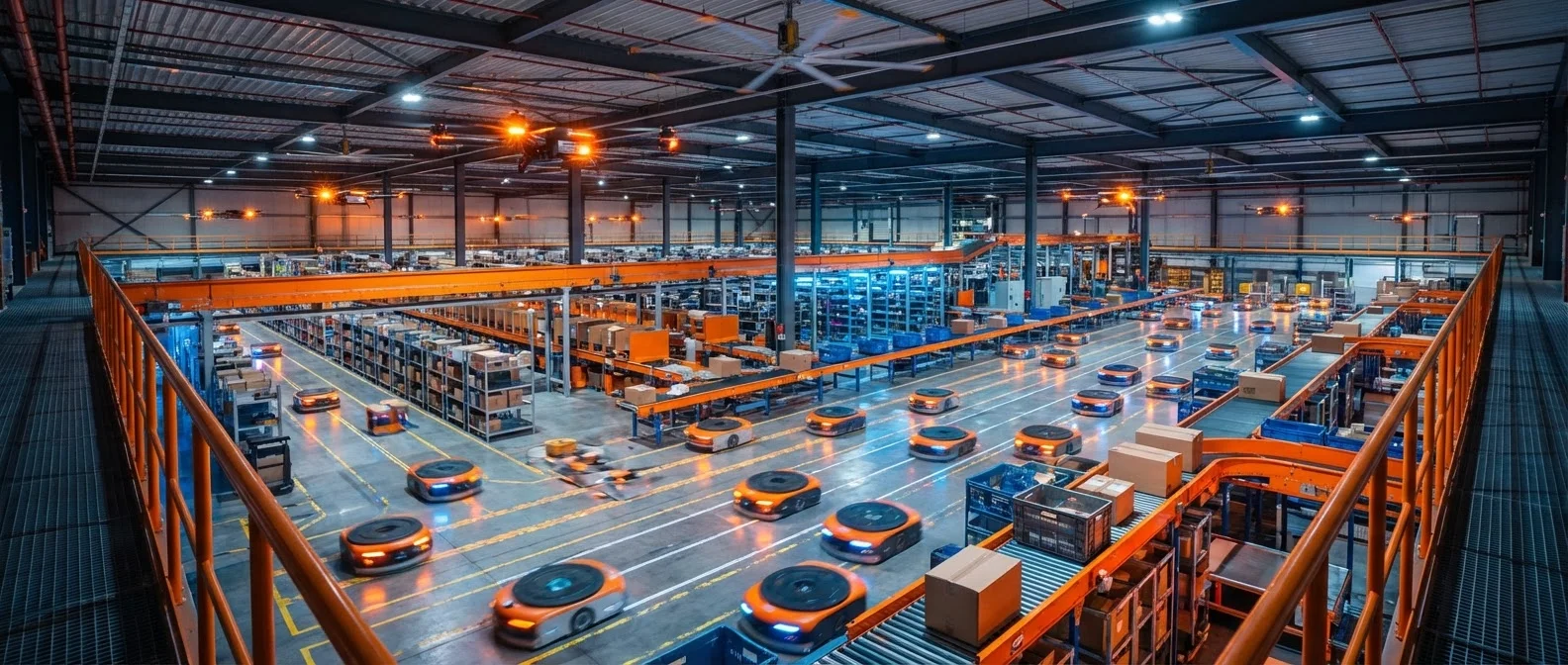
Not long ago, a typical warehouse was a vast expanse of shelving, forklifts threading through narrow aisles, and workers walking miles each shift to pick orders. Today, that picture is changing fast. Autonomous robots, automated storage systems, and robotic arms are turning logistics into a high-tech sector where speed, accuracy, and efficiency jump by double digits annually.
The supply chain is the backbone of the global economy. From raw materials to the finished product in a consumer's hands, every step demands coordination, speed, and reliability. Robots handle tasks that once required armies of workers walking miles per shift.
AGV vs AMR: Two Generations of Warehouse Automation
The story of warehouse robots begins in the 1950s, when Barrett Electronics introduced the first Automated Guided Vehicle (AGV) in Northbrook, Illinois. It was a simple tow truck that followed a wire embedded in the floor instead of a rail. Since then, AGVs have evolved into sophisticated systems using lasers, magnets, optical tape, and UV floor lines for navigation. They can carry loads ranging from 450 kilograms to 73 tons (in port applications) and move at speeds up to 1.3 metres per second.
However, AGVs have one critical limitation: they require infrastructure. Wires, magnetic tape, laser reflectors — the warehouse has to be built around them. Every route change means cutting into floors or moving reflectors.
The solution comes from Autonomous Mobile Robots (AMR), the newer generation. Instead of following fixed paths, AMRs “see” the world around them through LiDAR, depth cameras, and ultrasonic sensors. They use SLAM algorithms (Simultaneous Localization and Mapping) to dynamically map their environment, detect obstacles in real time, and plan alternative routes when something blocks their way. No floor infrastructure required.
The difference in flexibility is enormous. An AGV follows the route A-B-C, always. An AMR can decide that the route A-D-C is faster right now because aisle B is congested. This kind of intelligence makes them ideal for dynamic environments where needs shift by the hour.
Amazon: The Warehouse of the Future Already Exists
Amazon's transformation shows how completely robots can reshape logistics. In 2003, Mick Mountz founded Kiva Systems, inspired by problems he had witnessed at Webvan — a company that collapsed partly due to the staggering cost of order fulfillment. Mountz's idea was simple but radical: instead of the worker going to the shelf, bring the shelf to the worker.
Kiva created small orange robots that slid under portable storage units (pods), lifted them using a corkscrew mechanism, and carried them to human pick stations. Each robot could lift up to 450 kilograms (or 1,360 kilograms in the larger model), navigated by scanning barcodes on the floor, and needed only five minutes of charging per hour of operation.
In March 2012, Amazon acquired Kiva Systems for $775 million — its second-largest acquisition at the time. Amazon stopped selling the robots to third parties, renamed the company Amazon Robotics in August 2015, and began scaling at a massive pace. By June 2019, over 200,000 robots were operating across Amazon warehouses worldwide.
The numbers keep climbing. Cathie Wood, CEO of ARK Invest, predicted in 2023 that Amazon could be adding roughly 1,000 robots per day, reaching a point where robots would outnumber human workers by 2030. In some newer facilities — such as one in Delaware — that tipping point has already been reached.
In July 2022, Amazon unveiled Proteus, its first fully autonomous AMR (Autonomous Mobile Robot), designed to move freely among humans without needing fenced safety zones. A few months later, in November 2022, came Sparrow — a robotic arm capable of recognizing, selecting, and handling millions of individual products. It represents a step toward the holy grail of robotic logistics: fully automated pick-and-pack.
DHL, FedEx, and the Competitive Landscape
Amazon may dominate headlines, but the traditional logistics giants are not standing still. DHL, one of the world's largest logistics companies, has invested heavily in AMRs through partnerships with firms like Locus Robotics. Locus robots navigate autonomously through warehouses, approach workers, receive items in their bins, and carry them to the shipping zone. The worker doesn't need to walk — they stay at their station and the next robot arrives within seconds.
FedEx, for its part, uses high-speed sorting robots in its distribution centers. Automated systems scan barcodes, weigh packages, and direct them to the correct shipping zone in seconds. Sorting automation is critical: a single FedEx hub can handle hundreds of thousands of packages per day, and even a few seconds of delay per package multiplies into hours of lost productivity.
Beyond the major players, a wave of startups is fueling competition. Fetch Robotics (acquired by Zebra Technologies), 6 River Systems (acquired by Shopify), Geek+ (China, with over 30,000 robots deployed worldwide), and GreyOrange (Singapore/India) are building a rapidly expanding ecosystem. Competition drives prices down and accelerates adoption.
Humanoid Pickers: Robots Gain Hands
One of the biggest technical barriers to warehouse automation has always been the “last act” — picking, the task of selecting the right item from a shelf packed with different products. A robot can easily move a pallet, but grabbing a soft T-shirt next to a fragile vase requires exceptional tactile sensing, object recognition through computer vision, and the ability to adapt to tens of thousands of SKUs.
Advances in deep learning and neural networks are changing that. Amazon's Sparrow can now recognize and handle millions of individual items. Boston Dynamics developed Stretch, a robot designed specifically for unloading containers and trucks — an extraordinarily physical task that was traditionally done exclusively by humans. Stretch can move up to 800 boxes per hour.
Even more striking is the push toward humanoid robots in logistics. Companies like Figure AI, Agility Robotics (with Digit), and 1X Technologies are developing humanoid robots capable of navigating spaces designed for people — stairs, doors, narrow aisles. Amazon is already testing Agility's Digit in its warehouses. Though still in early stages, these robots promise a warehouse where literally every physical task — transport, picking, packing, loading — is performed by machines.
📦 Key Takeaway: The 2030 Supply Chain
The global warehouse automation market is projected to exceed $30 billion by 2028. AS/RS (Automated Storage and Retrieval Systems), which originated in the 1960s, now achieve space utilization of up to 90%, inventory accuracy above 99.9%, and picking rates of 750 lines per hour per operator. The combination of AMR, AS/RS, robotic picking arms, and AI-driven software is creating “perfect warehouses” with near-zero errors.
The Last Mile: Robots at Your Doorstep
Automation doesn't stop at the warehouse door. The “last mile” — delivery from the distribution center to the customer's home — is the most expensive segment of the supply chain, accounting for roughly 53% of total shipping costs. Here, robots are attempting an even bigger disruption.
Starship Technologies, founded by Skype's co-founders, already operates fleets of small autonomous robots in university campuses and cities across the US, UK, and Estonia. The six-wheeled bots cruise along sidewalks at up to 6 km/h, delivering food and small packages. Nuro, with its purpose-built driverless vehicles, partners with chains like Kroger and Domino's for deliveries with zero human intervention.
Amazon tested a similar concept with Amazon Scout, a small six-wheeled sidewalk robot, though it later discontinued the program. Meanwhile, delivery drones (Prime Air) remain in trial. Regardless of which technology prevails — sidewalk robots, autonomous vehicles, or drones — the trend is unmistakable: human involvement in the delivery process is shrinking steadily.
Ports and Heavy Logistics: Robots at the Hundred-Ton Scale
Logistics robotics isn't limited to small packages. At ports, automation operates on an entirely different scale. The Port of Rotterdam pioneered AGV use for container transport in 1993 — massive driverless vehicles carrying 20- and 40-foot containers around the clock. By 2014, there were 20 fully or semi-automated port terminals worldwide.
Today, that number is growing rapidly. Newer port AGVs use batteries with automatic swapping instead of diesel, cutting emissions to near zero. Automated stacking cranes place containers with millimetre precision, while AI software optimizes the loading-unloading sequence for maximum throughput.
Similar automation is entering large cross-docking centers, where goods transfer directly from inbound to outbound trucks without intermediate storage. Here, speed is critical and robots minimize handling times.
The Workforce: Threat or Evolution?
Every conversation about logistics robots inevitably arrives at the question: what happens to jobs? The answer isn't straightforward. Robots primarily take over repetitive, physically demanding, and hazardous tasks — moving heavy loads, working in extreme temperatures (refrigerators, freezers), night shifts. AS/RS systems reduce injury risks by lifting weights instead of workers.
At the same time, new roles are emerging: robotics technicians, fleet managers, maintenance engineers, warehouse data analysts. Amazon, despite its 200,000+ robots, employs more people than ever in its fulfillment centers — though the nature of the work is changing. The warehouse worker of the future looks more like a robot supervisor than a manual handler.
It's worth noting that the logistics sector has faced chronic labor shortages for years, especially in warehouse positions. The demanding conditions — heavy physical strain, shift work, heat or cold — make recruitment difficult. In many cases, robots fill gaps that companies simply cannot fill with people.
Looking Ahead: 2026–2030
The next five years are expected to bring exponential scaling. By 2028, it's estimated that over 50% of large warehouses in the developed world will use some form of robotic automation. The key trends:
First, the convergence of robotics and AI. Robots will become “smarter” thanks to foundation models (large AI models) that allow them to handle objects they've never seen, understand voice commands, and collaborate as teams (swarm logistics).
Second, humanoid robots will enter real warehouses on a trial basis. Figure AI has raised over $2 billion in funding, Agility Robotics is already in trials at Amazon, and Tesla is preparing Optimus. The era when a humanoid robot performs general warehouse tasks is no longer science fiction — it's imminent.
Third, automation will extend to mid-size and smaller businesses. RaaS (Robots-as-a-Service) models — renting robots on a monthly subscription instead of buying them — make the technology accessible to companies that couldn't previously justify million-dollar investments.
Fourth, the fully autonomous supply chain — “lights-out warehousing” — will start becoming reality in specialized categories (e.g., pharmaceuticals, electronics). Warehouses running in the dark, without heating, without humans, 24/7. It's not far off.
The question is no longer “whether” robots will dominate logistics, but “how quickly.” The answer, looking at the numbers, the investments, and the technological maturity, is: much faster than anyone imagined.