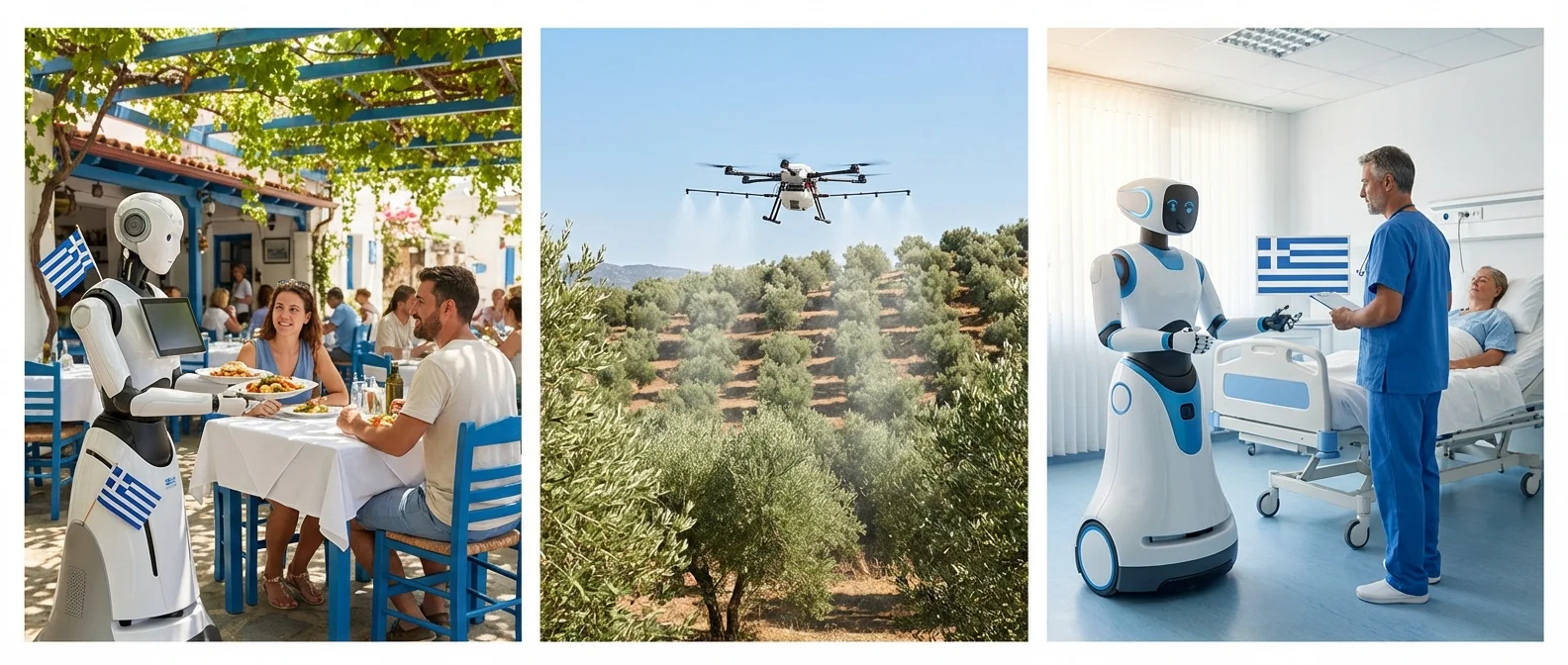
Greece may not be the first country that springs to mind when you think of robotics, but the reality in 2026 tells a different story. From cat-faced robot waiters in Athenian restaurants to a da Vinci surgical system in a public university hospital, from Chinese sorting bots at the national postal service to the world's first robot tour guide inside a cave — robotics is quietly transforming everyday life across the country.
🤖 Dining & Hospitality: Robot Waiters at Greek Tables
If you've eaten at a Chinese restaurant in Athens or Thessaloniki over the past couple of years, there's a good chance a robot brought your food. Pudu Robotics' BellaBot and KettyBot — cat-faced delivery robots made in China — have become a common sight across dozens of Greek eateries. The machines ferry dishes from kitchen to table using LiDAR sensors and depth cameras to dodge obstacles and diners alike.
The trend isn't limited to Asian restaurants. Hotels in Rhodes, Santorini, and Halkidiki are experimenting with room-service robots, while several fast food chains are exploring robotic order delivery. COVID-19 accelerated the shift: the need to minimize human contact, combined with chronic seasonal staffing shortages in Greek tourism, made robot waiters an appealing proposition.
The cost? A BellaBot runs about €15,000–20,000 — roughly equivalent to four or five months' salary for a human waiter. It doesn't get sick, take breaks, or require social insurance contributions. On the other hand, it can't take orders, smile genuinely, or make small talk — things that, for Greeks, are an inseparable part of the dining experience.
📦 Hellenic Post (ELTA): 55 Sorting Robots — A European First
In September 2021, Greece's national postal service became the first in Europe to deploy parcel-sorting robots. A fleet of 55 small yellow Chinese-made robots was installed at ELTA Courier's facility in Kryoneri, a northern suburb of Athens.
The robots receive parcels at eight infeed stations, scan each package's destination barcode, and distribute them across 144 sorting destinations. According to Errikos Tzavaras, then CEO of ELTA Courier, sorting speed increased by 250%, with robots handling nearly 76% of the center's total parcel volume.
The investment was part of ELTA's broader digital transformation strategy, and the pandemic “accelerated the process,” Tzavaras told Xinhua. Beyond speed, the robots reduced human errors and created a safer working environment during COVID.
🏥 Healthcare: The da Vinci System Arrives at a Public University Hospital
On May 24, 2024, Aretaieio University Hospital — part of the National and Kapodistrian University of Athens (NKUA) — inaugurated Greece's first robotic surgical system at a public university hospital. The da Vinci system is a state-of-the-art minimally invasive tool capable of performing general, urological, gynecological, and thoracic procedures.
The ceremony at the Maggineio Amphitheatre was attended by NKUA Rector Professor Gerasimos Siasos, Health Minister Adonis Georgiadis, and Deputy Health Ministers. The system will serve patients from across Greece and double as a training resource for medical students and surgical residents.
Private Greek hospitals had already been using da Vinci systems for years — but bringing robotic surgery into the public university system marks a critical step: equal access to cutting-edge technology regardless of a patient's ability to pay.
🏛️ Tourism: Persephone, the World's First Robot Cave Guide
Since mid-July 2021, a robot named Persephone has been welcoming visitors to the Alistrati Cave in northern Greece — and it's widely considered the world's first robot tour guide operating inside a cave. With a white body, black head, and two glowing eyes, Persephone rolls along on wheels through the first 150 meters of the cave's public walkway. A human guide takes over for the remaining 750 meters.
The robot can conduct tours in 33 languages, interact in three, and answer 33 questions — though only in Greek. It was built by the National Technology and Research Foundation at a cost of €118,000, based on an idea by the cave's scientific director, Nikos Kartalis, who saw a similar robot leading tours in an art gallery — on TV, 17 years before he finally secured funding to build one.
The name “Persephone” comes from Greek mythology: Hades abducted Persephone and took her to the underworld through gates said — according to local legend — to lie beneath the Alistrati Cave itself. The cave is three million years old, was first explored in 1974 by the Hellenic Speleological Society and Austrian speleologists, and has been open to the public since 1998. It draws around 45,000 visitors per year.
📚 Education: Greece Leads in Student Robotics
Perhaps the most promising area of robotics in Greece is education — and recent developments back that up.
In January 2026, the Region of Crete delivered 140 educational robotics kits to primary schools in Heraklion, with a target of 300 kits across the island. The program, run in partnership with the Hellenic Educational Robotics Organization (HERO), equips each school with hundreds of construction components, sensors, Bluetooth control units, and competition gear (football and obstacle courses). The cost of participating in international robotics competitions is fully covered.
Earlier, in March 2024, the Region of Attica launched a pilot robotics program in 100 primary schools across Athens. That September, Greece hosted the FIRST Global Challenge at the Stavros Niarchos Foundation Cultural Center (SNFCC) — the world's largest student robotics competition — drawing over 3,000 young participants from 193 countries under the theme “Feeding the Future.” The opening ceremony at the Panathenaic Stadium featured a concert by the Black Eyed Peas.
On the international stage, Greek students consistently punch above their weight: Greece shone at the 2024 World Robotics Olympiad in Izmir (theme: “Allies of the Earth”) and at the 27th International Robotic Sports Olympiad in Australia in January 2026.
🔬 Greek Research & Startups
Greek robotics isn't limited to importing foreign technology — the country produces its own innovation too. At the University of Macedonia, researchers developed a “social robot” with an AI brain and a soft, friendly face, designed to support children on the autism spectrum. The robot engages with children, motivates them, and helps them develop social skills.
Diana Voutyrakou, a young Greek woman named to the Forbes 30 Under 30 list, created a robotic cane for the visually impaired — a tool that uses sensors to detect obstacles and guide the user through audio and haptic feedback.
In the drone sector, the Greek subsidiary of Perceptual Robotics develops autonomous drones for industrial inspection, with a focus on the American market. Meanwhile, in March 2025, Duke Robotics established a Greek branch under Managing Director Alexandra Papaconstantinou, deploying IC Drone technology for high-voltage power line maintenance.
And one lesser-known use case: in August 2022, an underwater robot was deployed to clean the seabed around Alonissos — the Aegean island previously named Greece's Best Green Eco Destination.
🏺 An Ancient Precedent: The Automatic Servant
Greece's relationship with robots didn't start in the 21st century. The word “automaton” itself is ancient Greek, and the ancients built actual automated machines. The “Automate Therapaenis” — a 2,000-year-old robot described by Philo of Byzantium — was a mechanical servant that poured wine automatically: a guest placed their cup in the robot's right hand, and it dispensed first wine, then water, in correct proportions.
Nor was this an isolated case. Hero of Alexandria (1st century AD) built automated theaters, self-opening doors, and vending machines (the first in recorded history). The tradition of automation, in other words, runs deep in Greek inventive DNA.
Greece's Robotics Map 2026 — Key Locations
- ELTA, Kryoneri (Athens) — 55 parcel-sorting robots, first in Europe
- Restaurants (Athens, Thessaloniki, islands) — BellaBot/KettyBot delivery robots
- Aretaieio Hospital (Athens) — da Vinci Xi robotic surgery
- Alistrati Cave (Serres) — “Persephone” tour guide robot in 33 languages
- Crete & Attica — 100+ schools with educational robotics kits
- University of Macedonia — Social robot for children with autism
- Alonissos — Underwater seabed-cleaning robot
- Duke Robotics Greece — IC Drone for high-voltage power lines
🔮 What Comes Next?
The picture is encouraging but still fragmented. Greece has no national robotics strategy (unlike South Korea, Japan, or Germany), nor a significant industrial base for robot manufacturing. The majority of robots operating in the country are imported — mainly from China, the U.S., and Europe.
That said, there are solid reasons for optimism. The human capital is exceptional: Greek students and university teams consistently rank among the best at every major robotics competition, Greek universities produce serious academic research, and startups like Perceptual Robotics win awards worldwide. Greece hosted the FIRST Global Challenge (2024), Crete is distributing robotics kits to schools (2026), and the country is gradually embracing robotics in sectors that suit its economy: tourism, hospitality, healthcare, and logistics.
The challenge for the years ahead is to transition from user to creator — to turn Greece's outstanding talent into industrial production and exportable robotics products. If the “Automate Therapaenis” could serve wine 2,000 years ago, the land that created it can surely accomplish far more in the 21st century.