📖 Read more: Robotics in Greece: Startups Leading Innovation
🌱 What Is Precision Agriculture?
Precision agriculture is a field management system that collects, processes, and analyses spatial and temporal data — from soil composition to individual plant health. The goal: applying the right input (water, fertiliser, pesticide) in the right amount, at the right location, at the right time.
The idea isn't new — the earliest applications date back to the 1980s in the US, with GPS-guided fertiliser distribution at university test fields in Minnesota. What changed dramatically in recent years is the integration of autonomous robots, drones, machine learning, and IoT sensors into commercial products available to ordinary farmers — not just research institutions.
🤖 The Robots Reshaping the Field
Dozens of companies are now developing autonomous agricultural robots. Each one takes a different approach: lasers, UV radiation, targeted spraying, mechanical weed removal. The following stand out for their real-world results.
Leading Agricultural Robots 2025–2026
| Company / Robot | Technology | Result |
|---|---|---|
| Blue River (John Deere) — See & Spray | Computer vision + targeted spraying | 90% herbicide reduction. Acquired by John Deere for $305M. |
| Carbon Robotics — LaserWeeder | Thermal laser weed destruction | 200,000 weeds/hour. Zero chemicals, zero residue in the soil. |
| ecoRobotix — ARA | Solar power + micro-spraying | 95% herbicide reduction. Autonomous, lightweight, no soil compaction. |
| Small Robot Company — Tom, Dick & Harry | AI + three specialised micro-robots | Per-plant farming: each plant is treated individually. TIME Best Inventions 2022. |
| Verdant Robotics | Multi-action: spraying + fertilising + laser | Integrated platform for “superhuman farming.” |
John Deere's acquisition of Blue River Technology in 2017 for $305 million was a turning point: the world's largest agricultural machinery manufacturer acknowledged that autonomous spray robots aren't “future technology” — they're an essential tool today.
📖 Read more: Dark Factory 2030: Humanoid Robots Will Build Cars
📊 Numbers That Speak for Themselves
According to Verified Market Research, the agricultural robotics market is expected to reach $11.58 billion by 2025 — reflecting the technology's rapid move from research labs to commercial farms. The global population is projected to hit 9.6 billion by 2050, meaning food production must effectively double. Agricultural robots aren't a luxury — they're a necessity.
🔬 UV Treatment & Lasers: Chemical-Free Solutions
Two technologies are replacing pesticides entirely: UV-C radiation and laser weeding.
📖 Read more: DARPA: Robots Saving Lives on the Battlefield
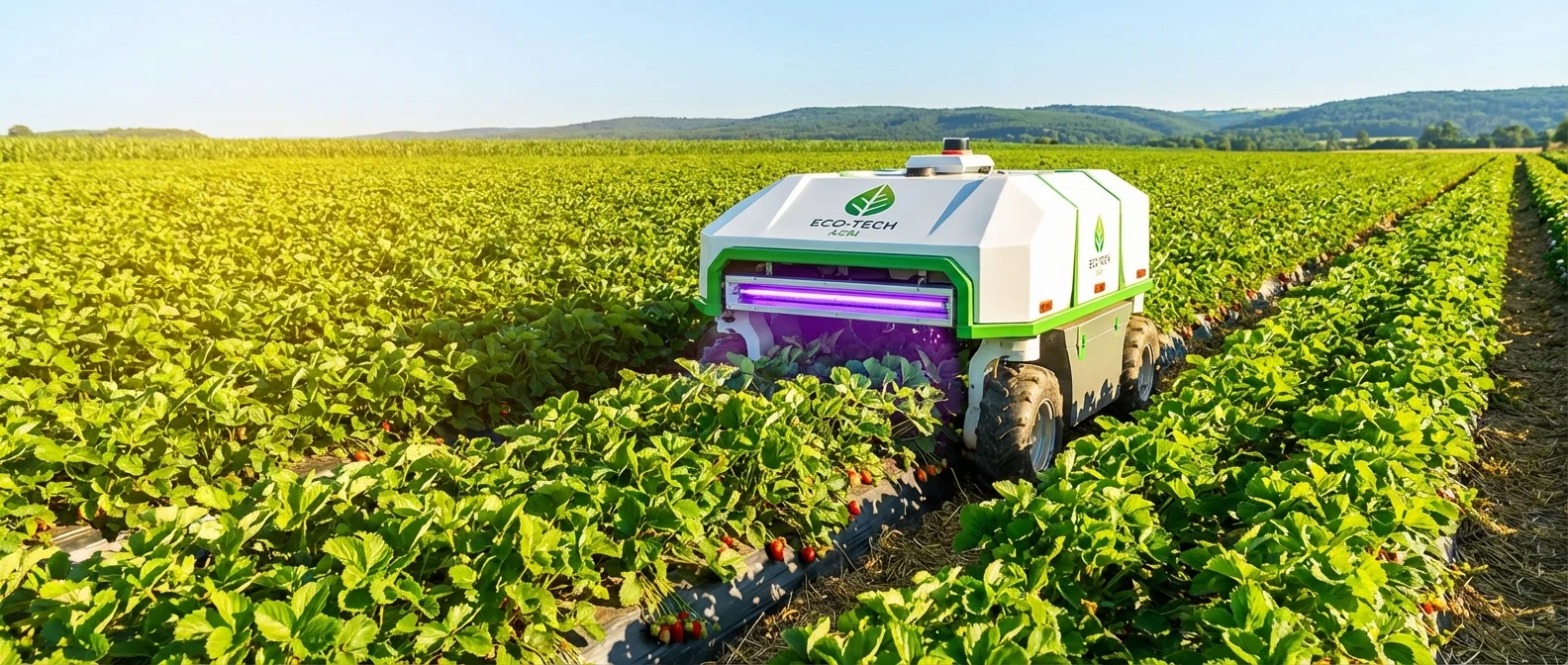
UV-C treatment (TRIC Robotics and others): Robots equipped with UV-C lamps move between crop rows, emitting radiation that kills fungi, bacteria, and pathogens without leaving any chemical residue. The technology is particularly effective in greenhouse crops — tomatoes, strawberries, grapes — where botrytis and other fungal infections cause devastating losses.
Laser weeding (Carbon Robotics LaserWeeder): Autonomous robots fitted with computer vision cameras identify weeds in real time and destroy them with a thermal laser beam. No chemicals, no residue, zero impact on the soil. According to Interesting Engineering, the LaserWeeder can eliminate 200,000 weeds per hour — a rate that's physically impossible by hand.
🌍 Europe Is Leading the Way
The EU has been a pioneer in pushing for pesticide reduction. The Farm to Fork Strategy, part of the European Green Deal, sets an ambitious target: 50% reduction in chemical pesticide use by 2030. That policy pressure is creating enormous demand for alternative technologies — driving massive investment in robotic alternatives.
The target doesn't stop at herbicides. It encompasses fungicides, insecticides, and parasiticides — the entire spectrum of chemicals used in modern agriculture. Countries like France, the Netherlands, and Denmark have already adopted large-scale pilot programmes for robotic farming.
📖 Read more: EngineAI T800: The 'Terminator' Robot That Kicks Its Own CEO
- France: A pioneer in precision agriculture since 1997–98. Today, fewer than 10% of farmers have variable-rate systems, but GPS adoption is widespread.
- United Kingdom: Small Robot Company (Tom, Dick & Harry) was named a Best Invention 2022 by TIME — three robots that scan, spray, and plant on a per-plant basis.
- Switzerland: ecoRobotix develops solar-powered micro-spraying robots that run entirely without fossil fuels.
- Australia: 70% of farmers in Western Australia use windrow burning and seed destructor technologies to combat herbicide-resistant weeds.
🧑🌾 What This Means in Practice for Farmers
Agricultural robots solve three critical issues simultaneously:
- Cost: Fewer chemicals = lower expenses. Targeted application of fertilisers and herbicides slashes input costs dramatically.
- Labour: The ageing farm workforce (particularly in Japan, but also across Europe) means there aren't enough hands to go around. A robot can work 24/7.
- Environment: Reduced chemical runoff into groundwater, less pollution, better biodiversity.
🔮 What's Coming: 2026–2030
The next five years will bring three critical developments:
- Per-plant farming: Every plant will be treated individually — the right water, the right fertiliser, the right timing. Small Robot Company and Verdant Robotics are already implementing this model.
- Autonomous swarms: Instead of one large tractor, multiple small robots (swarm farming) will cover fields simultaneously, reducing soil compaction.
- AI + satellites: Machine learning combined with satellite imagery and IoT sensors will give every farmer access to data that until recently only large corporations possessed.
Over $4.6 billion has already been invested in agtech startups worldwide. The goal is clear: by 2050, the average farmer will feed roughly 265 people — more than triple today's figure. Agricultural robots don't replace the farmer — they transform them into the manager of an automated precision system.