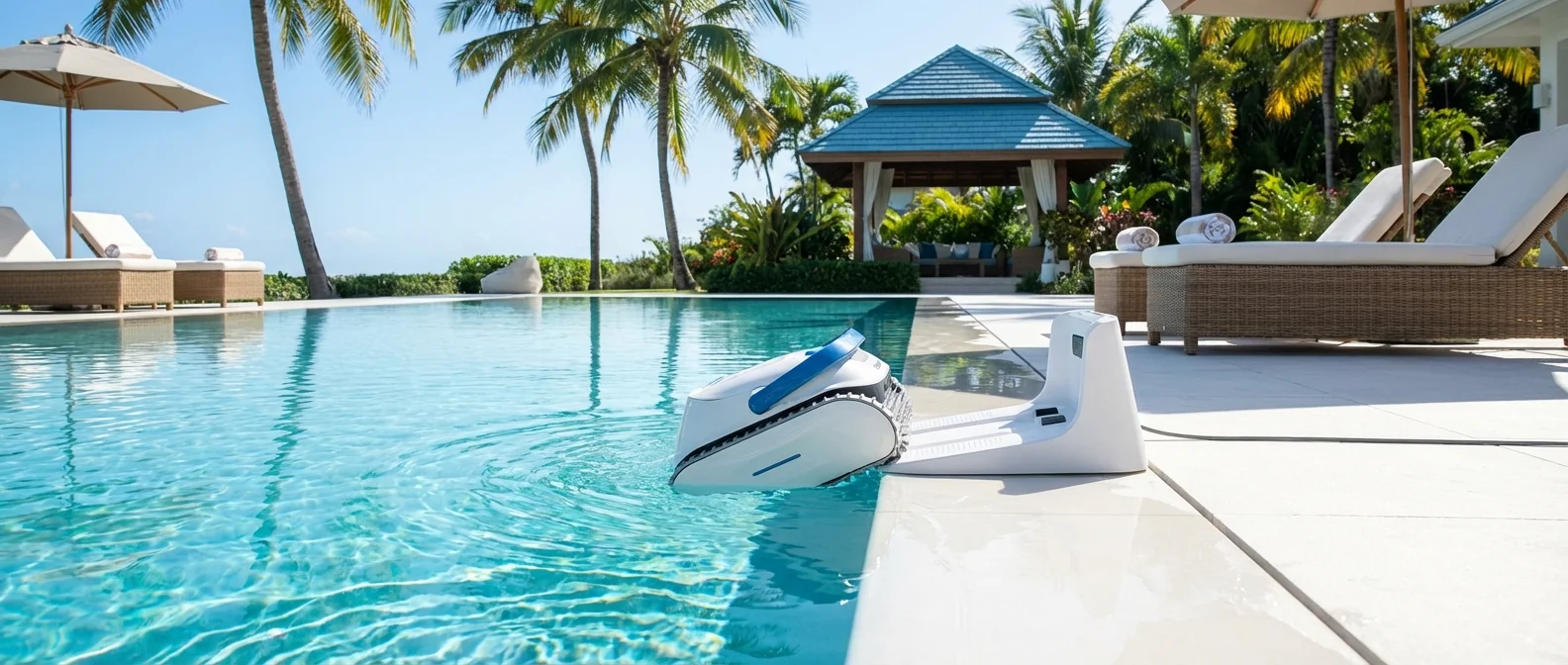
Pool cleaning has always been a thankless chore — skimming by hand, scrubbing the waterline, unclogging filters every other day. Not anymore. In 2026, robotic pool cleaners look nothing like the clunky contraptions of the past. They're cordless, AI-navigated, sensor-mapped, and self-charging. These little machines handle the job on their own — you just watch from the patio.
📖 Read more: Robotics in Greece: Startups Leading Innovation
The History: From 1912 to AI
The idea of automated pool cleaning isn't as new as you'd think. It actually dates back over a century — though the earliest versions would be completely unrecognizable compared to today's robots.
Three Types of Cleaners — One Clear Winner
Not all pool cleaning machines are built the same. There are three main categories, each with a different approach — but only one truly deserves the “robot” label.
Suction-Side Cleaners
Connect to the skimmer or pump and use the filtration system's suction. Simple, cheap, but slow and without smart navigation.
Pressure-Side Cleaners
Run on water pressure and require a separate booster pump. Push debris into a bag. Good for large leaves, but noisy.
Electric Robotic Cleaners
Fully autonomous with their own motor, navigation microchip, PVA brushes, and internal filter. Clean floors, walls, and waterline. The only serious choice today.
Electric robotic models are the category evolving fastest. They use navigation microchips, gyroscopic sensors, and PVA (polyvinyl alcohol) brushes that scrub every surface without scratching. Track-based models climb walls, while the best ones reach up to the waterline.
📖 Read more: Robots for the Elderly: Home Assistance Without Risk
The Best Models of 2026
We dug through dozens of models, analyzed expert reviews, and crunched the data. These are the standout robotic pool cleaners on the market right now.
Dolphin Nautilus CC Plus
The king of the category. Corded (60 ft cable), 2-hour cycle, climbs walls, dual scrubbing brushes, massive filtration system. Handles pools up to 50 feet. Schedule it to clean every 1, 2, or 3 days automatically.
Beatbot AquaSense 2 Ultra
A cordless powerhouse with AI-powered mapping and smart path optimization. 5,500 GPH suction, 5-hour battery, walls + waterline. App with detailed analytics for every cleaning cycle.
Aiper Scuba X1
Cordless, 3-hour runtime, with an impressive filtration system (thick filter material that traps even algae). Four cleaning modes: floor, walls, waterline, and smart. Compact charging station.
Polaris 9650iQ Sport
Corded (70 ft), Wi-Fi enabled, iAquaLink app, Alexa compatible. Four-wheel drive, deep-clean mode, dirty-canister indicator. Climbs walls, stairs, and bench seats.
Betta SE Solar
A solar-powered robot that continuously cleans the pool's surface. Dual motors, remote control, stores solar energy for shaded hours. No battery or cord needed — ever.
Ultenic Pooleco 10
Cordless, 90 minutes, plug-and-play with no app needed. Charge it, toss it in the pool, done. Floor only, but surprisingly fast for the price. Easy filter cleanup.
📖 Read more: Robots in Agriculture: Less Pesticides, More Crops in 2026
Top Models Comparison
| Model | Type | Clean Time | Walls | App | Best For |
|---|---|---|---|---|---|
| Dolphin Nautilus CC Plus | Corded | 2 hours | ✅ | ❌ | General use |
| Beatbot AquaSense 2 Ultra | Cordless | 5 hours | ✅ | ✅ AI | Premium homes |
| Aiper Scuba X1 | Cordless | 3 hours | ✅ | ✅ | Algae / filtration |
| Polaris 9650iQ Sport | Corded | Custom | ✅ | ✅ Alexa | Large pools |
| Betta SE Solar | Solar | Continuous | ❌ | Remote | Surface debris |
| Ultenic Pooleco 10 | Cordless | 90 min | ❌ | ❌ | Budget / simple |
The Technology Behind the Robots
What makes a modern pool robot so effective? It's not just the battery or the brushes — it's the combination of multiple technologies working in sync.
AI Mapping
Top models map the pool's shape during the first cycle and optimize the path going forward. The Beatbot AquaSense 2 Ultra uses AI path optimization to eliminate overlap entirely.
Cordless Operation
High-capacity lithium batteries (3–5 hours). Compact charging stations with magnetic docking. No more tangled cables on the pool deck.
PVA Brushes
Polyvinyl Alcohol — flexible brushes that scrub without scratching. Work on all surfaces: gunite, vinyl, fiberglass, tile, and plaster.
Smart App Control
Bluetooth + Wi-Fi connectivity. Choose modes (floor, walls, waterline, auto), set schedules, view zone-by-zone time analytics. Some even support Alexa voice commands.
📖 Read more: Robots in Logistics: Reshaping the Supply Chain
Wall Climbing
Track-based or specialty-wheeled models that scale vertical walls. The best ones reach 2–4 inches above the waterline to catch stubborn debris.
Ultra-Fine Filters
Multi-layer filters capturing particles down to 2 microns: pollen, algae, fine dust. The Aiper Scuba X1 showed visible algae buildup in the filter after just one hour.
How to Choose the Right One
With so many options, the decision can get overwhelming. Follow these four criteria to find the right model for your pool:
Selection Guide in 4 Steps
- 1. Pool type: Inground or above-ground? Wall-climbing robots can put too much stress on above-ground pool walls.
- 2. Size: Pools under 30 feet need smaller models (Polaris P70). Over 50 feet require longer cables or more powerful batteries.
- 3. Surface: Each material (vinyl, fiberglass, gunite, plaster, tile) needs compatible brushes. Check before you buy.
- 4. Debris type: Lots of leaves → large basket (Dolphin Nautilus). Fine dust/pollen → ultra-fine filter (Aiper Scuba X1). Both → premium all-in-one (Beatbot).
Corded vs Cordless: What to Expect
The big showdown in 2026's robotic pool cleaner market is between corded and cordless models. Both have their strengths — the right pick depends on your specific needs.
| Feature | Corded | Cordless |
|---|---|---|
| Runtime | Unlimited | 1.5 – 5 hours |
| Suction power | Higher | Medium – High |
| Ease of use | Moderate (cable) | Very easy |
| Price | $300 – $1,500 | $200 – $2,000 |
| Smart features | Basic – Wi-Fi | AI mapping / App |
| Best for | Large pools | Convenience / smaller pools |
📖 Read more: Robots in Space: NASA's Exploration Fleet in 2026
Why It's Worth the Investment
Clay Spann, Senior VP of Merchandising at Leslie's (the largest pool and spa care company in the US, operating since 1963), puts it plainly: "Robotic cleaners have a unique advantage over suction-side or pressure-side cleaners because they don't rely on your pool pump to operate. Using a robotic pool cleaner helps improve the circulation and filtration beyond what your pump and filter can offer on their own."
Time Savings
2–3 hours of autonomous cleaning instead of manual labor. Schedule it and forget about it — your pool stays spotless.
Cost Reduction
Fewer chemicals, less filter wear, no need for frequent professional cleaning. A pool robot pays for itself in 1–2 seasons.
Better Hygiene
They remove dust, pollen, algae, and bacteria more effectively than manual cleaning. Sanitizers work best in clean water.
Extended Equipment Life
Regular cleaning = less debris in the filter = fewer breakdowns = longer life for your pool and its equipment.
Frequently Asked Questions
Can I swim while the robot is running?
Technically yes with most models, but it's not recommended. Corded units have cables that can tangle around you, while cordless ones might bump into your feet.
How long does a pool robot last?
With proper maintenance, 3–5 years on average. Premium models (Dolphin, Polaris) can last 7+ years. The most critical component is the motor — look for “commercial grade” units.
How often should I run it?
During swimming season, every 2–3 days is enough for most pools. If your pool sits under trees or in a dusty area, daily use is recommended.
The Bottom Line
Robotic pool cleaners in 2026 are no longer a luxury — they're the smart choice. From $200 you'll find reliable budget models, while $1,000–$1,500 gets you AI mapping, cordless operation, and wall climbing. Your pool deserves a robot — and you deserve to relax instead of scrubbing.