📖 Read more: Weave Isaac: The $7,999 Robot That Folds Your Laundry
🕰️ A Brief History of Robot Mowers
The idea of a machine that mows the lawn on its own isn't new — it's been around for over half a century. What changed is the technology: from random-bounce wire-guided bots to satellite-navigated autonomous systems that rival professional groundskeepers.
S. Lawrence Bellinger patented the MowBot: 57 kg, 3-hour runtime, covering 280 m². Retail price: $800 — roughly $6,860 in today's money.
Husqvarna launched the world's first solar-powered robotic mower, based on André Collens' 1992 patent.
The Bosch Indego introduced lawn mapping — the first model to mow in systematic parallel lines instead of random patterns.
Volta released the first robot mower using AI vision — camera-based navigation powered by neural networks, with no perimeter wire needed.
Husqvarna announced satellite-based GPS/RTK navigation — 2-3 cm accuracy without any boundary wire.
Husqvarna CEORA debuted: a professional-grade robot mower covering up to 75,000 m² via satellite navigation.
AM Robots launched the Storm — the world's first LiDAR-equipped robot mower, needing no external positioning systems whatsoever.
⚙️ How Do They Work?
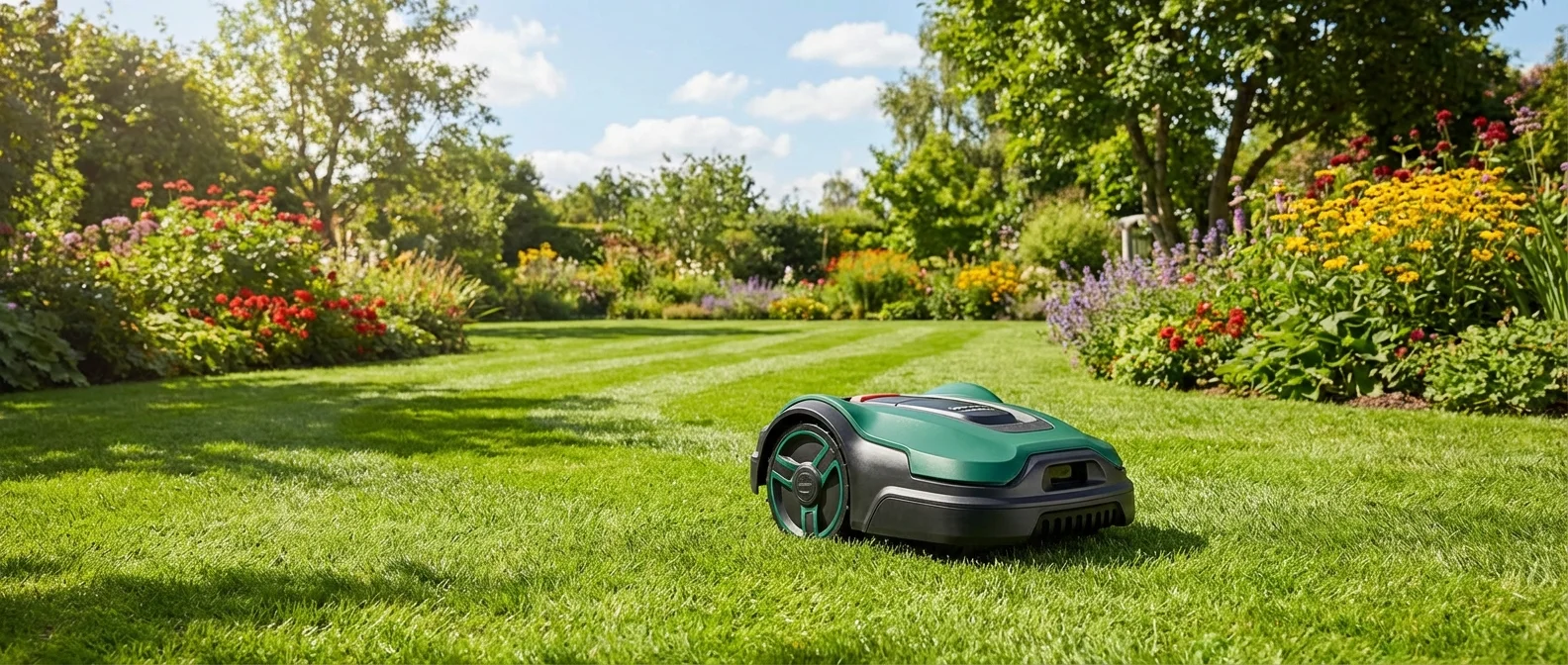
A robotic mower cruises around your lawn autonomously, trimming grass into fine clippings that decompose naturally — essentially a continuous mulching process that feeds the turf. What sets modern models apart is how they navigate.
Perimeter Wire
The classic approach: a guide wire is buried along the lawn's edges to define boundaries. Reliable but requires installation effort.
GPS / RTK
Satellite navigation with a ground-based reference station delivers 2-3 cm accuracy. No physical wire needed — users draw boundaries digitally via an app.
AI Vision (Camera + CNN)
An onboard camera paired with convolutional neural networks identifies grass, obstacles, and pathways in real time — no boundary markers required.
LiDAR
Laser scanning creates a 3D map of the environment. Fully independent of GPS or external systems — works even under dense tree cover.
📖 Read more: LG AI Agent: The Robot That Cleans and Folds Clothes
Battery & Charging
Li-ion or LiFePO4 cells with automatic return-to-dock charging. Runtime ranges from 60 to 180 minutes depending on the model.
Smart App & Scheduling
Full control from your phone: mowing schedules, cutting zones, blade height adjustment, real-time GPS tracking, and firmware updates.
📊 Navigation Technology Comparison
Each navigation method has its trade-offs. The right choice depends on your lawn size, budget, and terrain complexity.
| Feature | Perimeter Wire | GPS / RTK | AI Vision | LiDAR |
|---|---|---|---|---|
| Accuracy | ±10-20 cm | ±2-3 cm | ±5-10 cm | ±3-5 cm |
| Setup | Wire burial required | Base station install | Plug & play | Plug & play |
| Mowing Pattern | Random / linear | Systematic (grid) | Systematic | Systematic |
| Works in Shade | ✅ Yes | ⚠️ Reduced accuracy | ✅ Yes | ✅ Yes |
| Cost | $ (low) | $$$ (high) | $$ (mid) | $$$ (high) |
| Best For | Small yards | Large properties | Complex gardens | Commercial use |
🏆 Top Models of 2026
The robot mower market is booming. Below are the standout models either already available in Europe or expected to ship in 2026.
Automower 450X NERA
- Coverage: 5,000 m²
- Navigation: EPOS (satellite)
- Slope: up to 45%
- App: Automower Connect
- AWD (all-wheel drive)
CEORA (Professional)
- Coverage: 75,000 m²
- Navigation: EPOS satellite
- Cutting width: 56 cm
- Use: sports fields, parks
- Anti-theft GPS tracking
Landroid Vision M800
- Coverage: 800 m²
- Navigation: AI Vision (camera)
- No perimeter wire
- App: Worx Landroid
- Rain sensor
Indego M+ 700
- Coverage: 700 m²
- Navigation: LogiCut (mapping)
- Perimeter wire
- Smart System integration
- Multi-zone mowing
Storm (LiDAR)
- Coverage: 1,500+ m²
- Navigation: LiDAR (world first)
- No GPS / no wire
- 360° obstacle avoidance
- Dense vegetation: OK
SILENO Life 1250
- Coverage: 1,250 m²
- Navigation: Wire + SensorControl
- Slope: up to 35%
- App: Gardena Smart
- Noise: 58 dB
🏟️ From Golf Courses to City Parks
Robot Mowers at the PGA Tour
In October 2024, FireFly AMP autonomous reel mowers maintained the fairways at the PGA Tour's Black Desert Championship in Utah — the first time robot mowers were ever used at a professional golf event. The machines navigated via a network of RTK base stations, delivering centimeter-level precision across enormous playing surfaces.
Husqvarna — the Swedish company founded as a firearms maker in 1689 — now leads the robot mower industry. In 2022, it introduced CEORA, a professional-grade system that uses satellite navigation (EPOS) without physical wires and can handle areas up to 75,000 square meters.
RTK (Real-Time Kinematic) technology works by comparing the carrier wave phase of a satellite signal against a fixed ground-based reference station. This yields positioning accuracy measured in centimeters — precise enough to leave no uncut strip on a football pitch or municipal park.
📖 Read more: Roborock Saros Z70: The Robot Vacuum With an Arm and Legs
💰 Pricing Guide
Robot mower prices vary dramatically based on navigation technology and coverage area. Below is a general breakdown of what to expect in 2026.
| Tier | Coverage | Price Range (€) | Technology |
|---|---|---|---|
| Entry-Level | 300-500 m² | €400 – €700 | Perimeter wire |
| Mid-Range | 500-1,000 m² | €700 – €1,200 | Wire / AI Vision |
| Advanced | 1,000-3,000 m² | €1,200 – €2,500 | GPS / Vision / LiDAR |
| Premium | 3,000-5,000 m² | €2,500 – €4,000 | GPS/RTK + AWD |
| Commercial | 5,000+ m² | €5,000+ | EPOS / RTK satellite |
Hot Climate Considerations
In warmer regions with temperatures regularly exceeding 35-40°C, look for models with rain sensors, AWD capability, and adjustable cutting height — keeping grass slightly taller during heatwaves reduces water stress. Gardena, a Husqvarna subsidiary, offers strong service networks across Southern Europe, making after-sales support more accessible.
🔮 What's Coming: 2026-2027 Tech Trends
Multi-Zone AI Mapping
Next-gen mowers will automatically identify zones — flower beds, pathways, dining areas — and adapt their mowing behavior accordingly.
Swarm Robotics
Multiple small robots collaborating across large properties — instead of one big machine, four or five units dividing the workload.
Integrated Solar Charging
Full circle: new solar panels built directly into the mower's body, enabling near-endless operation in sunny climates.
Mow + Water in One
All-in-one garden care: mowing, automated irrigation (Husqvarna acquired ETWater in 2024), and fertilizing from a single platform.
❓ Frequently Asked Questions
Can it handle slopes?
Most models manage inclines of 25-35%. Premium options like the Husqvarna Automower 450X NERA with AWD tackle slopes up to 45%. For especially steep terrain, all-wheel drive is essential.
Is it safe around kids and pets?
Modern robot mowers feature ultrasonic sensors, bump detection, and AI vision to spot obstacles and automatically stop their blades if lifted. That said, it's good practice not to run the mower unsupervised around small children or free-roaming pets.
Does it need Wi-Fi?
Basic operation works without Wi-Fi — just press start. An internet connection (Wi-Fi or Bluetooth) is only needed for smart features: the app, scheduling, GPS tracking, and firmware updates.
How loud are they?
Much quieter than a conventional mower. Most robot mowers operate at 55-62 dB — about the volume of a normal conversation. Many owners run them overnight without disturbing the neighbors.