📖 Read more: SoftBank's Trillion-Dollar Bet on Robotics and AI
⚽ The Coincidence That Isn't a Coincidence
Let's start with a fact few people know: Hyundai-Kia is one of the top-tier sponsors (FIFA Partner) of the 2026 World Cup. Hyundai also owns 80% of Boston Dynamics — the maker of Spot, the most recognizable robot dog in the world. The acquisition cost roughly $880 million (December 2020) and was finalized in June 2021.
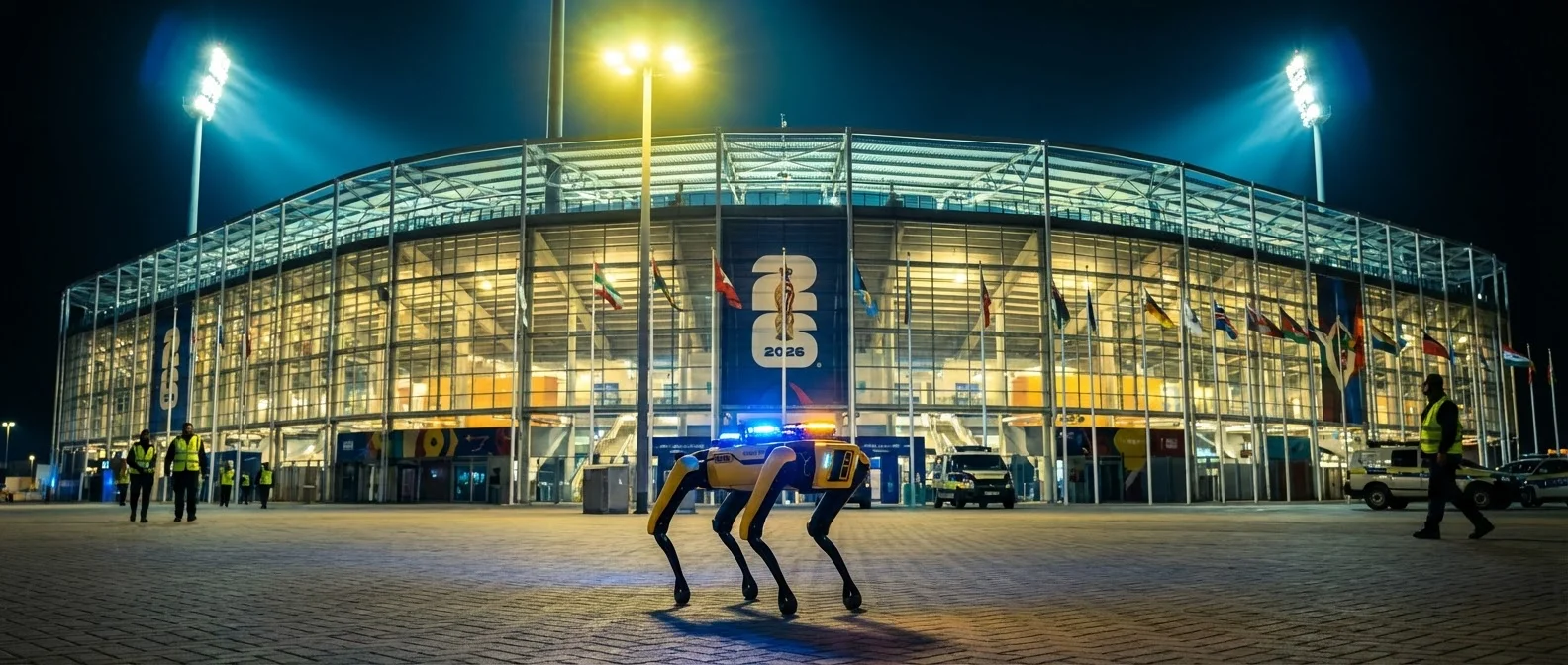
This means there's a direct corporate pipeline between the world's leading robot dog manufacturer and one of FIFA's main sponsors. The possibility of deploying Spot robots for stadium security sweeps isn't hypothetical — it's already technically feasible. In May 2025, Boston Dynamics appeared on America's Got Talent Season 20, showcasing robot dog choreography — showmanship technology that would be equally at home during opening ceremonies.
🦾 Spot: The Specs Behind the “Guard”
Spot by Boston Dynamics weighs just 55 lbs (25 kg), costs $74,500 (2020 pricing, now typically sold in enterprise bundles), and can operate autonomously or semi-autonomously. It's a quadruped, electrically powered, and the “quietest robot” Boston Dynamics has ever built — a crucial feature for patrols near crowds.
In a security role, Spot can be equipped with:
- 360° cameras (optical + thermal) for autonomous navigation and detection
- 3D LiDAR scanning for real-time spatial mapping
- Acoustic sensors for detecting unusual sounds
- Wi-Fi/4G connectivity for live streaming to command centers
- Autonomous navigation along pre-mapped routes, including stairs
It can climb stairs, operate in rain (IP54 rating), open doors, and patrol without human supervision. Battery life: approximately 90 minutes — enough for a full perimeter sweep of a stadium's exterior.
👮 Robot Dogs in Policing: The Story So Far
Using robot dogs for security isn't theoretical — it's already been tried, and the reaction has been decidedly mixed.
Massachusetts State Police (2019)
In November 2019, Massachusetts State Police became the first law enforcement agency in the world to deploy Spot. Its role: bomb squad operations — replacing humans in potentially lethal explosive disposal missions.
The NYPD “Digidog” Saga (2020-2023)
The most well-known — and most controversial — case came from New York. In February 2021, the NYPD deployed a Spot robot (nicknamed “Digidog”) during police operations in the Bronx. The lease cost $94,000. Videos of the robot walking through low-income housing went viral.
The backlash was fierce. The ACLU, the Surveillance Technology Oversight Project, and politicians (including Alexandria Ocasio-Cortez) condemned the deployment. Representative Ritchie Torres introduced federal legislation against robotic police surveillance. In April 2021, the NYPD canceled the lease.
But the story didn't end there. In April 2023, Mayor Eric Adams revived the program — purchasing two Spot robots for $750,000. The city stated this time the robots would only be used in “dangerous situations” — hostage scenarios, active shooters, HAZMAT incidents.
Robot Dogs in Law Enforcement Worldwide
- Massachusetts State Police — First in the world (November 2019), bomb squad
- NYPD “Digidog” — Canceled 2021, revived 2023 ($750K / 2 robots)
- LAPD — Acquired Spot via DHS donation
- Honolulu PD — Spot at COVID-19 checkpoints
- Singapore — Spot patrols in parks for COVID social distancing
- Hyundai/Kia factories — Factory Safety Service Robot (Spot-based, September 2021)
🔫 Ghost Robotics: The Military Side
Not all robot dogs do patrols. Ghost Robotics (Philadelphia) builds the Vision 60 — a quadruped designed explicitly for military and paramilitary use. It's used by the U.S. Air Force (Tyndall AFB) for base perimeter sweeps, and by CBP (Customs and Border Protection) for patrols along the U.S.-Mexico border.
The key difference: Ghost Robotics did not sign the anti-weaponization pledge launched by Boston Dynamics in October 2022. Instead, it demonstrated the SPUR (Special Purpose Unmanned Rifle) platform — a robot dog fitted with a 6.5mm Creedmoor rifle. The image went viral and triggered international outcry.
📖 Read more: Top 10 Humanoid Robots of 2026: The Complete Ranking
🇨🇳 The Chinese Competitors
The robot dog market isn't a Boston Dynamics monopoly. China's Unitree Robotics sells the Go2 Pro for around $3,500 — nearly 20 times cheaper than Spot. Xiaomi sold the CyberDog for $1,540. Deep Robotics (China) and ANYbotics (Switzerland) also produce industrial quadrupeds.
Lower prices don't mean zero risk. In April 2025, cybersecurity researchers discovered backdoors in Unitree robot software — code that allowed remote access to Chinese servers. Unitree robots have been used in Chinese military drills and on the battlefield in Ukraine, prompting a U.S. Congressional investigation.
| Robot | Manufacturer | Price | Primary Use |
|---|---|---|---|
| Spot | Boston Dynamics (USA) | $74,500+ | Industry, security, construction |
| Vision 60 | Ghost Robotics (USA) | Military contract | Military, borders, base security |
| Go2 Pro | Unitree (China) | ~$3,500 | Research, hobbyist, military |
| CyberDog | Xiaomi (China) | ~$1,540 | Consumer, demo |
| ANYmal | ANYbotics (Switzerland) | Enterprise | Industrial inspections |
🔒 Privacy and Civil Liberties Concerns
The ACLU (American Civil Liberties Union) has raised serious concerns about using robot dogs in public spaces. The main issues:
- Mission creep: Robots purchased for bomb disposal gradually get used for patrols, surveillance, and facial recognition
- Racial targeting: Deploying the Digidog in the Bronx — a predominantly Black and Latino neighborhood — was widely interpreted as racially biased policing
- No federal regulation: There is no federal law in the U.S. governing the use of autonomous surveillance robots by police departments
- Intimidation factor: The presence of quadruped robots in neighborhoods creates a sense of dystopia
Boston Dynamics signed an anti-weaponization pledge in October 2022, along with 5 other robotics companies. The pledge, however, is voluntary — it carries no legal weight. And companies like Ghost Robotics didn't sign it.
🏟️ Qatar 2022 → USA 2026: What Changes
At the 2022 World Cup in Qatar, security relied entirely on human personnel: 50,000 security officers from over 13 countries, alongside drones and AI cameras. Robot dogs were not used. Total attendance monitored: 3.4 million spectators across 64 matches.
The 2026 World Cup will be an entirely different challenge. Instead of 8 stadiums in 1 small country (Qatar — 4,200 sq mi), there will be 16 stadiums across 3 massive countries (USA, Canada, Mexico). Venues stretch from Vancouver to Miami, Seattle to Mexico City. The match count: 104 (up from 64 in Qatar). Tournament window: June 11 – July 19, 2026. The final at MetLife Stadium, New Jersey (AT&T Stadium in Dallas holds approximately 94,000 — the tournament's largest venue).
This scale demands autonomous, round-the-clock surveillance — exactly what robot dogs already do in factories, airports, and military bases. The police departments in many host cities (NYPD, LAPD) already own Spot robots.
"Technology is neither good nor bad. How we use it determines its nature. A robot dog sweeping buildings for bombs saves lives — the same robot patrolling neighborhoods can terrorize."
— Matt Skeleton, Surveillance Technology Oversight Project, 2023🔮 What to Expect
No official body — not FIFA, not the DHS, not the U.S. Secret Service — has announced “robot dogs at the 2026 World Cup” as a certainty. But the evidence speaks volumes:
- Hyundai-Kia (FIFA sponsor) owns Boston Dynamics (Spot manufacturer)
- The NYPD already has Spot robots — and New York/New Jersey hosts the final
- The LAPD already has Spot — and Los Angeles hosts matches
- The U.S. Air Force uses Ghost Robotics Vision 60 on bases — the same technology could be applied to perimeter security at stadiums
- The Factory Safety Service Robot (Spot in Hyundai factories) transfers easily to stadium environments
Even if we don't see robot dogs inside the stadiums, it's almost certain they'll be deployed for perimeter sweeps, parking facilities, fan zones, and transit infrastructure. The question isn't if — it's how many.