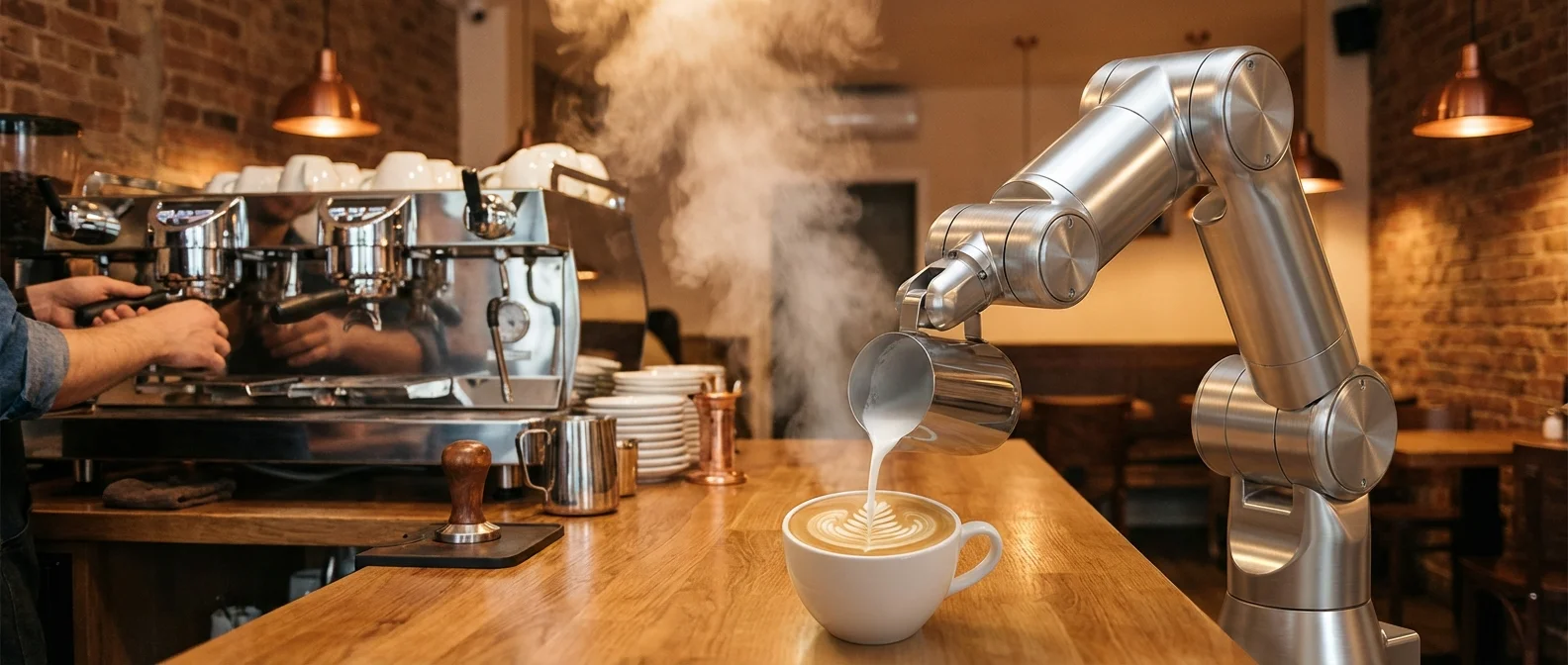
Picture this: you tap a touchscreen, watch a robotic arm grind fresh beans, steam milk to a precise 0.1°C tolerance, and hand you a latte — all in under 60 seconds. No queue, no small talk, no tipping. This isn't a tech fair demo anymore. Robot baristas are already operating in airports, shopping malls, and university campuses worldwide. Here's what the technology looks like, who's building it, and whether it could ever replace the human behind the counter.
📖 Read more: Claude AI Controls Robots: From Mars to Quadrupeds
Why Robot Baristas — and Why Now
The coffee industry has a chronic problem: labor cost and turnover. In the US, the average barista quits within six months. Training costs money, the hours are brutal, and demand keeps climbing — especially in specialty coffee, a market on track to hit $152.69 billion by 2030.
At the same time, consumers want speed and quality: they don't want to wait 10 minutes in line, but they don't want watery vending-machine sludge either. Robot baristas solve both problems: they deliver specialty-grade coffee in 60 seconds, with consistent quality and zero labor costs.
Three developments made robot baristas possible: cheaper collaborative robotic arms (the KUKA iiwa, Universal Robots cobots), improved computer vision for cup and cup-size recognition, and IoT sensors that monitor temperature, pressure, and extraction in real time.
How a Robot Barista Works
You order via touchscreen or mobile app, and the system takes it from there:
- Grinding: A built-in grinder processes fresh beans per order — grind size adjusts automatically based on drink type (espresso, pour-over, cold brew).
- Espresso extraction: The robotic arm loads the portafilter, tamps at a consistent ~30 lbs of pressure, and pulls the shot at 92-96°C under 9 bars.
- Milk steaming: An automated steam wand heats and froths milk to 60-65°C — the sweet spot for latte art.
- Pouring: The arm pours the drink into the cup, executing latte art patterns (rosetta, tulip, heart) via precisely controlled flow rate.
- Cleaning: After every drink, automated portafilter purge, steam wand flush, and drain cycle — all without a human hand touching anything.
Why Precision Matters
A shift of just 2°C in extraction temperature dramatically changes the taste — too hot and it's bitter, too cool and it's flat. Robot baristas control temperature to within ±0.1°C, something practically impossible for a human pulling shots during the morning rush. Similarly, tamp pressure needs to be identical from shot to shot — robotic arms hit ±0.5 lb every single time.
Who's Building Robot Baristas
Cafe X Technologies (USA)
The pioneer. Founded in San Francisco in 2015 by Henry Hu, Cafe X uses a KUKA robotic arm that serves specialty coffee in about 40 seconds. It operates at airports (SFO, SJC) and shopping centers in California. The kiosks source beans from local specialty roasters — demonstrating that robots and quality coffee are not mutually exclusive.
📖 Read more: Delivery Robots: Autonomous Food Delivery 2026
Crown Digital — Ella (Singapore)
Ella is a fully autonomous robot barista kiosk that fits in just 4 square meters. It churns out up to 200 coffees per hour with zero human intervention. Deployed in bistros, malls, and offices across Singapore, Malaysia, and the UAE, it uses AI to adapt recipes based on customer feedback.
Rozum Café (Belarus)
Built around Rozum Robotics' own PULSE collaborative arm. Offers a turnkey franchise model: buy the kiosk, plug it in, and the coffee starts flowing. Setup cost starts at $75,000. Units operate at universities and metro stations in Russia, Poland, and the Czech Republic.
Briggo (USA)
An ATM-sized automated coffee haus targeting airports and hospitals — spaces with 24/7 demand but limited workforce. You order through the app, walk up, scan a QR code, and grab your drink. Deployed at Austin-Bergstrom Airport and San Jose Airport.
Robot vs. Human Barista
| Metric | 🤖 Robot Barista | 👨🍳 Human Barista |
|---|---|---|
| Speed | 40-60 sec/drink | 90-180 sec/drink |
| Consistency | Identical quality every shot | Varies with fatigue/skill |
| Availability | 24/7 (with maintenance) | 8-hour shifts |
| Cost per drink | Lower long-term | $0.50-1.00 labor per cup |
| Human connection | None | Smile, small talk, tips |
| Flexibility | Pre-programmed recipes only | On-the-fly adjustments |
The Market in Numbers
The global specialty coffee market is the biggest driver: currently worth over $80 billion, it's projected to reach $152.69 billion by 2030. Europe accounts for 46.21% of global market revenue, while Asia is poised to become the largest consumer by the end of the decade.
Meanwhile, the robotic food preparation market is growing at roughly 25% per year. Miso Robotics (creator of Flippy, the frying robot) has already installed robots at 100+ White Castle locations and is running trials at Jack in the Box and Chipotle. If fast food is embracing kitchen robots, specialty coffee can't stay behind.
📖 Read more: Educational Robots: STEM Teaching Machines for Every Class
The Technology Inside
- Collaborative Robotic Arms: Compact, safe 6-axis arms (KUKA iiwa, Universal Robots UR5e, Rozum PULSE) that work alongside humans without safety cages.
- IoT Sensors: Temperature, pressure, water flow, and weight sensors monitor every extraction parameter in real time.
- Computer Vision: Cameras identify cup type, milk level, and portafilter cleanliness. In premium models, vision guides latte art pouring.
- Cloud AI / Machine Learning: Every drink's data is sent to the cloud. Algorithms optimize recipes based on feedback — star ratings, reorder rates, time-of-day preferences.
- Predictive Maintenance: The system tracks grinder wear, gasket condition, and pipe cleanliness — alerting technicians before a breakdown hits.
Would Robot Baristas Work in Greece?
Greece has a unique coffee culture. We consume staggering amounts — the freddo cappuccino and freddo espresso are practically national beverages. The tradition of sitting at a kafeneio means human interaction is central to the experience.
That said, there are niches where a robot barista would fit perfectly: airports (Athens El. Venizelos, Thessaloniki Macedonia), hospitals with round-the-clock demand, university libraries, even ferry terminals on the islands. In these settings, demand exists but staffing is difficult — a robot barista could happily serve a freddo at 3 AM without complaint.
Challenges & Criticism
- Loss of human warmth: For many people, coffee isn't just a beverage — it's the chat with the barista, the recognition, the “the usual?” A robot can't replicate that.
- Setup cost: A complete robot barista kiosk runs $75,000-$200,000. That's prohibitive for small businesses.
- Technical failures: Breakdown = zero coffees. Unlike a broken espresso machine, a robot requires a specialized technician.
- Limited menu: Today's systems don't make Greek coffee (briki!), fresh juice, or sandwiches — only espresso-based drinks.
- Job displacement: In a country with high youth unemployment, replacing baristas with robots raises serious ethical questions.
What Comes Next
The next generation of robot baristas will incorporate multimodal AI — they'll understand your voice, recognize your face (think PopID's facial recognition payment system, already in use at CaliGroup chains), and remember your coffee routine. CaliGroup/Miso Robotics is already experimenting with biometric payments across fast food chains.
But the real revolution might not be technological — it might be cultural. Just as self-checkout took a decade to gain acceptance, robot baristas will go through a “curious novelty” phase before becoming part of everyday life.
So Who Wins?
Nobody “wins.” The most likely scenario is coexistence: robot baristas in high-traffic, grab-and-go locations (airports, train stations, office lobbies) — human baristas in specialty cafés where the experience, conversation, and craft of coffee are the whole point. There's room for both.