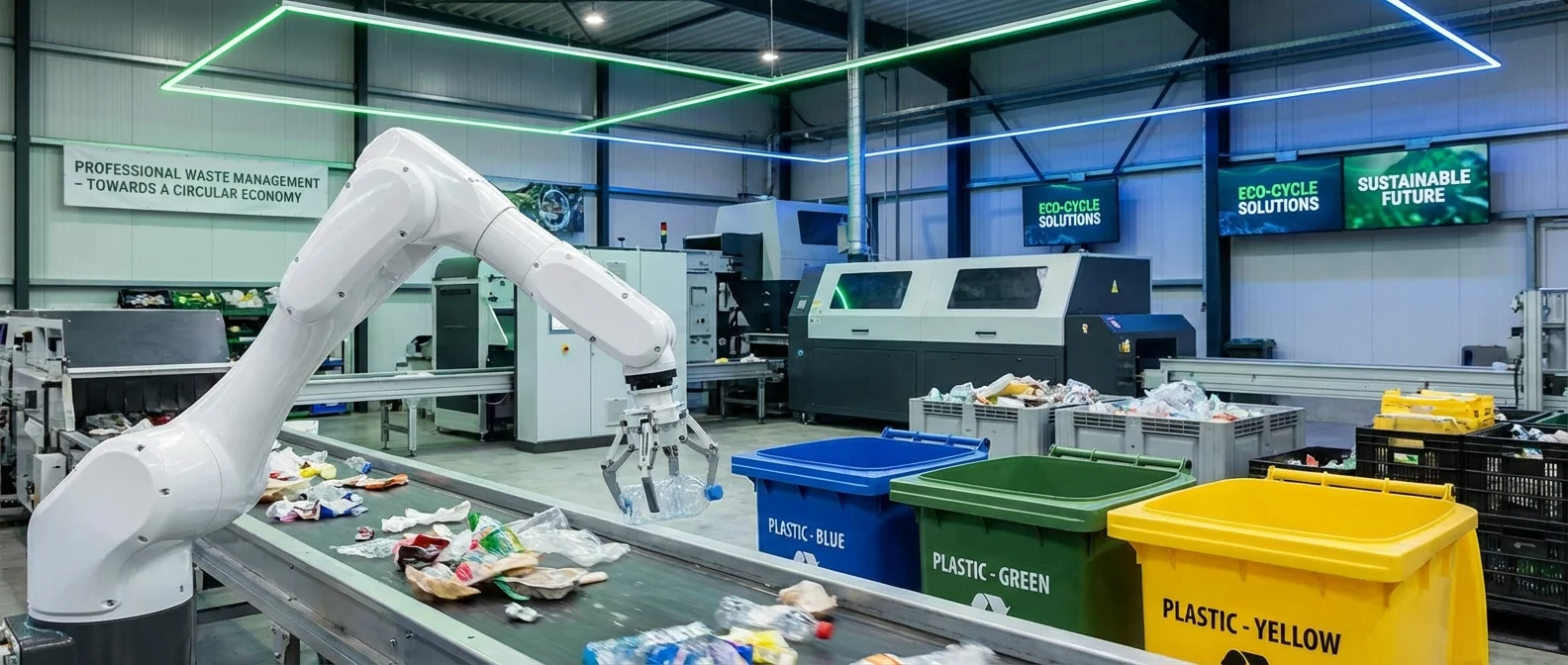
Every year, the world produces over 2 billion tonnes of municipal solid waste — and only about 9% of all plastic ever made has actually been recycled. The bottleneck isn't collection: it's sorting. If you mix a yogurt cup with a PET bottle, traditional sorting lines can't always tell them apart. AI-powered recycling robots are changing that, processing 80+ items per minute with up to 95% accuracy. Here's how this technology works, who's building it, and why it could finally make recycling profitable.
📖 Read more: DJI Romo: The Drone Giant's First Robot Vacuum
Why Recycling Needs Robots
Materials Recovery Facilities — MRFs — are the nerve centers of modern recycling. In the US alone, there are more than 300 of them, and the global MRF market was valued at $6.6 billion in 2019. But processing one tonne of recyclable material costs an average of $82, while the recovered material sells for only around $45. The math doesn't work — unless you slash the labor and error costs.
Human sorters on a conveyor belt work tiring shifts, often in unhealthy conditions, and struggle to keep up with high-speed lines. Contamination rates are a constant headache: one misplaced grease-soaked pizza box can ruin an entire bale of cardboard. Enter robotic sorting — systems that never get tired, never take breaks, and can distinguish between 50+ material types in real time.
China's 2017 National Sword policy — which banned the import of most recyclable waste — was a watershed moment. Countries that had been shipping their recycling abroad suddenly had to sort it properly at home. That created massive demand for automated sorting technology, and investment in recycling robots surged.
How Recycling Robots Work
A typical automated MRF uses multiple sorting stages, each targeting different material types. Here's the process from start to finish:
Pre-Sorting & Bag Opening
Incoming waste is dumped onto a conveyor belt, where bag openers tear open plastic bags and pre-sorters remove large contaminants (wood, textiles, bulky items) before the main sorting begins.
Screening & Size Separation
Disc screens and trommel drums separate materials by size. Flat items (paper, cardboard) ride over the top, while smaller containers fall through to separate conveyor lines.
Magnetic & Eddy Current Separation
Strong electromagnets pull out ferrous metals (steel cans), while eddy current separators use a rapidly rotating magnetic field to repel and eject non-ferrous metals like aluminum cans.
Optical & AI Sorting
Near-infrared (NIR) sensors and cameras scan each item on the belt. Computer vision classifies it by material type, color, and shape. Air jets or robotic arms then push or pick the item into the correct bin — at speeds humans simply can't match.
📖 Read more: How Robots 'See': Cameras, Sensors, and Obstacles
Quality Control & Baling
A final AI-driven quality check scans outgoing streams for contaminants. Clean, sorted materials are compressed into bales and shipped to processors for remanufacturing.
The Technology Behind the Sorting
Recycling robots combine several cutting-edge technologies to achieve their speed and accuracy:
Computer Vision & Deep Learning
Convolutional neural networks (CNNs) trained on millions of waste images classify objects in milliseconds. They recognize not just material type (plastic, paper, metal) but specific product categories — a shampoo bottle vs. a detergent jug — enabling far more granular sorting than traditional systems.
Near-Infrared (NIR) Spectroscopy
NIR sensors bounce infrared light off objects and analyze the reflected spectrum. Different polymers — PET, HDPE, PP, PVC — each have unique spectral signatures, allowing the system to distinguish between plastic types that look identical to the human eye.
Hyperspectral Imaging
A step beyond NIR, hyperspectral sensors capture hundreds of wavelength bands simultaneously. This allows identification of black plastics (invisible to standard NIR), multi-layer packaging, and even food contamination — solving some of the toughest challenges in recycling.
High-Speed Delta Robots
Delta-configuration robotic arms — with three lightweight parallel linkages — perform the physical picking. They operate at extreme speeds (over 3,000 picks per hour) with sub-millimeter precision, using suction cups or pneumatic grippers to grab items off a fast-moving belt.
Leading Recycling Robot Companies
AMP Robotics
Pioneer of AI-guided recycling. Their Cortex system uses computer vision to identify and sort 80+ items per minute. Raised over $190M in funding and deployed across hundreds of facilities in North America and Europe.
📖 Read more: LG AI Agent: The Robot That Cleans and Folds Clothes
ZenRobotics
One of the earliest entrants in robotic waste sorting (founded 2007). Specializes in construction & demolition (C&D) waste, where mixed heavy materials make manual sorting especially dangerous and slow.
Machinex
Builds complete MRF solutions including the SamurAI sorting robot. Combines traditional mechanical sorting equipment with AI-powered robotic pickers for end-to-end facility automation.
TOMRA
Global leader in sensor-based sorting. Their optical sorting machines process everything from food-grade plastics to mixed municipal waste. Powers many of the world's reverse vending machines (bottle deposit systems).
Greyparrot
Focuses on AI waste analytics — camera systems that monitor every item on the belt and provide real-time data on waste composition, contamination rates, and sorting efficiency. A “brain” layer on top of existing MRF infrastructure.
Recycleye
Computer-vision startup that retrofits existing sorting lines with AI recognition. Their system classifies waste into 30+ categories and is designed for easy drop-in installation on legacy conveyor systems.
Robots vs. Human Sorting
| Metric | 🤖 Robotic Sorting | 👷 Human Sorting |
|---|---|---|
| Speed | 80+ picks/minute | 30-40 picks/minute |
| Accuracy | Up to 95% | ~70-85% |
| Operating Hours | 24/7 (with maintenance breaks) | 8-hour shifts, fatigue after 4-5h |
| Consistency | Identical performance hour 1 and hour 10 | Degrades with fatigue |
| Safety | No exposure to hazardous materials | Risk of sharps, chemicals, biohazards |
| Adaptability | Requires retraining for new waste streams | Instantly adapts to unusual items |
| Cost (long-term) | High upfront, low marginal cost | Ongoing labor costs |
What Materials Do Robots Sort?
Modern recycling robots can distinguish dozens of material types. Here are the most common categories they handle:
Special Case: Battery Sorting
Lithium-ion batteries in the waste stream are one of the biggest fire hazards at MRFs. AI systems are increasingly trained to detect loose batteries on conveyor belts and divert them before they're crushed — a critical safety function that's nearly impossible for human sorters to perform reliably at belt speed.
📖 Read more: Ocean Robots: Researching Hurricanes From Inside
The Global Waste Crisis in Numbers
Where Robotic Sorting Is Used
Single-Stream Recycling
The most common application. Households put all recyclables in one bin — paper, plastic, metal, glass — and the MRF sorts it all. AI robots are essential here because the mix is unpredictable and volume is high. Single-stream facilities process anywhere from 20 to 60 tonnes per hour.
Construction & Demolition Waste
C&D waste is heavy and heterogeneous: concrete, wood, metal, drywall, insulation. ZenRobotics pioneered robotic sorting for this sector, where human sorters face serious injury risks from heavy and sharp objects.
E-Waste Recycling
Electronic waste contains valuable metals (gold, copper, rare earths) but also hazardous substances (lead, mercury, cadmium). AI sorting can identify and separate circuit boards, cables, batteries, and housings — improving both resource recovery and safety.
Textile Recycling
As fast fashion drives textile waste to record levels, new facilities are using NIR and computer vision to sort garments by fiber type (cotton, polyester, nylon blends). This is a prerequisite for fiber-to-fiber recycling, which is far more sustainable than downcycling textiles into rags or insulation.
Benefits by the Numbers
| Benefit | Before Robots | After Robots |
|---|---|---|
| Sorting purity | 70-80% | 90-95% |
| Material recovery rate | 60-70% | 85-95% |
| Contamination in bales | 8-15% | 2-5% |
| Throughput | Baseline | +30-50% |
| Labor cost per tonne | $30-50 | $10-20 |
📖 Read more: Physical AI: What It Is and Why It Matters in 2026
Challenges & Limitations
- High upfront cost: A single robotic sorting unit can cost $200,000-$400,000. Retrofitting an entire MRF requires a multi-million dollar investment — a tough ask for municipalities with tight budgets.
- Black plastic blindness: Standard NIR sensors can't detect dark/black plastics because the carbon pigment absorbs near-infrared light. Hyperspectral imaging solves this, but at a higher price point.
- Dirty & wet conditions: Waste is messy. Cameras and sensors need constant cleaning and calibration. Moisture, grease, and dust can all degrade optical performance.
- Novel materials: Compostable bioplastics, multi-layer packaging, and new polymer blends confuse systems trained on historical data. Models need continuous retraining as the waste stream evolves.
- Integration complexity: MRFs are complex systems where mechanical and robotic sorting must work in harmony. Poor integration — wrong belt speed, incorrect sensor placement — can undermine the whole line.
What Comes Next
Foundation Models for Waste
Large vision-language models are being adapted for waste classification. Instead of training bespoke models for each facility, a single foundation model could identify virtually any object — even items it has never seen before — by understanding material properties from visual and spectral cues.
Digital Twin MRFs
Real-time digital replicas of sorting facilities allow operators to simulate workflow changes, predict equipment failures, and optimize belt speeds without any downtime. Think of it as a flight simulator for waste processing.
Fully Autonomous “Lights-Out” MRFs
The end goal: sorting facilities that run 24/7 with zero human operators on the floor. Every stage — from receiving to baling — handled by coordinated robots and AI systems. The first proof-of-concept facilities are expected by 2028-2030.
Why This Matters
The European Union's Circular Economy Action Plan mandates that 65% of municipal waste be recycled by 2035. Greece currently hovers around 20%, making it one of the lowest in Europe. AI-powered sorting technology could be the catalyst that finally closes this gap — not by asking consumers to be more careful (decades of campaigns prove how unreliable that is), but by making the sorting infrastructure smart enough to handle whatever comes down the belt.
For every tonne of material that a robot recovers instead of sending to landfill, there's a direct carbon benefit: recycled aluminum saves 95% of the energy needed to produce it from raw bauxite, recycled paper saves 60-70%, and recycled PET saves 75%. The climate case for recycling robots is as strong as the economic one.
Bottom Line
Recycling robots aren't a futuristic dream — they're already running in hundreds of facilities worldwide. They sort faster, more accurately, and more safely than humans. As costs come down and AI models get smarter, robotic sorting will become the standard, not the exception. The technology exists. The economics are getting there. The only question is how fast we deploy it.