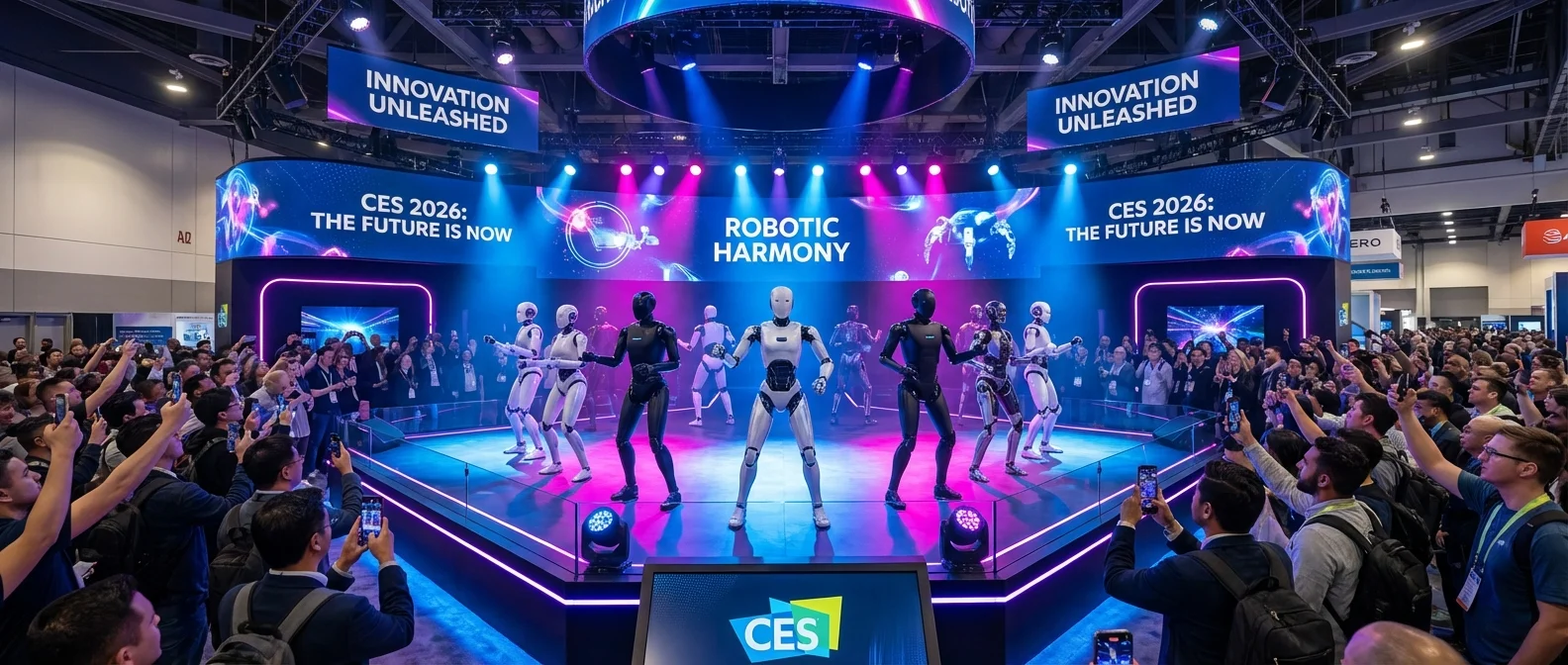
January 6–9, 2026, Las Vegas — CES 2026 was arguably the most “robotic” tech expo in history. With 38 companies in the humanoid robotics category alone, 3,500+ exhibitors, and thousands of attendees, humanoid robots officially graduated from the lab to the main stage. Who stole the show — and who wasn't even there?
"More robots and humanoid-looking robots than we've ever had before. You are seeing humanoid robots right now — sometimes it works, sometimes it doesn't."
— Gary Shapiro, CEO of the Consumer Technology Association (CTA)🏆 #1: Boston Dynamics Atlas — The Undisputed Star
On the evening of January 5, the night before CES officially opened, in a Las Vegas hotel ballroom, Zachary Jackowski (VP & General Manager of the Atlas program) stepped up and said: "For the first time ever in public, please welcome Atlas to the stage."
And Atlas walked. It picked itself up from the floor, moved fluidly across the stage for several minutes, waved to the audience, swiveled its head. Boston Dynamics had even warmed up the crowd with Spot robot dogs dancing in sync to K-pop music — like the opening act of a rock concert.
This was a gutsy move. Most companies avoid live humanoid demos — on a live stage, things go wrong. Just two months earlier (November 2025), a Russian humanoid fell flat on its face during an official presentation. Boston Dynamics decided Atlas was ready. And it paid off.
Why Atlas Won Everything
- CNET “Best Robot” CES 2026 — official award
- First ever public live demonstration — a bold statement of confidence
- Fully electric system (replacing the old hydraulic design) — ground-up redesign
- Google DeepMind's Gemini Robotics partnership — a new AI brain
- Target deployment: Hyundai's HMGMA factory (Georgia, USA) by 2028
Worth noting: the demo was remotely piloted, but Atlas is being designed for full autonomy. Hyundai Mobis supplies the robot's actuators, giving Hyundai a clear supply chain advantage over Tesla's Optimus (which Korea Herald reported faces persistent “actuator hurdles”).
🏠 #2: LG CLOiD — The Household Humanoid
LG — one of the world's largest consumer electronics companies — unveiled CLOiD at CES 2026: a humanoid robot designed specifically for household chores.
What does CLOiD do? It folds laundry, fetches food, and handles domestic tasks. LG gave the press a live demo on the first night (January 6), and according to AP News, "LG is certainly one of the biggest tech companies to promise to put a service robot in homes."
That's the key point: this isn't a startup promise — it's a company that's already in hundreds of millions of homes through its TVs, refrigerators, and washing machines. If LG decides every household needs a robot assistant, it has the distribution channels to actually make it happen.
🥋 #3: Unitree G1 — Kung Fu, Backflips, and Dance Moves
China's Unitree Robotics (founded 2016, Hangzhou) didn't come to CES to talk — it came to put on a show. The G1 humanoid (127 cm / 4'2″ tall) performed live:
- Complex choreographed dance routines
- Flying sidekicks — martial arts-style airborne kicks
- Standing backflips — from a standstill
In a market where Boston Dynamics' Atlas costs hundreds of thousands, the Unitree G1 starts at roughly $16,000 — a price that dramatically undercuts the competition. Unitree is following the well-known Chinese strategy: low cost, fast scaling, spectacular demos. And at CES 2026, it worked flawlessly.
🦵 #4: Roborock Saros Rover — The Vacuum with Legs
Possibly the most unexpectedly impressive reveal at CES 2026. China-based Roborock unveiled the Saros Rover — a robot vacuum that literally sprouts chicken-like legs to climb stairs.
Yes, you read that correctly. The vacuum walks up stairs, cleaning each step along the way. According to AP News, the demo was "a tad slow in its ascent and descent (but it was cleaning each step)". It can handle “almost any style of stairwell, including spiraled.”
The Saros Rover doesn't have a release date yet — it's still in development. But if it works reliably at scale, it will be a game-changer for every multi-story home.
🤖 #5: Nvidia — “Physical AI” and Robot Companions
Jensen Huang (Nvidia CEO) didn't unveil a humanoid — but he presented something more fundamental: Nvidia's "Physical AI" platform. The idea? Train AI models in photorealistic virtual environments governed by real physics, then deploy them in actual robot bodies.
Key announcements:
- Cosmos — AI foundation model that simulates environments governed by real-world physics
- Vera Rubin — Next-generation AI superchip, already in full production
- Nvidia × Siemens — Partnership for an AI-driven industrial revolution
The crowd's favorite moment? Huang called two small robots onto the stage that "waddled out chirping" — and the audience didn't want to see anything else after that.
✈️ Bonus: Autonomous Airport Robots
Oshkosh revealed a fleet of autonomous robots designed for airport ground operations: fueling, cleaning, cargo handling, passenger boarding. The goal: fewer delays without compromising safety, all-weather operation. CEO John Pfeifer said testing is already underway with major airlines, likely debuting at large hub airports like Atlanta and Dallas.
📊 The Robots That Weren't There
Some of the biggest names in robotics were nowhere to be found at CES 2026:
🔍 Missing in Action — and Why
| Company | Robot | Status |
|---|---|---|
| Tesla | Optimus (Gen 3) | No CES presence. Internal use only. Head Milan Kovac resigned (June 2025) |
| Figure AI | Figure 03 | Absent. $39B valuation (Sep 2025). Pivoting to home robotics |
| Agility Robotics | Digit | Didn't appear. Focused on warehouse contracts (Amazon, GXO) |
| 1X Technologies | NEO | Pre-orders open ($20,000). Launching 2026. Caveat: most tasks still teleoperated |
The absence of Tesla's Optimus was conspicuous. Elon Musk had promised “limited production” in 2025, but Korea Herald reported that Hyundai (via Hyundai Mobis) has a clear supply chain advantage — while Tesla continues to wrestle with “actuator hurdles.”
🔮 What It All Means
CES 2026 marked a clear inflection point: humanoid robots are no longer sci-fi concepts. They're products entering production.
Key CES 2026 Trends
- Physical AI: Nvidia and Google are defining the new era — train in simulation, deploy in the real world
- AI Is the Bottleneck: "Hardware can only go so far in humanoid robotics. For humanoids to succeed, AI is critical" — Prof. Han Jae-kwon
- Robot-as-a-Service (RaaS): Agility pioneered it (GXO contract), 1X offers $499/month subscriptions
- Price War Begins: Unitree G1 at ~$16,000, 1X NEO at $20,000 — prices are falling fast
- Industry Convergence: Software + chipsets + AI + sensors — “All the pieces of the technology are coming together” — Alex Panas, McKinsey
"Hardware can only go so far in humanoid robotics. For humanoids to succeed, AI is critical."
— Professor Han Jae-kwon, Korea Herald (Jan. 15, 2026)🏭 Hyundai: The Biggest Winner?
Beyond Atlas, Hyundai dominated CES 2026 as a whole. Its booth drew 20,500+ visitors — up 28% compared to two years prior.
The strategy behind this: Chairman Euisun Chung designated robotics as a core growth engine back in 2018. The acquisition of Boston Dynamics (2021, ~$880M) wasn't a random bet — it was part of a long-term play that's now bearing fruit. Hyundai plans to manufacture 30,000 robots per year at a new U.S. facility by 2028.
📝 Final Verdict
CES 2026 wasn't just a tech show. It was the official coming-out party for humanoid robots in the mainstream. Atlas walked onstage. CLOiD folded laundry. The G1 did kung fu. A vacuum cleaner grew legs. And behind it all: AI models, supply chain battles, and a multi-billion-dollar race between Korea, China, and the United States.
If CES 2025 was the year robots grabbed headlines, CES 2026 was the year they proved they're coming.