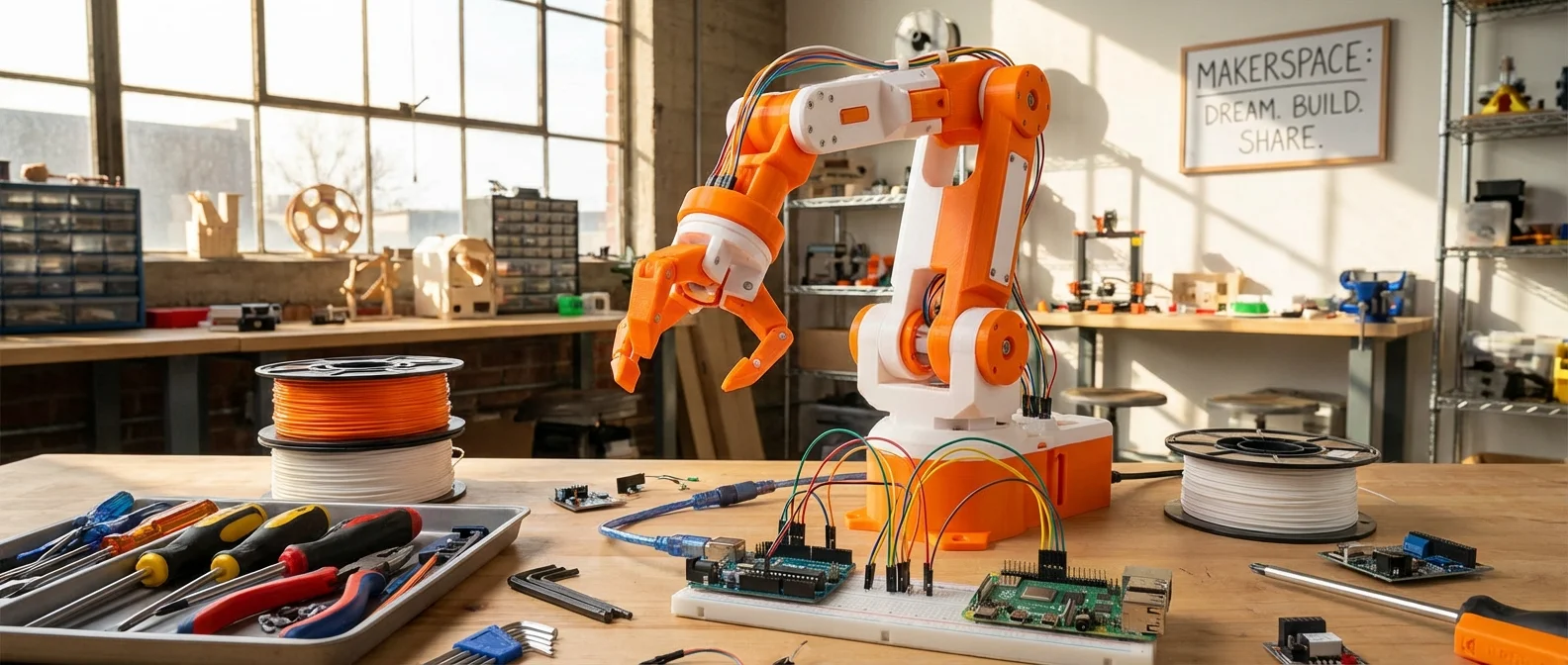
What if you could build your own robot arm — with a 3D printer, a handful of servo motors, and less than €130? Hugging Face, the company that transformed how we share AI models, is now doing the same thing for robotics. Their LeRobot platform and the SO-100 robot arm prove that building robots is no longer the exclusive domain of million-dollar labs.
Hugging Face: From Chatbot to Robotics Revolution
Hugging Face was founded in 2016 in New York City by French entrepreneurs Clément Delangue, Julien Chaumond, and Thomas Wolf. They originally built a chatbot app for teenagers — the name comes from the 🤗 emoji. But they quickly pivoted toward something far bigger: an open platform for machine learning.
Today, with 250 employees, Hugging Face hosts thousands of AI models, datasets, and tools. Their Transformers library became an industry standard, and they collaborate with tech giants including Amazon Web Services, Meta, and Scaleway. In July 2022, they released BLOOM — an open-source language model with 176 billion parameters.
But their boldest move wasn't in software. It was in hardware.
LeRobot: AI Robotics for Everyone
The LeRobot platform represents Hugging Face's big bet on robotics. Released as an open-source project on GitHub, it aims to do for robots what the Transformers library did for language models — but this time for real-world machines.
🤗 LeRobot — What It Offers
- 🔧 Hardware-agnostic interface — unified Python API for any robot, from the SO-100 to full humanoids
- 📊 LeRobotDataset format — Parquet + MP4 on the HF Hub, enabling streaming of massive robotics datasets
- 🧠 State-of-the-art policies — ACT, Diffusion, Pi0Fast, GR00T N1.5, SmolVLA, XVLA
- 🌐 Community — 204+ contributors, 3,800+ forks, active Discord server
- 📚 171+ Datasets — demonstration data for training robots on real-world tasks
- 🎮 Supported hardware — SO100, SO101, Koch, LeKiwi, Reachy2, Unitree G1, EarthRover
The philosophy is simple: everything that can be open-source should be. Every model, every dataset, every 3D-printable design — all published freely on the Hugging Face Hub for anyone to use.
SO-100: The Arm That Changes Everything
The SO-100 (Standard Open 100) is the original robot arm designed by The Robot Studio in collaboration with Hugging Face. It's a 6-DOF (degrees of freedom) system built almost entirely from 3D-printed parts and low-cost servo motors.
What You Need: Bill of Materials
The cost for a full teleoperation setup (leader + follower arm) starts at roughly €244:
| Component | Quantity | Price (EUR) |
|---|---|---|
| STS3215 Servo (Feetech) | 12 | ~€13/each |
| Motor Control Board | 2 | ~€12/each |
| USB-C Cables (2 pcs) | 1 | ~€7 |
| Power Supply | 2 | ~€13/each |
| Table Clamps | 4 | ~€9 |
| Screwdriver Set | 1 | ~€10 |
| Total (2 arms) | ~€244 |
For a single arm (6 servos, 1 controller, 1 power supply), the cost drops to around €128. The 3D-printed parts are made from PLA plastic on any FDM printer — even entry-level models like the Creality Ender 3 (~€150) will do the job.
💡 Don't Have a 3D Printer?
The project provides guides for online printing services. You can order all the parts from third parties without owning any equipment — services like JLCPCB, Craftcloud, or local FabLabs can print everything you need.
Step by Step: From Box to Robot
Assembly follows a clear process. The first arm might take a bit over an hour, but once you've got the hang of it, the second one can be done in under sixty minutes.
3D print all parts in PLA. Settings: 0.4mm nozzle, 0.2mm layer height, 13% infill. A single STL file contains all components.
Configure Motors
Each STS3215 servo gets a unique ID via Python script. Connect one at a time to the controller for automatic baudrate configuration.
Assemble
27 steps: base → shoulder → elbow → wrist → gripper. Daisy-chain motors together. M2 and M3 screws throughout.
Calibrate
Run lerobot-calibrate: move each joint to its midpoint, then through full range of motion. Ensures policy transfer between robots.
Leader-Follower: Learning by Demonstration
The real magic of the SO-100 lies in its leader-follower system. Two identical arms — the leader (controller) and the follower (executor) — are linked through LeRobot. The user moves the leader by hand (its gears are removed for minimal resistance), and the follower mirrors every motion in real time.
These movements are recorded as demonstrations — video plus position/action data in LeRobotDataset format (Parquet + MP4). This data is then used to train a neural network through imitation learning. After training, the follower performs tasks autonomously — no human input required.
SO-101: The Evolution
The SO-101 is LeRobot's “flagship” robot — an improved version of the SO-100. The key innovation is in its gear ratios: instead of identical gearing across all joints, the SO-101 leader uses three different transmission ratios.
⚙️ SO-101 Leader Gear Ratios
- Base (Shoulder Pan): 1/191 — balances control and freedom
- Shoulder Lift: 1/345 — maximum weight support
- Elbow Flex: 1/191 — flexibility
- Wrist (Flex/Roll): 1/147 — lightweight movement with no resistance
- Gripper: 1/147 — precise grip
This design ensures the leader can hold its own weight without external help while still letting the user move it with minimal force. The follower uses 6x STS3215 motors with 1/345 gearing across all joints for maximum torque.
April 2025: The Pollen Robotics Acquisition
In April 2025, Hugging Face made a move that signals just how serious they are about robotics: they acquired French startup Pollen Robotics. Founded in 2016 in France by Matthieu Lapeyre and Pierre Rouanet, the company created Reachy 2 — an open-source humanoid robot.
“We want to make Artificial Intelligence robotics Open Source.”
— Clément Delangue, CEO of Hugging Face, in a post on X
The acquisition brings humanoid robotics expertise into the LeRobot ecosystem. Reachy 2 is already supported as compatible hardware, and the team is working toward 3D-printable humanoids that anyone can build. Delangue envisions a future where robots are built and shared the same way AI models are today.
AI Models: From Demo to Autonomy
LeRobot isn't just a hardware project — it's a complete AI framework. The control policies it provides include state-of-the-art machine learning algorithms:
Training is just as straightforward. A single lerobot-train command kicks off learning from your teleoperation data. ACT (Action Chunking with Transformers) and Diffusion Policy models learn to replicate human movements, while VLA models (Pi0Fast, GR00T N1.5, SmolVLA) combine language commands with visual perception for more complex tasks.
Evaluation works both in simulation (LIBERO, MetaWorld) and on real hardware through a unified evaluation script.
Why This Matters
Traditional robotics requires equipment costing hundreds of thousands of euros, proprietary software, and years of specialization. LeRobot radically changes this landscape:
Cost
From hundreds of thousands down to ~€128. Robotics now accessible to students, makers, and researchers in developing countries.
Openness
Every STL file, every line of Python, every trained model — freely available under Apache-2.0 license.
Reproducibility
Calibration ensures that a neural network trained on one robot works on any other SO-100 anywhere in the world.
Community
204 contributors, free tutorials, Discord, Chinese-language guides, hackathons — global robotics education.
Consider the comparison: an industrial Universal Robots UR5e arm costs between €25,000 and €35,000. An SO-100 costs €128 — that's 99.5% cheaper. It obviously can't match industrial robots in precision and durability, but for education, prototyping, and AI research, it's a game changer.
The Future: From Arms to Humanoids
Hugging Face's trajectory in robotics is clear: what started with a simple robot arm will evolve into full open-source humanoid robots. The Pollen Robotics acquisition, Unitree G1 support in LeRobot, and VLA models (Vision-Language-Action) all show that the company is building a complete ecosystem.
LeRobot's short history is already impressive. In just months, it gathered 21,700 GitHub stars, 3,800 forks, and 204 contributors. It hosts 26 trained models and 171 datasets on the Hugging Face Hub, along with a free Robot Learning Tutorial that teaches anyone how to train robots.
🎓 Get Started Today
You don't have to wait. LeRobot installs with pip install lerobot. There are simulation environments (LIBERO, MetaWorld) for experimenting without hardware. If you want a real robot, order 6 servo motors, print the parts, and follow the guide. In about an hour, you'll have your own robot — and you'll be training it to pick up objects.
Hugging Face has proven that democratization isn't just about language models. The same philosophy that made BERT and GPT-2 accessible to every developer now makes robotics accessible to every maker, student, and researcher on the planet.