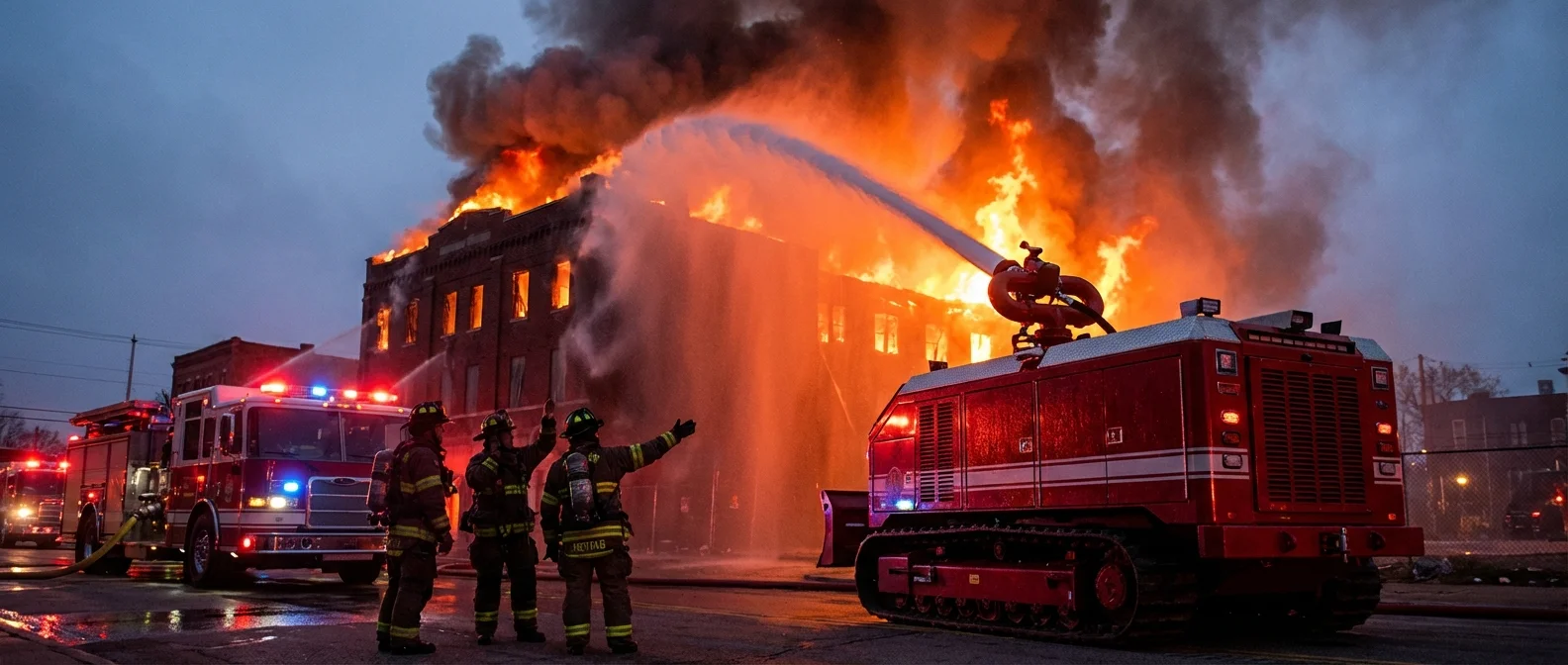
On April 15, 2019, as Notre-Dame de Paris was engulfed in flames, more than 400 firefighters struggled to save the medieval cathedral. Among them moved a half-meter-tall tracked robot — Colossus, built by France's Shark Robotics. Operated remotely, it directed powerful water streams into areas where no firefighter could safely stand. It was the moment the world realized that firefighting robots aren't science fiction — they're real rescue tools.
📖 Read more: DARPA: Robots Saving Lives on the Battlefield
Today, in early 2026, dozens of fire departments across the United States, Europe, Japan, and China use robotic systems in their daily operations. From remote-controlled tracked machines that enter burning buildings to thermal-imaging drones that locate trapped victims, robotics is transforming the way we fight fire.
Why We Need Robots in Firefighting
Firefighting is one of the most dangerous professions in the world. Firefighters face temperatures exceeding 800°C (1,470°F), toxic smoke, structural collapse risks, and explosions. According to the NFPA (National Fire Protection Association), roughly 60 firefighters lose their lives every year in the United States alone during operations. Globally, the number is many times higher.
Robotic systems don't replace firefighters — they complement them. They take on the most hazardous missions: scouting the interior of burning buildings, suppressing flames in areas where temperatures prohibit human presence, evacuating trapped individuals, and monitoring structural integrity. In simple terms, they do the work that would otherwise cost human lives.
Colossus: The French Hero of Notre-Dame
Shark Robotics, a French company based in La Rochelle, designed Colossus specifically for urban firefighting operations. It's a tracked robot weighing roughly 500 kg (1,100 lbs), capable of navigating unstable terrain, staircases, and debris. It carries a fire cannon that can deliver water or foam at up to 2,500 liters per minute.
During the Notre-Dame fire, Colossus entered the cathedral's central nave, where molten lead from the roof was dripping onto the floor and temperatures far exceeded any human tolerance. Its thermal camera provided real-time intelligence to the officers coordinating the operation, while simultaneously cooling the pillars and walls to prevent further collapse. Without it, firefighters would have had to do this job at the risk of their lives — or not do it at all.
After Notre-Dame, the Paris Fire Brigade (Brigade de Sapeurs-Pompiers de Paris) permanently integrated Colossus robots into its fleet. Shark Robotics now has clients in dozens of countries, from Germany to the United Arab Emirates.
Thermite RS3: America's Armored Firefighting Robot
On the other side of the Atlantic, Howe & Howe Technologies (now part of Textron Systems) developed the Thermite RS3 — a tracked robot weighing 1,600 kg (3,500 lbs) that looks more like a small armored vehicle than a traditional robot. It withstands surface temperatures up to 900°C (1,650°F), can push cars and debris out of the way, and delivers water at a rate of 9,500 liters (2,500 gallons) per minute.
In 2020, the Los Angeles Fire Department (LAFD) became the first fire department in the United States to operationally deploy a robotic firefighting vehicle, purchasing a Thermite RS3. It was immediately used in a multi-story building fire in downtown LA, buying critical time and allowing crews to avoid collapse risk. Since then, fire departments in New York (FDNY), Chicago, and dozens of other cities have acquired similar robots.
📖 Read more: DJI Romo: The Drone Giant's First Robot Vacuum
Reconnaissance Robots: Boston Dynamics' Spot in Fire Zones
It's not just the large tracked robots changing firefighting. Boston Dynamics' quadruped robot Spot is already used by fire departments for building reconnaissance after fires or structural collapses. Equipped with thermal cameras, LiDAR, and gas sensors, Spot can enter buildings deemed too dangerous for humans, map interior spaces, and identify hot spots that indicate reignition risk.
The FDNY (Fire Department of the City of New York) was among the first organizations to adopt Spot for firefighting applications. The four-legged robot can climb stairs, squeeze through narrow openings, and stream live video back to the command center. It doesn't put out fires — but the intelligence it provides saves time, resources, and ultimately, lives.
Firefighting Drones: Eyes in the Sky
Unmanned aerial vehicles (drones) have become an integral part of modern firefighting tactics. During the Notre-Dame fire, drones provided thermal imaging and visual surveillance, helping officers understand where the fire was spreading and where to focus their resources. Today, drone models like the DJI Matrice 300 RTK are equipped with dual-spectrum thermal cameras and routinely deployed in wildfires, industrial accidents, and urban fires.
For countries particularly affected by wildfires — such as Greece, Australia, and Portugal — drone integration into fire services is a strategic necessity. Drones can detect smoke before a fire becomes visible, map active fronts in real time, and coordinate aerial assets like water bombers and helicopters. They don't replace firefighting aircraft, but they provide real-time intelligence that aircraft simply can't.
LUF 60: The Austrian Typhoon
A particularly unique firefighting robot is the LUF 60, made by Austrian company LUF (Lösch- und Fernlenktechnik). Instead of a water cannon, it uses a jet engine turbine that creates a powerful airstream mixed with atomized water. This “typhoon” can cool entire rooms in seconds and clear toxic smoke from tunnels, underground parking garages, and industrial facilities.
The LUF 60 is extensively used across European countries, especially in highway tunnels in Austria, Italy, and Switzerland, where a fire can become deadly within minutes due to the confined space. It weighs approximately 1,500 kg (3,300 lbs), moves on tracks, and is remotely operated from a safe distance.
The Japanese Approach: Coordinated Robotic Systems
Japan, after the Fukushima disaster in 2011 — where robots were deployed in high-radiation environments — invested heavily in robotic firefighting. Mitsubishi Heavy Industries developed the Water Cannon Robot, a tracked system capable of projecting water to heights of 70 meters (230 feet), specifically designed for petrochemical plant fires and high-rise buildings.
In 2019, the Tokyo Fire Department unveiled a fully integrated robotic firefighting system consisting of four robots working in coordination: a reconnaissance robot with a drone, a high-flow water suppression robot, a hose transport robot, and an aerial surveillance drone. This integrated approach illustrates where robotic firefighting is headed: not a single machine, but a system of machines working together.
📖 Read more: EngineAI T800: The 'Terminator' Robot That Kicks Its Own CEO
DOK-ING: The Croatian Powerhouse
Croatian company DOK-ING, originally known for its mine-clearing robots, developed a range of firefighting robots used in industrial facilities, mining operations, and airports. The DOK-ING MVF-5 machines can withstand extremely high temperatures, carry a self-cooling system, and deliver either water or foam depending on the type of fire (fuel, chemical, etc.).
DOK-ING's story illustrates how technologies developed for military purposes (mine clearance) can find invaluable applications in civilian protection. Their robots are operated remotely from up to a kilometer away, and operators see exactly what they're dealing with through thermal and optical cameras.
🔥 Key Firefighting Robots of 2026
- Colossus (Shark Robotics, France) — ~500 kg, tracked, 2,500 L/min, thermal camera, Notre-Dame hero
- Thermite RS3 (Howe & Howe / Textron, USA) — ~1,600 kg, withstands 900°C, 9,500 L/min, used by LAFD
- LUF 60 (LUF, Austria) — ~1,500 kg, jet turbine, ideal for tunnels and confined spaces
- Water Cannon Robot (Mitsubishi, Japan) — reaches 70m height, for petrochemical and high-rise fires
- DOK-ING MVF-5 (DOK-ING, Croatia) — self-cooling, water/foam, for industry and mining
- Spot (Boston Dynamics, USA) — quadruped recon, thermal/LiDAR, post-fire use by FDNY
Artificial Intelligence and Autonomous Decision-Making
Most firefighting robots today are teleoperated — meaning a human operator controls their movements via a console. Teleoperation works well, but it introduces latency and depends on a stable wireless connection, which can easily be lost inside a burning building full of steel and concrete.
The next generation of firefighting robots will incorporate AI for semi-autonomous operation. This means the robot will be able to navigate a building on its own, recognize obstacles, detect hot spots, and decide where to direct water — even if it temporarily loses contact with its operator. Research labs at MIT, ETH Zurich, and universities in Tokyo are developing navigation algorithms for zero-visibility conditions — that is, inside dense smoke.
One particularly promising field is AI-powered thermal analysis: trained neural networks analyze thermal images in real time and predict how a fire will evolve over the next several minutes. This helps both robots and officers make decisions before a situation becomes critical — for example, before a room reaches flashover (full room ignition).
Wildfires: A Different Challenge
Wildfires present a unique challenge for robotics. Unlike urban fires, they spread across vast areas, access is difficult, and conditions shift with the wind. Here, drones play the dominant role: detecting smoke before a fire becomes visible, mapping fronts in real time, and helping coordinate aerial assets (water bombers, helicopters).
Countries like Greece, Australia, and the western United States — all severely impacted by wildfires every year — are increasingly exploring robotic solutions. Surveillance drones are already in regular use, but the adoption of tracked robots for creating firebreaks or suppressing flames in inaccessible terrain could dramatically change the equation. Pilot programs in several countries are already underway.
Cost and Accessibility
Firefighting robots don't come cheap. A Thermite RS3 costs approximately $275,000–$350,000. A Colossus runs around €150,000–€200,000. Thermal imaging drones start at €5,000–€15,000 for basic models, but specialized firefighting configurations reach €50,000+. A quadruped reconnaissance robot like Spot costs around $75,000.
📖 Read more: Exoskeletons: The Robotic Suits Giving Humans Superpowers
These figures may seem substantial, but they compare favorably with the cost of a standard fire engine ($500,000–$1,500,000) — and, of course, they can't be compared to the value of a human life. Many fire departments fund robot purchases through government grants, federal allocations, or donations.
Limitations and Challenges
Despite their impressive capabilities, firefighting robots face significant limitations:
- Weight and mobility: Large tracked robots (500–1,600 kg) can't fit through residential stairwells, elevators, or narrow passages. In practice, they operate primarily on ground floors, industrial spaces, or open areas.
- Battery life: Most robots run for 2–6 hours of continuous use. During a multi-hour fire, replacement or recharging may be needed.
- Wireless connectivity: In multi-story buildings with concrete and steel frames, the link between operator and robot can be severed.
- Training: Each robot requires a trained operator. Training a firefighter to use robotic systems takes time and resources.
- Maintenance: Robots exposed to extreme temperatures, water, and chemicals require regular servicing and replacement parts.
The Future: Autonomous Swarms and Prevention
Robotics research labs around the world are pursuing two major directions for the future of robotic firefighting:
The first is autonomous swarms — multiple small robots (ground and air) working together without human intervention. Imagine a swarm of small drones detecting the fire, two tracked robots entering from different angles, and a larger suppression robot following with water — all coordinated through AI. This isn't science fiction: DARPA is already funding such research.
The second direction is AI-driven prevention. Networks of IoT sensors placed in buildings, forests, and industrial facilities can detect a fire within its first seconds — before it grows out of control. Combined with robots that can activate automatically, a fire could theoretically be extinguished before the fire department even arrives. Pilot programs in warehouses, data centers, and museums are already testing this approach.
What This Means for Firefighters
Any discussion about robots and jobs brings up the word “replacement.” In firefighting, however, the reality is far more nuanced. No robot can replace the judgment, experience, and physical capability of a firefighter in every scenario. Robots don't go everywhere — they go where no one can or should.
The firefighter's role is evolving: from the person who enters the flames first, to the operator controlling robots, the analyst interpreting thermal data, and the officer making strategic decisions based on real-time intelligence. Firefighting isn't becoming less human — it's becoming smarter.
From Notre-Dame to the forests of California, from Tokyo's petrochemical plants to Austrian highway tunnels, firefighting robots are proving that technology, when used correctly, doesn't replace humans — it protects them.