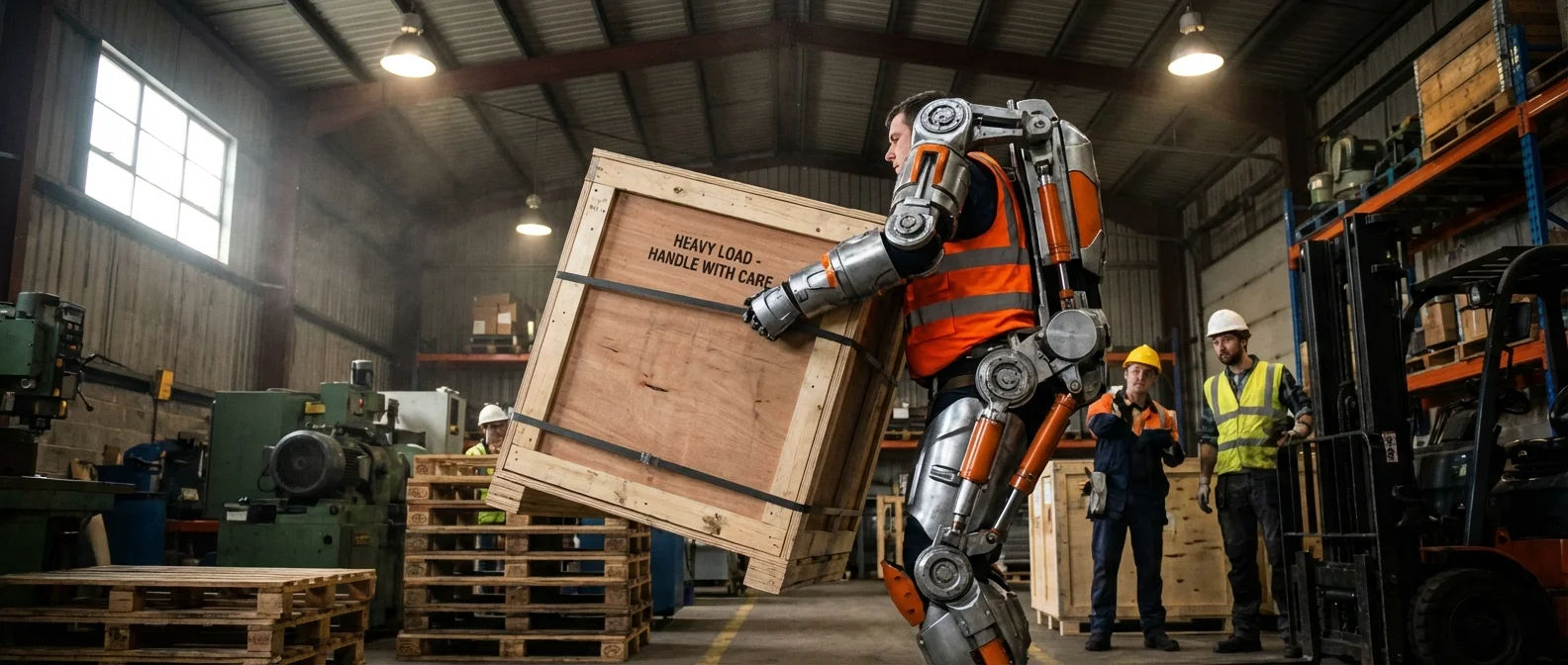
Imagine lifting 200 pounds like it's nothing. Imagine walking again after years in a wheelchair. Imagine working an 8-hour factory shift with your arms above your head — without pain. These aren't scenes from science fiction movies. This is the reality of 2026, and it's called the exoskeleton. The market reached $590 million in 2025, with over 100 products available, and is projected to exceed $1.79 billion by 2033.
⚙️ What an Exoskeleton Actually Is — And Isn't
Let's clear something up right away: real exoskeletons look nothing like Iron Man's suit. An exoskeleton is a wearable device that augments, assists, or restores human movement through mechanical interaction with the body. Think of it as a wearable tool, not a suit of armor. Most modern exoskeletons support a specific body region — back, shoulders, knees, ankles — and operate during specific tasks, not all day long.
There are two major categories: powered (active, with motors and batteries) and passive (using springs and elastic materials). Powered exoskeletons offer greater assistance but are heavier, more expensive, and have limited battery life. Passive exoskeletons are lighter, cheaper, and don't need charging, but can only provide elastic support. As of 2025, powered exoskeletons hold 71.4% of the market, though passive models are rapidly gaining ground in industrial settings due to their sheer practicality.
📜 From Yagin to Hardiman: A 136-Year Journey
The exoskeleton concept is far from new. In 1890, Russian engineer Nicholas Yagin built a device with bow springs connecting the user's waist and feet, designed to assist walking, running, or jumping through elastic energy storage and return. In 1917, American inventor Leslie Kelley created a running augmentation device powered by a backpack-worn steam engine — an early soft exosuit, decades before the term existed.
The modern era began in the 1960s with General Electric's Hardiman, co-developed with the U.S. Armed Forces. It used hydraulics and electricity to multiply the wearer's strength by a factor of 25 — lifting 110 kg would feel like lifting 4.5 kg. Impressive on paper. In practice, it weighed 680 kg, moved at 2.5 feet per second, and when both legs operated simultaneously, the resulting motion was — according to the engineers themselves — “violent and uncontrollable.” It was never used by humans.
🎖️ The Military Dreams That Never Materialized
DARPA (Defense Advanced Research Projects Agency) has been the largest funder of military exoskeletons in history. In 2001, it invested $50 million in the BLEEX program (Berkeley Lower Extremity Exoskeleton) at UC Berkeley. The result was a lower-body exoskeleton with 7 degrees of freedom, capable of carrying 75 kg of payload at 0.9 m/s. It was energy-autonomous — a significant first. But it remained a prototype.
Lockheed Martin took the baton with the HULC (Human Universal Load Carrier), licensing technology from Berkeley Bionics in January 2009. The specs were impressive: 200-pound payload capacity, top speed of 10 mph, hydraulic actuation powered by batteries. The U.S. Army awarded a $1.1 million contract in July 2010 for testing. Once again: tested but never deployed in the field.
The most ambitious — and most expensive — failure was TALOS (Tactical Assault Light Operator Suit). Announced in May 2013 by Admiral William McRaven of SOCOM, it aimed to create a bulletproof, armed suit with enhanced strength. The program involved 56 companies, 16 government agencies, 13 universities, and 10 national laboratories. The budget exceeded $80 million. In February 2019, the program was killed: “not suitable for close combat.” TALOS's only legacy was spin-off technologies — a cooling vest, a weapon stabilization system called “Third Arm,” and some armor components.
"No full-body military exoskeleton has ever been deployed in combat. Not one. The problems — weight, battery life, freedom of movement, noise — remain insurmountable for full-body systems."
— Task & Purpose analysis, July 2021Sarcos Robotics may be the most telling case study. Founded in 1983 by Prof. Stephen Jacobsen at the University of Utah, acquired by Raytheon in 2007, spun off in 2015, taken public on Nasdaq (STRC) via SPAC in September 2021. The Guardian XO — a full-body powered exoskeleton — was its flagship product. But it never achieved autonomous operation: it stayed tethered to an external power source. In November 2023, the company abandoned hardware entirely, pivoted to AI software, and in March 2024 rebranded as Palladyne AI (ticker PDYN). The Guardian XO remains a footnote in robotics history — technically impressive, commercially unviable.
🏥 Medical Exoskeletons: Where the Real Magic Happens
If military exoskeletons represent the field's biggest disappointment, medical exoskeletons represent its greatest triumph. Here, the technology is literally saving lives.
ReWalk / Lifeward: First Through the FDA Door
ReWalk was designed by Israeli inventor Amit Goffer in Yokneam, Israel. It's a robotic leg system that enables paraplegics to stand upright, walk, and climb stairs. It weighs 23.3 kg (the robotic legs account for 21 kg, with the backpack computer adding 2.3 kg) and is controlled via a wristwatch-type device. Price: $85,000 per unit.
The breakthrough came in June 2014, when it received FDA approval for personal use — the world's first exoskeleton to achieve this clearance. But the most remarkable moment came on May 8, 2012, when British woman Claire Lomas, paralyzed from the waist down after a 2007 horse-riding accident, completed the London Marathon in 17 days wearing a ReWalk — the first person in history to finish a marathon using bionic equipment. She later took part in the opening ceremony of the 2012 Summer Paralympics in London.
The company, now rebranded as Lifeward (Nasdaq: LFWD), launched ReWalk 7 across the U.S. in April 2025, described by CEO Larry Jasinski as “optimized for the real world.” In December 2025, it expanded to the UAE through an exclusive distribution deal with Verita Neuro.
Cyberdyne HAL: The Exoskeleton That Reads Your Nerves
Japanese Prof. Yoshiyuki Sankai began dreaming of an exoskeleton controlled by human nerve signals in 1989, right after completing his PhD in robotics. He spent the next three years (1990-1993) mapping motor neurons in the legs. He founded Cyberdyne in June 2004 in Tsukuba, Japan.
The result is called HAL (Hybrid Assistive Limb), and it works in a way no other exoskeleton can: skin-mounted sensors detect bioelectric signals before the muscles even begin to move. The CVC (Cybernic Voluntary Control) system interprets movement intent, while the CAC (Cybernic Autonomous Control) handles autonomous movements. The technology amplifies user strength up to 10 times.
The numbers speak for themselves: from a 22 kg battery in the early prototype, the HAL-5 (full-body version) dropped to just 10 kg. By February 2013, 330 HAL units operated across 150 medical facilities in Japan, available for institutional lease at $2,000/month. In February 2013, it became the first exoskeleton in the world to receive a global safety certification. In August 2013, it earned EC certification in Europe as the first non-surgical medical therapy robot.
Worth noting: modified HAL units were deployed during the Fukushima cleanup operations starting in November 2011 — proof that the technology can function under extreme conditions.
Ekso Bionics: From Berkeley to Medicare
Ekso Bionics started as Berkeley ExoWorks in 2005, founded by Homayoon Kazerooni, Russ Angold, and Nathan Harding at UC Berkeley. Rebranded as Ekso Bionics in 2011 (Nasdaq: EKSO), headquartered in San Rafael, California.
The medical EksoNR weighs 20 kg, moves at 3.2 km/h, with 2-4 hours of battery life. Ekso holds a remarkable track record of FDA clearances: April 2016 for stroke/SCI, June 2020 as the world's first for acquired brain injury, and June 2021 as the world's first for multiple sclerosis. In December 2022, it acquired the Indego product line from Parker Hannifin, and in August 2024 came the first CMS Medicare reimbursement for the Ekso Indego Personal — a pivotal milestone that opens the door to widespread patient access.
Wandercraft: Self-Balancing Without Crutches
French company Wandercraft achieved something no one else had: the world's first self-balancing exoskeleton. The Atalante X is deployed in clinical gait rehabilitation settings, where users don't need crutches or a walker — a massive differentiator from ReWalk and Ekso. It now operates in over 100 hospitals and clinics across the U.S., with FDA clearance and a second indication expansion.
The most exciting development is EVE: the first self-balancing personal exoskeleton, designed for home and outdoor use, completely hands-free. Clinical trials began in February 2025, using NVIDIA AI and simulation tools. In June 2025, Wandercraft closed a $75 million Series D round to fund EVE's launch, expected during 2026. The company is simultaneously developing Calvin-40, an autonomous cargo-carrying humanoid robot, in partnership with Groupe Renault.
🏭 Industrial Exoskeletons: The Quiet Revolution
While medical exoskeletons grab headlines, the largest silent revolution is happening on factory floors. This isn't about full-body suits — it's about simple, practical, often passive devices that reduce the risk of musculoskeletal injuries.
Ford led the charge: in August 2018, EksoVest units were deployed across 15 automotive plants worldwide. It's a passive, spring-powered upper-body exoskeleton — no battery, no motor. Just springs supporting the arms during overhead work. Simple. Effective.
German Bionic takes it a step further. In January 2025, it launched the Apogee ULTRA with 80-pound lifting support. In May 2025, the Exia — an AI-powered exoskeleton trained on real movement data — adapts in real time and provides 84-pound assistance. In December 2025, German Bionic introduced vest designs specifically for women — addressing a chronic problem in ergonomic equipment that has historically failed to accommodate female body types.
Hyundai/Kia launched the X-ble Shoulder in February 2025 — a lightweight carbon-fiber shoulder exoskeleton — at South Korean factories. Italian manufacturer Comau released the MATE-XB in June 2023, a passive lumbar exoskeleton with no battery and up to 55-pound support, designed for logistics and warehousing. Festool unveiled the ExoActive in August 2024, a powered exoskeleton for construction workers, reducing shoulder and arm strain by up to 30%.
Exoskeleton Market 2025-2033
- 2025 market size: $590.02 million
- 2033 projection: $1.79 billion
- CAGR: 14.48%
- North America: 44.10% share (2025)
- Healthcare: 48.76% of the market
- Powered tech: 71.40% share
- 100+ products on the market (2025)
- Fastest-growing region: Asia-Pacific
🏃 Consumer Exoskeletons: The Next Frontier
Until recently, exoskeletons were exclusively medical or industrial tools. That's changing. In August 2024, Canadian outdoor brand Arc'teryx, in partnership with Skip, announced “powered pants” — the world's first consumer exoskeleton designed for hiking and everyday use. The move signals exoskeletons' transition from specialized medical devices to lifestyle consumer products.
CES 2026 confirmed this trend emphatically. RoboCT showcased the GoGo — a lightweight exoskeleton weighing just 2.3 kg, AI-powered and multi-mode, designed for post-stroke patients but also for everyday mobility. Sumbu brought the Exo-S3, a leg exoskeleton with AI dual-vector drive and human intent recognition. Ascentiz proposed something even more intriguing: a modular exoskeleton with swappable hip and knee modules, with AI trained on over 690,000 gait cycles.
The trend is unmistakable: exoskeletons are shrinking in size, weight, price, and complexity, while growing in accessibility. Think of them like e-bikes a decade ago — from exotic, expensive curiosities to something you see every day on the street.
🏆 Cybathlon: The Olympic Games of Bionic Athletes
One institution deserves special mention: the Cybathlon, founded in 2013 by Prof. Robert Riener at ETH Zurich in Switzerland. It's the only competition in the world that allows powered/active assistive technologies — unlike the Paralympics, which prohibit them.
The first Cybathlon (2016) was held at the SWISS Arena in Kloten near Zurich, featuring 66 pilots from 25 countries and 4,600 spectators. Andre Van Ruschen (Team ReWalk, Germany) won the Exoskeleton Race. At Cybathlon 2020, held remotely due to COVID, Kim Byeong-Uk (Team Angel Robotics, South Korea) took the victory. At Cybathlon 2024 (October 25-27), with 67 international teams, Seunghwan Kim from KAIST (South Korea) won both the Exoskeleton Race and the Jury Award. The pattern is clear: South Korea dominates exoskeleton racing, winning two consecutive Cybathlons (2020, 2024).
⚖️ The Great Dilemma: Cost vs. Access
There's a fundamental problem that technology alone can't solve: price. A ReWalk costs $85,000. A medical EksoNR runs above $100,000. Even industrial powered exoskeletons range from $5,000 to $10,000 per unit. Passive models cost less — from a few hundred to a few thousand dollars — but offer less support.
The game-changing development came in 2024, when exoskeletons were classified under the Medicare brace benefit — paving the way for insurance coverage in the U.S. Germany already covers certain exoskeletons through health insurance funds. If this trend expands — and many believe it will — exoskeletons will become accessible to millions of people.
We shouldn't overlook lower-cost passive exoskeletons entering the market either. Technology doesn't always need motors and AI to change lives. Sometimes a well-designed spring on a worker's back is enough to prevent a herniated disc that would have kept them off the job for months.
🔮 What's Coming: 2026 and Beyond
The exoskeleton of the future won't look like Iron Man. It'll look more like a pair of augmented pants — lightweight, discreet, AI-driven. The signals are clear:
- Wandercraft EVE — first self-balancing personal exoskeleton, expected 2026
- RoboCT GoGo — 2.3 kg, AI-powered, multi-mode adaptive
- Arc'teryx × Skip — “powered pants” for lifestyle hiking
- ReWalk 7 — “optimized for the real world”
- German Bionic Exia — AI trained on real-world movement data
- NextStep Robotics AMBLE — subscription-based model (De Novo FDA submission 2026)
Researchers estimate that exoskeleton usage will reach millions of units by 2030. The market is growing at 14.48% annually. The Asia-Pacific region — particularly Japan, China, and South Korea — is the fastest-growing market. Europe and North America dominate medical applications.
The real question isn't whether exoskeletons will go mainstream — that could still take decades. The real question is how quickly costs will drop, how fast AI control technology will mature, and how soon insurance systems will realize that a $10,000 exoskeleton is cheaper than a $100,000 spinal surgery. Medicare's 2024 decision suggests some have already figured this out.