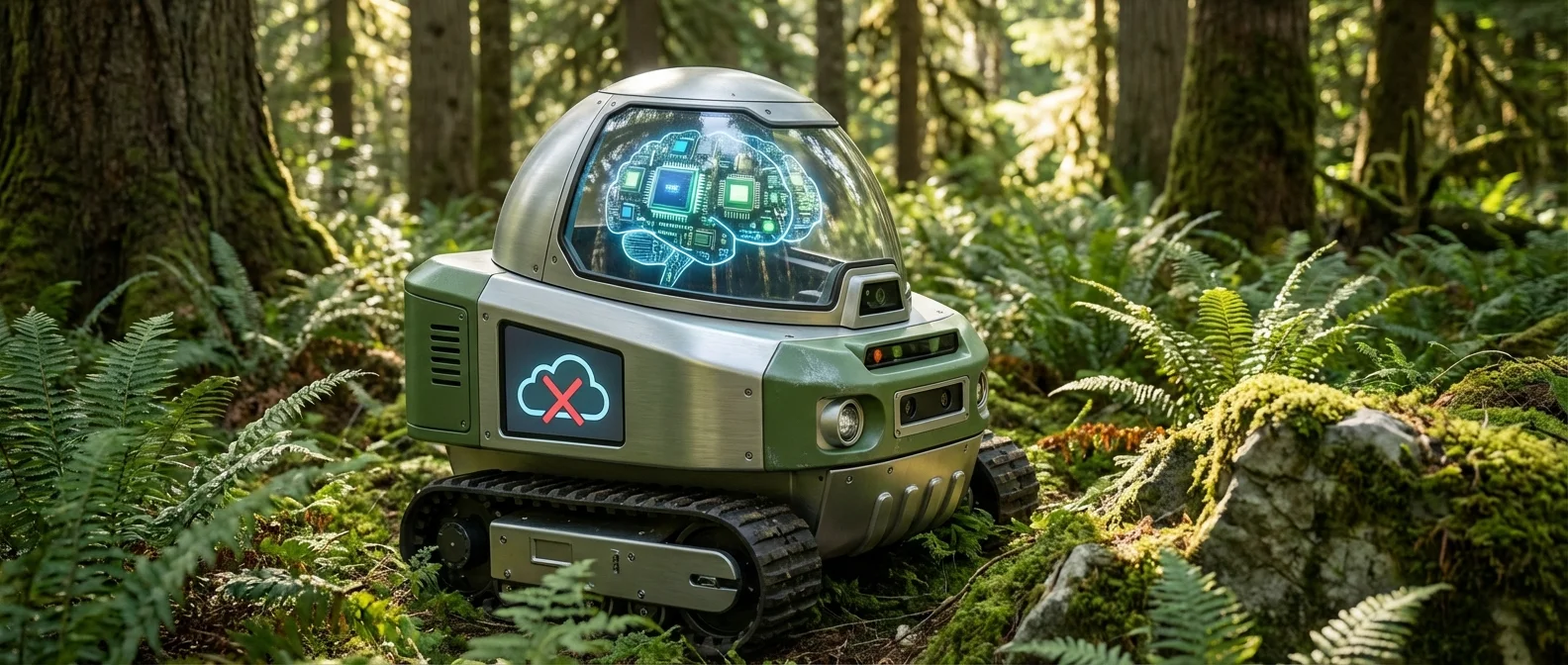
Every time a robot needs to decide whether the object ahead is a staircase or a cliff, it needs an answer in milliseconds. If that answer depends on a server in a data center thousands of miles away, the delay could prove catastrophic. This is precisely why Edge AI — running artificial intelligence locally on the device itself, without any cloud dependency — is emerging as perhaps the most critical development in modern robotics.
In this article, we explore what Edge AI means for robots in practice, which hardware platforms make it possible, why moving away from cloud dependency transforms both privacy and reliability, and how this technology will shape robotics in 2026 and beyond.
What Is Edge AI?
Edge computing means processing data near its source rather than in a centralized data center. The term has been around since the 1990s for content delivery networks, but it has gained new momentum thanks to artificial intelligence. According to Gartner, while only 10% of enterprise data was created outside the cloud in 2018, that figure was expected to reach 75% by 2025.
Edge AI — also known as “on-device AI” or “local AI” — combines this architecture with machine learning models that run directly on the device. For a robot, this means object recognition, navigation, obstacle avoidance, and decision-making all happen locally, on a chip inside the robot, without any data ever being sent to the internet.
The difference between a cloud-dependent robot and an edge AI robot isn't merely technical. It's the difference between a robot that freezes in a tunnel with no WiFi and one that keeps operating autonomously no matter what happens to the connection.
Why Robots Need Local Intelligence
Robots aren't smartphones. They operate in dynamic, uncontrolled environments — often with no stable internet connection. Autonomous drones fly over mountainous terrain with no cellular coverage. Warehouse robots move through metal buildings that block signals. Rescue robots enter buildings after earthquakes, where telecommunications infrastructure has collapsed.
In these scenarios, cloud dependency means operational failure. But even under ideal network conditions, three fundamental reasons make local processing superior:
1. Latency
A round-trip to a cloud server typically takes 50–200 ms. That sounds small, but in robotics, decisions need to happen in 5–20 ms. A surgical robot handling a scalpel cannot wait 200 ms for an instruction. A car traveling at 100 km/h covers 5.5 meters in 200 ms. Local processing eliminates this delay entirely.
2. Privacy and Security
A home robot with a camera that streams video to a cloud server creates a massive privacy problem. Who has access to the data? Where is it stored? What happens in a breach? DJI, for example, chose local storage for its new Romo robot vacuums for exactly this reason. Edge AI keeps data on the device, eliminating the risks inherent in data transmission.
3. Reliability and Autonomy
Researchers have noted that an edge computing device, such as a voice assistant, can continue serving local users even during cloud service or internet outages. The same principle applies exponentially to robots: a robot that loses its connection should never lose its ability to function.
The Hardware Making Edge AI Possible
Artificial intelligence demands enormous computing power. This requirement is traditionally why AI ran in the cloud, on GPUs costing tens of thousands of dollars. In recent years, however, purpose-built chips have made it possible to run AI models on small, low-power devices. These chips form the core of every edge AI robot.
NVIDIA Jetson: The King of Edge Robotics
NVIDIA's Jetson lineup is the world's most popular embedded AI platform. It began in 2014 with the Jetson TK1 and has evolved into an entire family:
The Jetson Nano (2019) targeted hobbyist robotics at just $99 with 0.47 TFLOPS of performance. The Jetson Orin Nano (2022–2024) raised the bar to 40 Sparse TOPS in the same compact form factor, with development kit pricing dropping to $249 after a December 2024 price cut. The Jetson AGX Orin delivers 275 Sparse TOPS at 60W — enough power for autonomous vehicles and humanoid robots.
Then in August 2025, NVIDIA released the Jetson AGX Thor: featuring a Blackwell GPU, 128 GiB of memory, and 2,070 FP4 TFLOPS, it's the most powerful “robot brain” ever shipped. NVIDIA claims it offers 7.5x more computing power and 3.5x better efficiency than the Orin generation. The price: $3,499 — a fraction of what a cloud server rack would cost.
Google Coral and Edge TPU
Google announced the Edge TPU in July 2018 and made it available to developers through its Coral product line in January 2019. It's a purpose-built ASIC designed exclusively for machine learning inference, capable of 4 trillion operations per second (4 TOPS) at just 2 watts of power consumption.
The Coral lineup includes a Dev Board (single-board computer), USB Accelerator, Mini PCIe, and M.2 cards. They run TensorFlow Lite models and are ideal for robots that need image recognition, object detection, or classification with minimal energy draw.
Intel Movidius and Qualcomm Robotics
Intel developed the Movidius Myriad X Vision Processing Units (VPUs), delivering roughly 4 TOPS at just 1 watt. They're widely used in drones, security cameras, and robotic systems through the OpenVINO framework. Qualcomm offers its Robotics RB3, RB5, and RB6 platforms, built on Snapdragon SoCs with dedicated AI engines delivering up to 15 TOPS, targeting drones, delivery robots, and autonomous vehicles.
How AI Fits on a Tiny Chip
Large AI models running in data centers can have billions of parameters. A Jetson Orin Nano, while powerful, can't run GPT-class models. The solution isn't just smaller chips — it's smaller, specialized models. Several techniques make this possible:
Quantization: Instead of using 32-bit precision numbers, models are converted to 8-bit or even 4-bit. Google's Edge TPU, for instance, exclusively accepts 8-bit models. The accuracy loss is minimal, but the reduction in size and power consumption is dramatic.
Pruning: Neurons and connections in a neural network that contribute minimally to the output are removed. This can shrink a model by 50–90% without significant performance loss.
Knowledge Distillation: A large, complex model ("teacher") trains a smaller model ("student") to replicate its behavior. The student doesn't learn from raw data but from the teacher's decisions, achieving 90–95% of the accuracy at 10% of the size.
Frameworks: Tools like TensorFlow Lite, NVIDIA TensorRT, Intel OpenVINO, ONNX Runtime, and PyTorch Mobile specialize in optimizing models for edge deployment. They automate quantization, operator fusion, and memory optimization, making the transfer of a model from cloud to edge a feasible process.
Robots Already Running on Edge AI
Edge AI isn't theoretical — it's already operating in millions of robots worldwide:
DJI's drones are perhaps the most impressive example. From the Mavic series to industrial Matrice and Agras platforms, they use on-device computer vision for obstacle avoidance, object recognition, and autonomous navigation. Even DJI's new Romo robot vacuum uses ML algorithms derived from the company's decade of experience in local image processing.
Tesla's Full Self-Driving (FSD) runs neural networks exclusively on the HW4 onboard computer inside the vehicle. It doesn't stream video to the cloud for analysis — road, sign, pedestrian, and vehicle recognition all happens locally in real time.
Boston Dynamics' Spot robots carry onboard edge AI computers that enable autonomous navigation across construction sites, factories, and hazardous environments without requiring a connection. iRobot and Roborock use on-device recognition in robot vacuums for object identification and route optimization.
In factories, robots from FANUC, ABB, and KUKA are progressively integrating Jetson-based edge AI for real-time quality control, defect detection, and predictive maintenance — cutting response times from seconds to milliseconds.
Cloud vs. Edge: It's Not Either/Or
It's important to clarify: Edge AI doesn't mean the death of the cloud. It means proper division of responsibilities. The future is hybrid — edge for real-time decisions, cloud for model training and data storage.
Think of it this way: the human brain makes decisions locally (edge), but consults libraries when deeper knowledge is needed (cloud). Nobody would wait for a phone call to a library before dodging an obstacle in the road. Similarly, a robot does obstacle avoidance locally while map updates happen when connected.
Federated Learning is a particularly promising direction: each robot trains locally on its own data, and only model updates (not raw data) are sent to a central server. This means thousands of robots can collectively improve a model without private data ever leaving the device.
The Edge AI Market: Numbers and Trends
The edge AI market is growing explosively. The number of IoT devices worldwide is expected to reach tens of billions by the end of the decade, with the majority of AI processing moving to the network's “edge.” NVIDIA sees Jetson modules as a growth pillar, Google is expanding the Coral lineup, and new players like Hailo (with AI chips delivering 26 TOPS at just 2.5W) are entering aggressively.
Meanwhile, the emergence of TinyML — machine learning on microcontrollers (MCUs) consuming less than 1 milliwatt — opens the door to AI even on battery-free sensors powered by solar energy or vibration. These developments will bring intelligence to every corner of robotics applications.
Edge AI Challenges in Robotics
The technology isn't without limitations. Edge AI models are necessarily smaller and less capable than their cloud counterparts. A Jetson Orin Nano can't run foundation models with hundreds of billions of parameters. Even the AGX Thor, at 2,070 TFLOPS, falls far short of a cloud data center.
Model updates ultimately require connectivity — new trained models need to reach the device somehow. Power consumption, while far lower than cloud, remains a challenge for small robots with limited batteries. And security for decentralized devices demands new trust models, moving away from cloud-centric architecture.
Nevertheless, the trajectory is clear: each new generation of edge chips brings exponentially more power in a smaller footprint. NVIDIA claims the Thor is 7.5x more powerful than the Orin — in just two years. If this pace continues, by 2030 an edge chip could run models that today require an entire server rack.
What This Means for the Future
The shift to Edge AI signals something deeper than a technical change. It marks the transformation of robots from “remote-controlled tools” to “autonomous entities.” A robot with Edge AI doesn't need a data center behind it. It thinks for itself. It reacts on its own. It adapts independently.
For consumers, this means home robots that aren't surveilled, drones that work everywhere, and cars that don't need 5G to drive safely. For industry, it means factories that keep running even if the internet goes down, and robots that react in milliseconds instead of seconds.
The era of “cloud-first” in robotics is ending. The era of “edge-first” is just beginning — and the chips, tools, and robots of 2026 show that the shift is now inevitable.