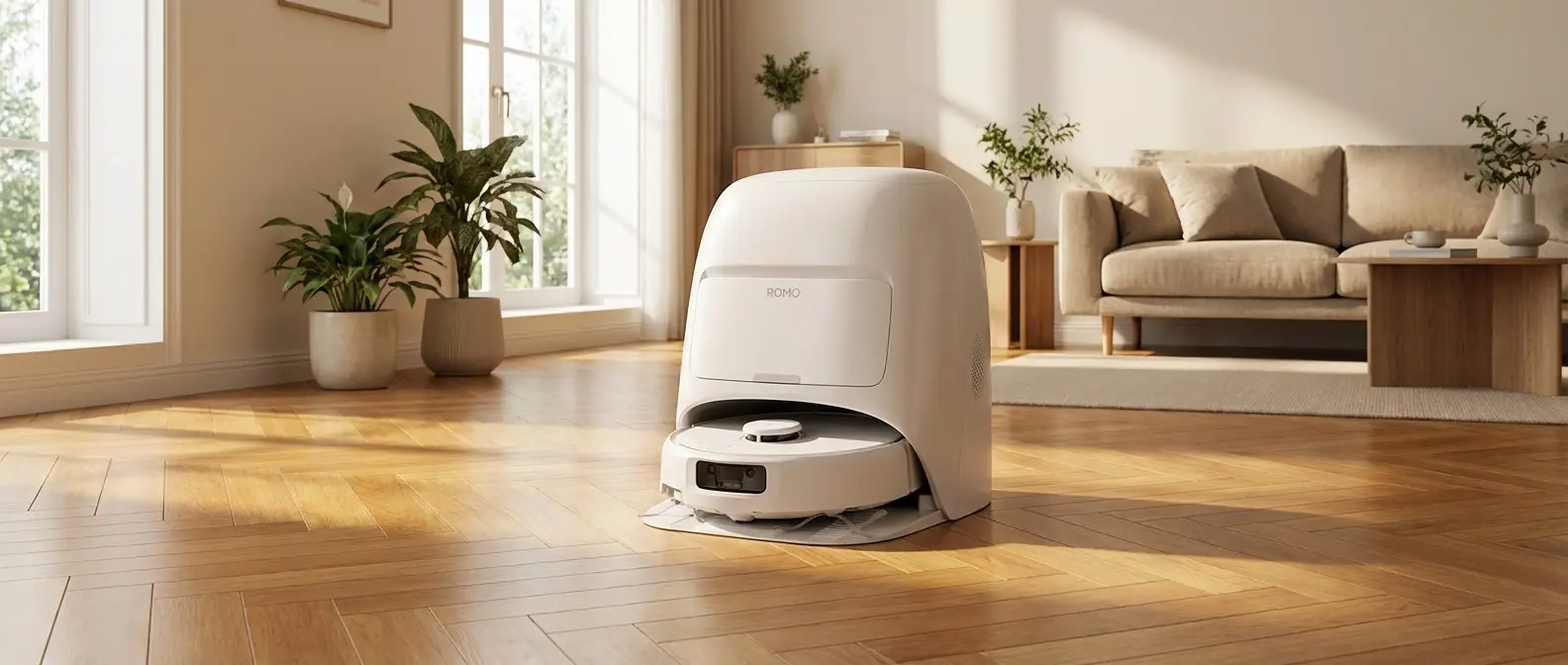
DJI — the Chinese colossus that commands over 90% of the global consumer drone market — has decided to venture into entirely new territory: robot vacuums. In August 2025, the company unveiled the DJI Romo lineup, three robot vacuum models that borrow obstacle avoidance sensors and path planning algorithms directly from its drone technology. The result? A bold entrance into a market dominated by Roborock, iRobot, and Ecovacs, complete with a head-turning design twist: a transparent shell.
📖 Read more: Top 5 Robot Vacuums 2026: Complete Buying Guide
Who Is DJI?
SZ DJI Technology was founded in 2006 by Frank Wang (汪滔) in Shenzhen, China. What started as a dormitory project at the Hong Kong University of Science and Technology grew into the world's largest consumer drone manufacturer in under two decades. Today, DJI employs roughly 14,000 people and its products — from the iconic Phantom series to the Mavic and Inspire lineups — are used by filmmakers, farmers, firefighters, and journalists across every continent.
The company's deep expertise in computer vision, obstacle avoidance, gimbal stabilization, and autonomous navigation makes the move into robot vacuums a natural evolution. DJI already had ground robotics experience through its educational RoboMaster S1 (2019) and RoboMaster EP (2020) platforms.
The DJI Romo Lineup: Three Models
The Romo series launched initially in China with three variants — they share the same cleaning platform but differ primarily in design and a few premium features:
Romo S
Opaque white housing. Full functionality with vacuuming, mopping, and auto-empty dock. The most affordable option in the lineup.
Romo A
Transparent top panel reveals the internal mechanisms. Same price and cleaning features as the Romo S.
Romo P
Fully transparent housing on BOTH the vacuum and dock. Extra compartment for alternate cleaning solutions (antibacterial for bathrooms, degreaser for kitchens).
💡 Why Transparent Design?
DJI is riding a growing trend known as the “transparent tech renaissance” — where gadgets expose their inner components as a design statement. Whether the internals will still look appealing after months of accumulated dust and grime remains an open question.
Key Specifications
| Feature | Specification |
|---|---|
| Suction Power | 25,000 Pa |
| Navigation Sensors | Binocular fisheye vision + 3 wide-angle laser sensors |
| AI Algorithm | Machine learning perception algorithm (from drone technology) |
| Obstacle Detection | Objects as thin as 2mm (cables, cards) |
| Main Brush | Dual anti-tangle roller brush |
| Side Brushes | 2 brushes on extendable robotic arms |
| Mopping | Spinning mop pads (auto-lift on carpets) |
| Dock Station | Auto-empty, mop wash, water refill — 2.5-hour full cycle |
| Voice Control | Yes — specify cleaning zones by voice |
| Security Camera | Yes — remote real-time monitoring |
| Data Storage | Local (on-device) — for privacy |
Drone Technology in a Robot Vacuum
Where DJI truly sets itself apart from the competition is in transferring genuine drone engineering into a vacuum cleaner. This isn't marketing spin — it's real technological heritage:
Obstacle avoidance: DJI's drones have used binocular vision and laser sensors for years to dodge trees, buildings, and wires. The same algorithm, adapted to floor level, can detect objects as thin as 2mm — a feat virtually no competitor can match. The vacuum also adapts its cleaning strategy to the type of obstacle: it gets close to furniture legs and chair feet but keeps a wide berth from socks or pet accidents to avoid getting stuck or spreading messes.
Path planning: The route optimization algorithms DJI developed for its drones — efficient spraying paths for its Agras agricultural drones or surveying coverage for its Matrice industrial platforms — now power the Romo's cleaning route generation.
Smart debris recognition: When the vacuum detects spilled pet food, it automatically slows its travel and brush speed (to avoid scattering smaller particles) while increasing suction. This dynamic adaptation mirrors how DJI's drones adjust flight behavior to changing wind conditions.
Local data storage: Unlike many competitors that upload floor maps to the cloud, the Romo stores all route data locally on the device. This isn't accidental — DJI has faced serious data privacy allegations in the United States, and local storage is a deliberate response to those concerns.
📖 Read more: Ecovacs vs Roborock: Which Robot Vacuum Wins in 2026?
How It Compares to the Competition
How does the DJI Romo stack up against the leading robot vacuums of 2025-2026?
| Feature | DJI Romo P | Roborock S9 MaxV | Roomba Max 705 | Ecovacs X8 Pro |
|---|---|---|---|---|
| Suction (Pa) | 25,000 | 20,000 | ~13,000 | 22,000 |
| Obstacle Detection | 2mm (laser + binocular) | AI camera + LiDAR | Camera + sensor | AI camera + 3D ToF |
| Mopping | ✅ Mop lift | ✅ Mop lift | ❌ | ✅ Mop lift |
| Extendable Brushes | ✅ | ✅ | ❌ | ✅ |
| Security Camera | ✅ | ✅ | ❌ | ✅ |
| Price (flagship) | ~$947 | ~$1,100 | ~$500 | ~$900 |
| Transparent Design | ✅ | ❌ | ❌ | ❌ |
DJI enters the market with competitive specs — particularly its 25,000 Pa suction, which exceeds every model listed above. The Roomba's lack of mopping highlights how far iRobot has fallen behind. That said, the absence of a LiDAR tower (the rotating sensor atop the unit) could mean different mapping accuracy — something only real-world testing will reveal.
Pricing and Availability
The DJI Romo lineup launched in China in August 2025 at the following prices:
- Romo S: CNY 4,699 (~$654 / ~€600)
- Romo A: CNY 4,699 (~$654 / ~€600)
- Romo P: CNY 6,799 (~$947 / ~€870)
A broader international rollout is expected during 2026, but the U.S. market remains uncertain. DJI has been on the U.S. Department of Commerce Entity List since December 2020, and in December 2025, the FCC banned the import of new DJI drone models. Whether this ban will extend to robot vacuums is unclear, but the ongoing U.S.-China geopolitical tension creates significant uncertainty.
🌍 Global Availability Outlook
Europe hasn't imposed similar sanctions on DJI, making a European launch — and by extension availability in markets like the UK and EU — highly likely in 2026. If the premium Romo P lands under €900, it would offer exceptional value against established competitors. Markets in Southeast Asia, Australia, and the Middle East are also expected to receive the Romo lineup.
Pros and Cons
✅ Pros
- 25,000 Pa suction — class-leading power
- Drone-grade obstacle avoidance (2mm detection)
- Extendable side brushes on robotic arms
- Auto-lifting mop for carpet transitions
- Local data storage (privacy-first approach)
- Built-in security camera with live feed
- Voice control with zone-specific cleaning
- Unique transparent design (Romo A & P)
- Backed by decades of AI & robotics expertise
❌ Cons
- Not available in the U.S. (geopolitical barriers)
- First product in a new category — no track record
- Transparent housing durability with regular use?
- No LiDAR tower — mapping accuracy remains untested
- Romo P approaching $1,000 price point
- App ecosystem and smart home compatibility unclear
- After-sales support outside China unproven
DJI as a Robotics Company
DJI's move into robot vacuums isn't just another product category — it's a signal of maturation. The company has already proven it can dominate a market (drones: 90%+ share), transfer technology across categories (e-bike motors, 2024), and build robust ecosystems (RoboMaster, Osmo, Agras).
The real question isn't whether DJI can build a competent robot vacuum — it clearly can. The question is whether it can dethrone established players like Roborock, Ecovacs, and Dreame who have years of category-specific experience. History suggests that when DJI decides to enter a market, it doesn't settle for second place.
Is It Worth the Wait?
If you need a robot vacuum right now, the Roborock S9 MaxV, Ecovacs X8 Pro Omni, or Dreame X50 Ultra are reliable choices with proven track records. However, if DJI launches the Romo internationally in 2026 at competitive pricing, it deserves serious consideration — especially if its obstacle avoidance proves as impressive in practice as it looks on the spec sheet.
The robot vacuum of 2026 is no longer just a gadget that sweeps your floor. It's an autonomous robotic assistant with AI perception, dynamic decision-making, and drone-grade path planning. DJI may be arriving late to this market, but it comes armed with decades of expertise in the most demanding field of autonomous navigation. And in a market hungry for the next disruptor, that might be enough.