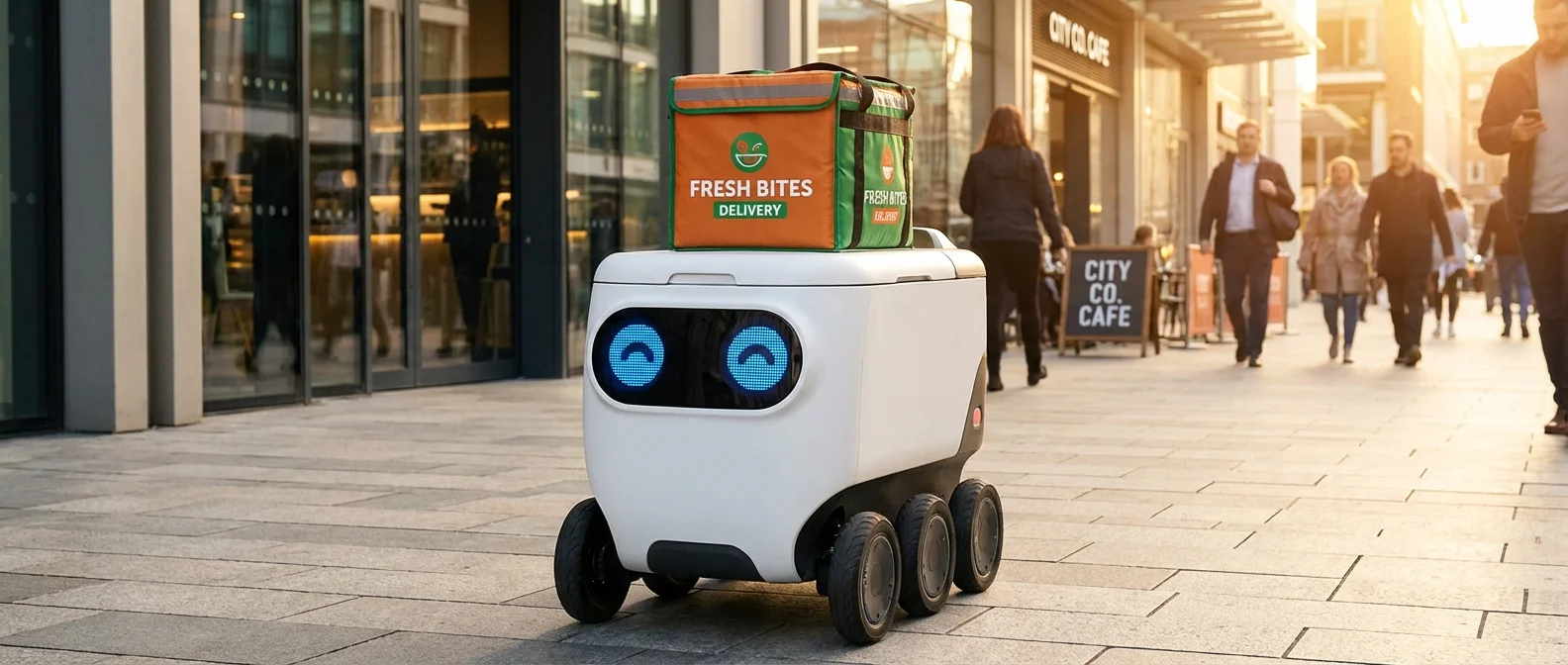
A small six-wheeled robot rolls silently along a university sidewalk in Virginia. No engine, no driver. It reaches a student's door, he unlocks the lid through an app, grabs his burrito, and the robot heads back to the restaurant on its own. This scene plays out millions of times a year — Starship Technologies alone has completed 9 million autonomous deliveries across 7 countries, with 2,700 robots on the streets. The era of robotic delivery isn't coming — it's already here.
📖 Read more: Amazon Warehouse Robots: Are They Replacing Workers?
🤖 What Are Delivery Robots?
Delivery robots are autonomous ground-based machines that handle “last mile” deliveries — transporting goods from a store or warehouse directly to the customer's door. They travel primarily on sidewalks at pedestrian speeds (3-6 mph in most cases), relying on a combination of sensors: stereoscopic cameras, time-of-flight cameras, LiDAR, radar, ultrasonic sensors, GPS/GNSS, and inertial measurement units (IMU). When autonomous navigation fails, a remote operator takes over via a 4G/5G connection.
The concept isn't new: Dispatch (later acquired by Amazon) and Starship Technologies launched pilot programs as early as 2016. But the COVID-19 pandemic obliterated every hesitation — delivery demand spiked, staffing shortages worsened, and robots suddenly had a real reason to be on the streets.
🇪🇪 Starship Technologies: The Pioneer
Starship Technologies was founded on June 11, 2014 in Tallinn, Estonia, by Janus Friis and Ahti Heinla — both co-founders of Skype. The idea was born after they competed in a NASA Centennial Challenge, where they designed autonomous robots for geological sample collection. They decided to apply the same technology to the last-mile delivery problem.
Today, Starship is the undisputed market leader. Key figures (October 2025): 9 million autonomous deliveries, 19 million kilometers (12 million miles) of autonomous driving, 2,700 robots in operation across 270 locations in 7 countries (US, UK, Germany, Estonia, Finland). The company raised $50 million in Series C funding (October 2025), bringing total equity funding to ~$280 million, plus €50 million in long-term loans from the EIB.
Starship's robots are electric, six-wheeled, weigh 25 kg (empty), and carry up to 9 kg of cargo. They move at pedestrian speed (6 km/h), with an 18-hour battery life and a range of ~40 km per day. They're equipped with 10 stereoscopic and time-of-flight cameras, ultrasonic sensors, radar, GPS, and IMU. They even have loudspeakers for communicating with pedestrians — complete with selectable voice characters and music playback. Customers unlock deliveries via biometric verification in the app.
Starship found its sweet spot on university campuses: in January 2019, it launched at George Mason University (Virginia) in partnership with Sodexo — the largest robot delivery fleet at any university at the time. It expanded to 9+ campuses by 2020. In the UK, grocery deliveries in Milton Keynes (partnering with Co-op and Tesco since April 2018) created “the world's largest autonomous robot fleet” (November 2020). A 2018-2021 study in Milton Keynes showed that the robots prevented 280,000 car trips, saving 137 tonnes of CO₂.
🦾 Serve Robotics: From Postmates to NASDAQ
Serve Robotics started life as Postmates X, the robotics division of Postmates. When Uber acquired Postmates in 2020 for $2.65 billion, the robotics team spun off as an independent company in March 2021. Co-founders: Ali Kashani (CEO, 15 patents), MJ Chun, Dmitry Demeshchuk. Serve went public on NASDAQ (SERV) in April 2024 — debuting at $4/share, with Uber holding ~16.6% and NVIDIA ~14.3%.
The numbers are eye-catching: by January 2025, Serve had raised over $247 million in just 12 months, with $183M+ cash on hand (June 2025). But revenue? Just $207,545 (2023) — a sign the company is still fighting for scale. It operates ~100 robots in Los Angeles (serving ~300 restaurants via Uber Eats and 7-Eleven), targeting 2,000 robots across multiple cities by the end of 2025.
Technically, Serve's robots offer Level 4 autonomy: they operate independently within defined boundaries but rely on remote operators at intersections or unexpected situations. Cargo capacity of ~50 liters, top speed of 18 km/h, zero CO₂ emissions. An interesting revenue twist: advertising on the robots can generate 25-50% of per-unit revenue, according to CEO Ali Kashani. In October 2025, Serve announced a multi-year partnership with DoorDash for deliveries in LA and across the US.
🟡 Coco: Robots with a Human Pilot
Coco (Coco Robotics) stands apart from the competition with one crucial distinction: its robots aren't autonomous — they're remotely operated by humans. Founded by Zach Rash (CEO) and Brad Squicciarini (CTO), both UCLA students. The philosophy: instead of waiting for perfect AI autonomy, put a human operator behind every robot remotely — cheaper than a delivery driver, safer than full autonomy.
Numbers (per cocodelivery.com): 1,000 robots produced, 500,000+ successful deliveries, 1 million+ miles traveled, 3,000 merchant partners. Operating in Los Angeles, Miami, Chicago, and — surprisingly — Helsinki, Finland (international expansion). Partners include DoorDash and Uber Eats. Among investors: Sam Altman (CEO of OpenAI). Total funding estimated at ~$55-60 million.
📖 Read more: Robots in Greece: Where They're Already at Work in 2026
🥝 Kiwibot: The Colombian Alternative
Kiwibot was founded in 2016 in Bogotá, Colombia, by Felipe Chávez (CEO) — who started as a courier service in Colombia in 2015. It incubated at UC Berkeley's SkyDeck, rolling out prototypes on campus in March 2017. By May 2018, it had completed 10,000+ orders.
However, Kiwibot ran into controversy. In December 2018, a robot caught fire near the Berkeley Student Union due to a defective battery. More significantly, it emerged that the supposedly “autonomous” bots were actually being controlled by operators in Medellín, Colombia — paid ~$2/hour, intervening every 5-10 seconds. The “autonomous” robot was essentially semi-autonomous with constant human oversight.
Despite these issues, the company is growing: by 2024 it delivers across 30+ universities in the US and expanded to UBC Vancouver in September 2025. Its robots feature 6 cameras with binocular vision, digitally animated eyes (to encourage positive pedestrian reactions), and AI machine learning algorithms. They're manufactured in China and assembled in Berkeley.
🚀 Nuro: The Road Colossus
Nuro doesn't resemble other delivery robots — because it doesn't travel on sidewalks. It's a self-driving vehicle with no passenger seat, roughly the size of a small car, that operates on public roads. Founded in September 2016 by two former Waymo (Google) engineers: Jiajun Zhu and Dave Ferguson. Valued at $6 billion (August 2025) — one of the highest-valued robotics startups in the world.
The story begins in January 2018 with the R1 — an electric self-driving van half the width of a sedan, weighing 680 kg, with room for 12 grocery bags. Kroger (the second-largest US supermarket chain) was the first customer, with trials in Scottsdale, Arizona (August 2018). Then came: SoftBank investing $940 million (February 2019, $2.7B valuation), partnerships with Domino's Pizza, CVS, 7-Eleven, and Uber (10-year deal, September 2022).
But the path wasn't straight. In November 2022, Nuro laid off 20% of staff (~300 people), and in May 2023 another 30% (~340 people), halting commercial expansion. In September 2024, Nuro announced a radical pivot: licensing its “Nuro Driver” — a Level 4 autonomous driving system — to automakers. In July 2025, it announced a partnership with Uber and Lucid Motors for a fleet of 20,000 robotaxis by 2031, with the first vehicles expected in 2026.
📦 Amazon Scout: When a Giant Falls
If anyone wonders whether delivery robots are easy, the story of Amazon Scout is the best answer. Amazon launched its small blue six-wheeled robots in January 2019 in Snohomish County, Washington, with just 6 units. It expanded to Irvine, California (August 2019), Atlanta, and Franklin, Tennessee (November 2020).
But in October 2022, Amazon ended field tests and disbanded the team (~400 employees worldwide). In January 2023, Scout was officially cancelled. Why? Multiple reasons: the robots required a human companion ("Amazon Scout Ambassador") on every mission — negating the cost advantage. They only operated Monday through Friday, during daylight hours only. The technology wasn't reliable enough for real-world conditions (sidewalks, slopes, obstacles). Ultimately, Amazon admitted: “There were aspects of the program that weren't meeting customers' needs.” The failure proves that even the world's richest tech company can't solve this problem with money alone.
⚔️ Delivery Robot Companies Compared — 2026
| Company | Founded | Deliveries | Fleet | Autonomy | Funding |
|---|---|---|---|---|---|
| Starship Technologies | 2014, Estonia | 9M+ | 2,700 | Semi-autonomous + remote | ~$280M equity |
| Serve Robotics | 2021 (Postmates X spin-off) | Not public | ~100 (target 2K) | Level 4 | $247M+ (12 months) |
| Coco | UCLA, LA | 500K+ | 1,000 | Human-piloted | ~$55-60M |
| Kiwibot | 2016, Colombia | Tens of thousands | 30+ campuses | Semi-autonomous | ~$12-15M |
| Nuro | 2016, Waymo spin | Pilot-only | Pivoted to Nuro Driver | Level 4 (road) | $6B valuation |
| Amazon Scout | 2019 | — | Cancelled (2023) | — | — |
📋 Regulation: Who Lets Robots on the Sidewalk?
The legal landscape for delivery robots — known as PDDs (Personal Delivery Devices) — is fragmented. In the United States, there is no federal standard: each state regulates independently. Virginia was the first state to pass PDD legislation (2017), allowing robots up to 50 pounds (empty) on sidewalks. Idaho, Wisconsin, Ohio, Florida, and Arizona followed (2017-2018), then Pennsylvania, Texas, Washington, and Utah (2019-2020). By 2024, over 20 states have PDD legislation in place.
Common rules: weight limits of 80-120 pounds loaded, speed of 10-12 mph on sidewalks (some states allow 20 mph on road shoulders), mandatory remote control capability, insurance, and pedestrian priority: robots are treated as pedestrians in most legislation. California passed a comprehensive framework (AB 1079, 2024). Notably, San Francisco initially voted to restrict robots on sidewalks (2017) but later revised its position.
📖 Read more: Figure AI 03: A Humanoid Robot with an AI Brain
🌱 Environmental Impact
One of the strongest arguments in favor of delivery robots is their environmental footprint. Electric and weighing just 25-50 kg, they consume 0.02-0.05 kWh/km — compared to 0.2-0.3 kWh/km for electric vans or far more for diesel. Serve Robotics claims ~0 g CO₂/km emissions. The Milton Keynes study (Starship, 2018-2021) documented: 280,000 car trips prevented, 500,000+ miles of car travel saved, 137 tonnes of CO₂ and 22 kg of NOx avoided.
A delivery robot has roughly ~3,000 times less kinetic energy than a car — considerably reducing the risk to pedestrians. If robotic delivery replaces even a fraction of delivery vans, global emissions could drop by ~2% annually, according to Serve Robotics estimates.
🤝 Humans vs. Robots: The Social Dimension
The interaction between humans and delivery robots turns out to be more nuanced than anyone expected. The vast majority of reactions are positive: people anthropomorphize the robots because of their appearance, pet them, help them when they get stuck, worry about them, even thank them for delivering. Kiwibot added digitally animated eyes to its robots for precisely this reason.
But there's a darker side too. Starship reports that people kick their robots. Technology journalist Paris Marx, in the book Road to Nowhere (2022), criticizes sidewalk usage: "there were instances of robots causing problems for people with disabilities." Wheelchair users face obstacles on narrow sidewalks, and blind pedestrians cannot detect the silent machines. In September 2022, a Serve robot was directed through an active crime scene (under police tape) by its remote operators — an incident that sparked outrage.
The Major Challenges
- Real-world navigation: Broken sidewalks, access ramps, construction sites, parked vehicles — city streets are nothing like a laboratory
- Weather conditions: Rain, snow, ice, extreme heat — robots struggle in harsh conditions
- Intersections: The biggest challenge — detecting traffic signals, safe crossing. Kiwibot initially required human takeover at every crosswalk
- Vandalism & theft: Kicking, tampering, interference — robots can't defend themselves
- Regulatory patchwork: 50 states, 50 sets of laws — no federal standard in the US
- Business model: Amazon proved that even with unlimited capital, autonomous delivery isn't automatically profitable
🇬🇷 Delivery Robots in Greece?
Short answer: they don't exist — at least not as of February 2026. The Greek delivery market is dominated by efood (Delivery Hero), Wolt (DoorDash), and Box. All deliveries are handled by human couriers, primarily on motorcycles and scooters — a product of Athens' urban topology (narrow sidewalks, hills, complex layout) and other cities.
There's no Greek PDD legislation, no pilot programs, and no domestic delivery robot companies. The closest European deployments are in the UK (Starship in 7+ cities), Estonia (Starship in Tallinn), Germany (Hamburg), and Finland (Starship + Coco in Helsinki). Greece, with its narrow sidewalks and Mediterranean culture of personal service, remains one of the last European markets likely to see robots on the pavement — if it ever does.
🔮 2026-2030: What's Next
The global delivery robot market is expected to reach $8-12 billion by 2030 (CAGR ~25-30%). The driving forces: delivery labor shortages, surging e-commerce, urbanization, and demand for zero-emission logistics.
Starship's model (sidewalks, slow speed, university campuses as controlled environments) appears to be winning. But advances in AI are changing everything: Level 4 autonomy will gradually eliminate remote operators, dramatically reducing per-delivery costs. Nuro points to an entirely different future — roads instead of sidewalks, robotaxis instead of delivery. And Coco proves you don't need perfect AI: you just need sufficiently cheap human operators.
One thing is certain: the sight of small robots quietly rolling along city sidewalks will become increasingly familiar worldwide. If that means fewer delivery vehicles, less CO₂, and hot food at your door in 20 minutes with no human intervention — perhaps it's worth sharing a bit of sidewalk space.