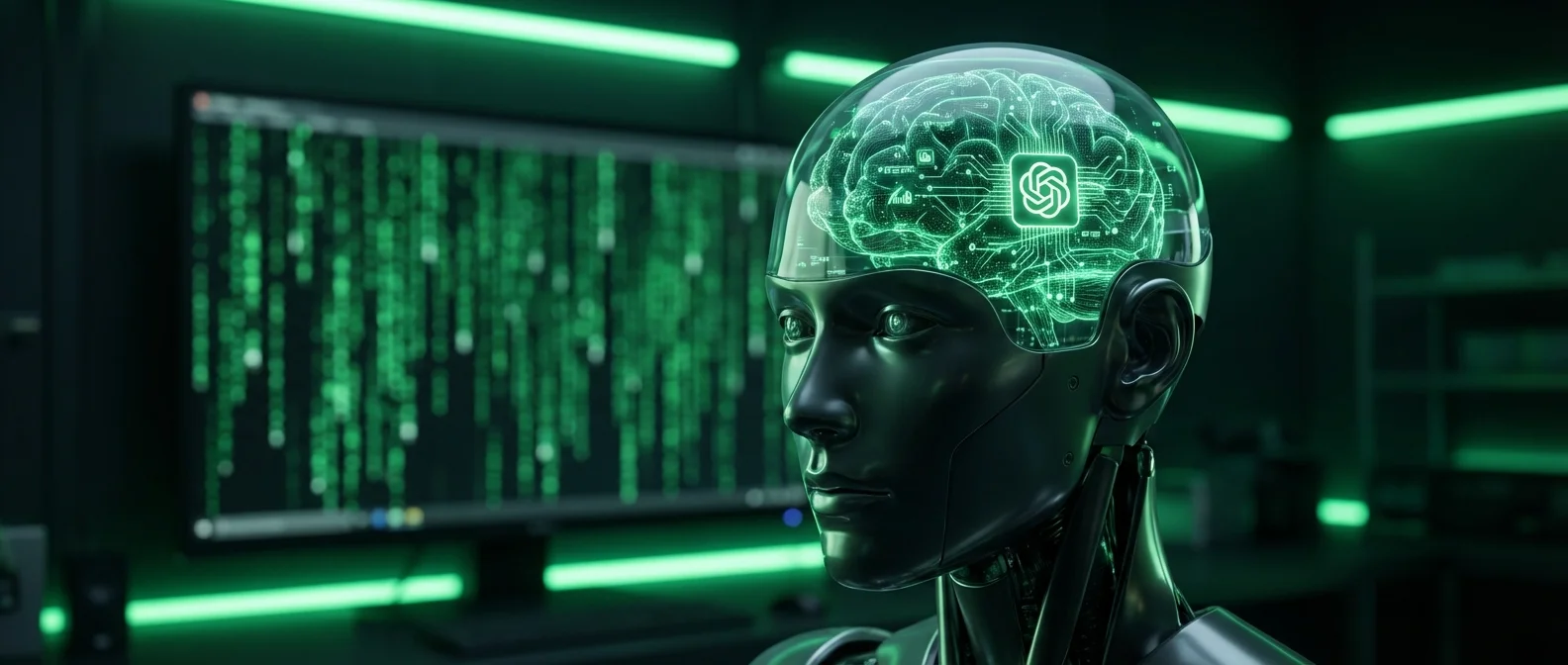
Robots no longer need thousands of lines of code for every command. Thanks to Large Language Models — with ChatGPT leading the way — a simple sentence in plain language is now enough: "Pick up the trash and throw it in the bin." This technological shift is turning LLMs into the “brain” of robots, ushering robotics into the age of general-purpose artificial intelligence.
What Does “AI Brain” Mean for Robots?
In traditional robotics, every movement is pre-programmed. An industrial robotic arm knows exactly where to move because an engineer wrote specific code for that task. If it encounters an unexpected situation — an object out of place, an obstacle in its path — the robot stops or fails entirely.
Large Language Models fundamentally change this paradigm. Instead of thousands of if-then rules, an LLM understands natural language, recognizes intent, plans action steps, and generates executable code in real time. In essence, the robot gains something resembling “thought” — the ability to handle novel situations without explicit programming.
Microsoft: The ChatGPT for Robotics Breakthrough
In February 2023, Microsoft published a groundbreaking research paper titled "ChatGPT for Robotics," demonstrating something remarkable: a language model could translate human commands into robot control code — without any robotics-specific training whatsoever.
The process works in three steps: the user issues a natural language command (e.g., "Fly the drone over the fence"), ChatGPT analyzes the intent and generates Python code, and the code executes directly on the robot. Microsoft tested this approach on drones, robotic arms, and mobile robots with impressive results across the board.
OpenAI took this concept into practice through its partnership with Figure AI. The Figure 02, a 168 cm humanoid robot, integrated OpenAI's language models, enabling genuine conversational interaction: the user speaks, the robot understands and acts. Notably, OpenAI had shut down its robotics division in 2021, only to return forcefully through this collaboration — a testament to how rapidly the field is evolving.
"The goal is for robots to understand the world through language, just like humans do. Natural language becomes the bridge between human intent and robotic action." — Microsoft Research, ChatGPT for Robotics, 2023
Google: The Pioneer of Embodied AI
Google was the trailblazer in connecting language models to robots. In 2022, the research team unveiled SayCan, a system that combines an LLM's reasoning ("what should happen") with a robot's physical capabilities ("what can happen"). The LLM proposes a step-by-step action plan, and the robot scores each step based on feasibility — preventing unrealistic suggestions from ever reaching execution.
That same year, Google DeepMind introduced Code as Policies, an innovative approach where an LLM writes executable Python code directly for robot actions. Natural language transforms into a program, and the program executes immediately — with no human intervention in the code itself.
In March 2023, Google published PaLM-E (Embodied), a multimodal model combining PaLM (540 billion parameters) with a Vision Transformer. PaLM-E “sees” through cameras, understands natural language, and produces robot actions — all without separate training. According to the paper by Danny Driess et al., it was literally a “generalist robot brain that accepts commands” in natural language.
In June 2023, DeepMind unveiled RoboCat, an AI model that controls robotic arms and autonomously adapts to new robot types and tasks — learning from just a handful of examples. Then in March 2025, Google DeepMind launched Gemini Robotics and Gemini Robotics-ER, new AI models designed specifically for controlling robots in the physical world, followed by an upgraded Gemini Robotics 1.5 in September 2025.
Google AI Robotics Timeline
NVIDIA, Anthropic & The New Guard
NVIDIA unveiled Project GR00T (Generalist Robot 00 Technology) at GTC 2024, a foundation model built specifically for humanoid robots. GR00T accepts text, video, and human demonstrations as input, and generates robot actions in real time. NVIDIA is already partnering with leading robotics companies — 1X, Agility Robotics, Apptronik, Boston Dynamics, Figure AI, and Fourier — building an entire ecosystem of AI-powered robots.
Anthropic, the creator of Claude, delivered a striking demonstration: Claude controlling a quadruped Boston Dynamics Spot robot. Through natural language, Claude planned tasks and guided the robot step by step — proving that LLMs aren't limited to chatbots but can operate in the physical world.
Worth mentioning is DeepMind's Gato (May 2022), a versatile multimodal model trained on 604 different tasks — from playing games and holding conversations to stacking objects with a robotic arm. On 450 of those tasks, Gato outperformed human experts at least 50% of the time.
How It Works: Perception → Reasoning → Action
An AI-powered robot brain operates in three phases:
One particularly fascinating approach is Google's "Inner Monologue" (2022), where the robot narrates its own thinking: "I see a cup on the table. I'll pick it up. The cup looks heavy, I'll use a stronger grip." This creates a feedback loop between linguistic reasoning and physical action, significantly improving decision-making in complex situations.
Challenges & Risks
The biggest concern is hallucinations. An LLM that “imagines” an answer in a chatbot is merely annoying. An LLM that “imagines” a movement in an industrial robot could injure people or destroy equipment worth millions. Transferring hallucinations to the physical world creates risks unprecedented in the field of AI.
Latency poses a critical technical challenge. Current LLMs need tens of milliseconds or even full seconds to generate a response. For a robot moving in real time — inside a factory, near humans — every millisecond counts. Developing edge AI models that run locally on the robot, rather than on cloud servers, is essential.
Finally, safety and liability remain open questions. Who is responsible if a robot with an LLM brain causes harm? The manufacturer, the AI company, or the user who gave the ambiguous command? Certifying an AI system that, by definition, isn't 100% predictable presents a regulatory challenge without precedent.
The Future: 2026 and Beyond
The convergence of Large Language Models and robotics has only just begun — but it's accelerating exponentially. From Google's SayCan (2022) to Gemini Robotics 1.5 (2025), only three years have passed. With Google, Microsoft, NVIDIA, OpenAI, and Anthropic all investing heavily in the space, we're at an inflection point: robots are genuinely starting to “understand.”
The coming years will bring multimodal models running entirely on-device (edge AI), eliminating cloud dependency. We'll see unified Foundation Models for robotics — a single “brain” that adapts to any robot body, from humanoids to industrial arms.
🔑 Key Takeaways
- LLMs are fundamentally transforming robot control — from code to natural language
- Google, Microsoft, NVIDIA, OpenAI, Anthropic: every tech giant is in the same arena
- PaLM-E (2023) was a watershed moment: vision + language + robot control in one model
- Gemini Robotics (2025) brings the AI brain to commercial robots
- Greatest obstacles: hallucinations, latency, safety — demanding innovative solutions
- The LLM + robotics convergence will redefine what “smart machine” truly means
The question is no longer whether robots will gain AI brains, but how quickly. At a pace where every month brings a new breakthrough, the era when we'll speak to robots the way we speak to colleagues isn't far off. And that changes everything — from factory floors to our living rooms.