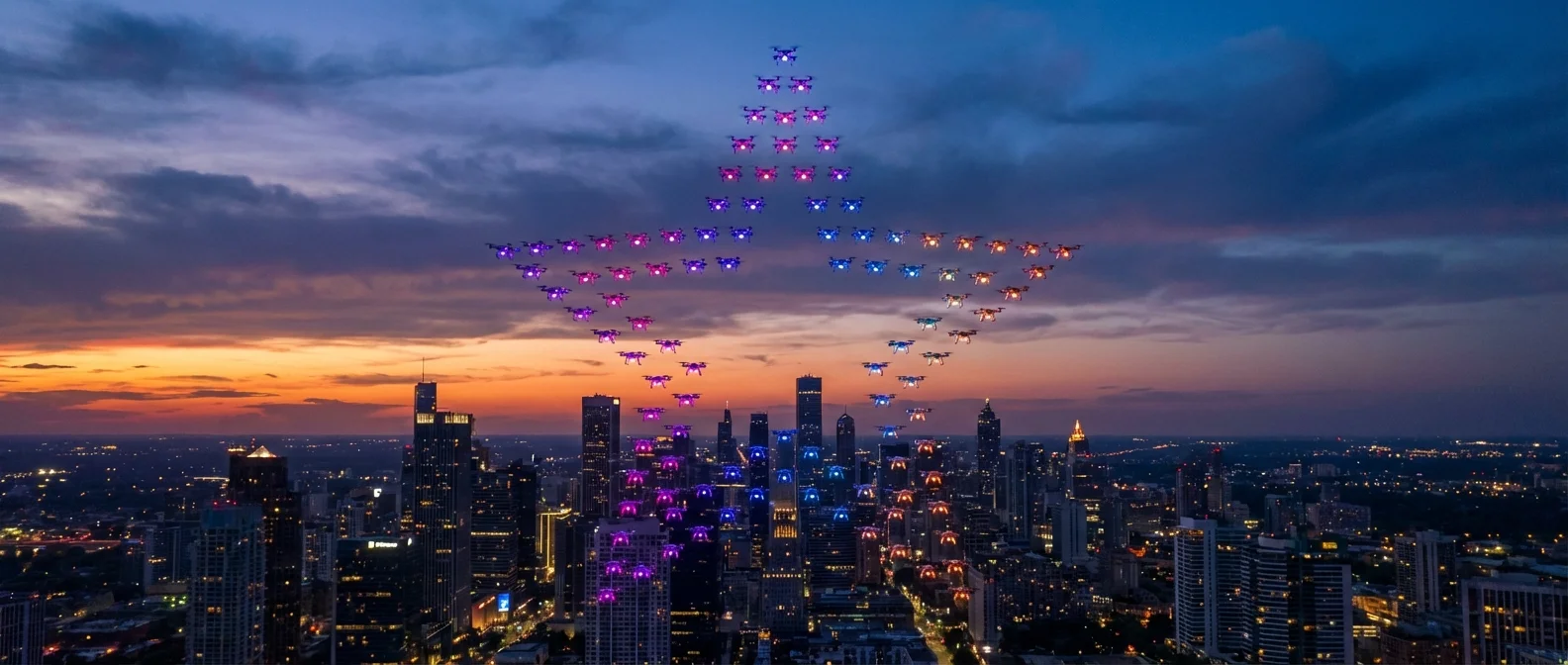
A small pilotless aircraft launches from a catapult at 108 km/h, flies autonomously over mountains and forests, and drops blood packages at a rural hospital in Rwanda — cutting delivery time by 61%. In a field in China, a 100-liter drone sprays pesticides with AI precision, replacing entire work crews. On the battlefield in Ukraine, a $500 FPV drone destroys an armored vehicle worth millions. Autonomous drones are no longer gadgets — they are a technology fundamentally reshaping agriculture, logistics, warfare, and even the way food reaches your doorstep.
🛸 What Are Autonomous Drones?
The term UAV (Unmanned Aerial Vehicle) describes any aircraft without a pilot in the cockpit. Drones can be remotely piloted or fly fully autonomously — following GPS waypoints, avoiding obstacles with AI, and completing missions without any human intervention.
Autonomy is classified into levels: from Level 1 (remote-controlled) to Level 4 (full autonomy without supervision). Zipline's delivery drones already operate at Level 4 — they fly, deliver, and return entirely on their own. Key autonomy components include GPS/GNSS navigation, IMU (Inertial Measurement Unit) with 9-11 degrees of freedom, LiDAR or stereoscopic cameras for obstacle avoidance, and AI machine learning algorithms.
Since 2024, 5G technology has been opening new horizons: the 5G specification guarantees latency of just 1ms (ultra-reliable low-latency communications), enabling real-time drone control from vast distances.
🏭 DJI: King of the Sky
DJI (Dà-Jiāng Innovations) was founded on January 18, 2006 in Shenzhen, China, by Frank Wang. From a small startup operating out of a house, it evolved into the undisputed ruler of the drone market — holding 80-90% of the global consumer drone market share (2025, according to CSIS and the Telegraph). Its revenue reached $3.83 billion (2021) with 14,000 employees.
The DJI Phantom (2013, $629) was the drone that created the mass market — “the iPhone of drones.” By 2017, DJI alone held 75% of the market. The latest flagship, the DJI Mavic 4 Pro (May 2025), features a 100 MP Hasselblad 4/3″ sensor, a 360° “Infinity” gimbal, omnidirectional obstacle avoidance, and a flight time of 51 minutes — numbers that would have been unthinkable just a few years ago.
⚔️ Top Drone Manufacturers Compared — 2026
| Manufacturer | Country | Market Share | Focus | Top Model |
|---|---|---|---|---|
| DJI | China | 80-90% | Consumer / Commercial | Mavic 4 Pro |
| Skydio | USA | ~4% (pre-exit) | Military / Enterprise | X10 |
| Autel Robotics | China | ~5% | Consumer / Enterprise | EVO Max 4T |
| Parrot | France | ~3% | Military / Enterprise | ANAFI AI |
| Zipline | USA | Delivery Leader | Delivery / Logistics | Platform 2 |
However, DJI faces intense pressure in the United States. It was placed on the Entity List (December 2020), added to the Pentagon's “Chinese military companies” list (October 2022), and in January 2025 the FCC banned approval of new DJI models. In addition, the Countering CCP Drones Act passed the House in September 2024 (pending in the Senate). Ironically, an independent 2024 analysis (FTI Consulting) found that all DJI data transmissions remained within the United States.
🇺🇸 Skydio: The American Challenger
Skydio, founded in 2014 in Silicon Valley by three MIT graduates (Adam Bry, Abe Bachrach, Matt Donahoe), is the largest American drone company. It is valued at $2.2 billion (Series E, February 2023) with revenue of $100 million (2023).
The flagship Skydio X10 (September 2023) is designed for military and enterprise use: a 64 MP narrow camera, 48 MP zoom (reads license plates at 800 feet), a FLIR 640×512 thermal camera, NVIDIA Jetson Orin processor, NightSense AI, IP55 water resistance, and 5G connectivity.
Skydio exited the consumer market in August 2023, focusing exclusively on defense: 22,000 Skydio drones are in service with the US military (September 2024). Clients include the US DoD, UK MOD, IDF, Indian Armed Forces, Royal Canadian Navy, and Ukraine. China sanctioned Skydio in October 2024 for supplying drones to Ukraine.
📦 Drone Delivery: From Rwanda to New York
The drone delivery market is transforming at breakneck speed. Three companies are leading the way:
Zipline
Founded in 2014 in San Francisco. Over 1 million commercial deliveries and 70+ million autonomous miles (April 2024). Operations span Rwanda, Ghana, the US, Japan, Kenya, Ivory Coast, and Nigeria. Platform 1 (fixed-wing) flies at 101 km/h, carries 1.8 kg, and launches from a catapult at 108 km/h in 0.33 seconds. In Rwanda, it cut blood delivery time by 61% and reduced blood unit expiration by 67%. Platform 2 (VTOL, March 2023) lowers packages by tether via a mini-drone with 1-meter precision.
Amazon Prime Air
Announced by Jeff Bezos in December 2013 on 60 Minutes. Operates in College Station, TX and West Valley Phoenix, AZ (November 2024, 50,000+ products). Delivery cost: $484/delivery (2022), target $63 by 2025 — versus ~$3.50 for ground shipping. Drone cost: $146,000/unit. Carries up to 2.26 kg at 80 km/h. The Lockeford, CA service ended in April 2024.
Google Wing (Alphabet)
Alphabet subsidiary with first test deliveries in 2014. The first drone delivery company to receive an air carrier certificate from the FAA (April 2019). Operates in Australia, the US (Virginia), Finland, and Ireland. Completed 50,000+ deliveries in Q1 2022. Faced criticism over noise (described as chainsaw-like by residents) — withdrew from Canberra in August 2023.
🌾 Agricultural Drones: The Quiet Revolution
Agricultural drone use began far earlier than most people realize — in Japan, in 1986, for rice paddy management. Today, agricultural drones represent a multi-billion-dollar market.
The DJI Agras series dominates: the Agras T50 features a 40-liter spray tank plus an optional 75-liter fertilizer spreader (50 kg), phased array radar, BeiDou/GPS/GLONASS/Galileo navigation, and IP67 water resistance. The newest models, the T70 and T100 (November 2024, China only), reach 70 and 100 liters respectively, with AI-powered flight algorithms. The series starts at $15,000.
Drone Applications in Precision Agriculture
- Multispectral imaging: NDVI cameras detect crop stress invisible to the naked eye
- Precision spraying: Variable-rate systems reduce pesticide use by up to 90% in targeted areas
- Crop mapping: 3D terrain models, orthomosaics, digital surface models
- Plant counting: AI identifies individual plants/trees and monitors growth
- Seed dispersal: Reforestation — drones sow 100,000+ seeds/day in hard-to-reach terrain
Beyond agriculture, Agras drones have been deployed in entirely unexpected applications: Spain used them for COVID-19 disinfection, Zanzibar employed them in a 2019 malaria eradication program, and during the Russia-Ukraine war they were modified for bomb drops (IDF) and machine gun mounting (PKM).
⚔️ Drones & Warfare: The Ukrainian Revolution
The Russia-Ukraine war (since 2022) is widely described as the first war involving mass deployment of commercial drones. Cheap FPV drones (First-Person View) costing just a few hundred dollars, modified with explosives and sensors, have replaced vastly more expensive munitions. The cost-effectiveness is staggering: a $500 FPV drone can destroy an armored vehicle worth millions.
Ukraine purchased 4,000 DJI drones (October 2023) with plans for 20,000 by May 2024. Russia deployed hundreds of Iranian-made Shahed-136 kamikaze drones. Turkey exported $1.8 billion worth of drones in 2024 (Baykar Bayraktar TB2), establishing drones as a central weapon of modern warfare.
The global military drone market is estimated at $12.5 billion (2024) and is expected to nearly double to $20 billion by 2034 (CAGR 4.8%). Leading military drone manufacturers include Baykar (Turkey), General Atomics (USA), Elbit Systems (Israel), and CASC (China). The US Air Force operated 7,494 UAVs (2012) — nearly 1 in every 3 of its aircraft.
🚁 eVTOL & Urban Air Mobility: Flying Taxis
The evolution of drones has led to something unprecedented: flying taxis for passengers. Three companies are leading the charge:
🚀 eVTOL Comparison — 2026
| Company | Aircraft | Speed | Range | Passengers | Status |
|---|---|---|---|---|---|
| Joby Aviation | S4 | 322 km/h | 241 km | 4 + pilot | FAA Part 135 ✅ |
| EHang | EH216-S | 130 km/h | 35 km | 2 | Pilotless! ✅ |
| Archer Aviation | Midnight | 240 km/h | 161 km | 4 + pilot | FAA Part 135 ✅ |
Joby Aviation (NYSE: JOBY) flew 249 km on a single charge (August 2021), broke the speed record at 330 km/h (January 2022), and achieved a 903 km hydrogen-powered flight (June 2024). Toyota invested $590 million, Delta $60M. Joby delivered the first eVTOL to a military base at Edwards AFB (September 2023, $131M USAF contract) and completed the first eVTOL flight in New York City (November 2023).
China's EHang (NASDAQ: EH) achieved something historic: in March 2025, the EH216-S was approved for commercial pilotless flights — the world's first autonomous passenger aircraft. Archer Aviation (NYSE: ACHR) secured an order for 200 aircraft from United Airlines, FAA Part 135 certification (June 2024), and completed 400+ test flights in 2024.
📋 Regulations & Legal Frameworks
The rapid expansion of drones has forced regulators worldwide to establish clear frameworks:
United States — FAA
Part 107 (August 2016): Commercial use up to 25 kg, max altitude 120 m, speed 160 km/h, pilot certification age 16+. Remote ID (December 2020): Mandatory identification for every drone in flight. 873,576 registered drones (May 2021).
Europe — EASA
Regulation 2019/947: Risk-based framework in 3 categories: Open (low risk), Specific (requires SORA assessment — for BVLOS, urban flights), Certified (full certification — large drones, passenger transport). Class labels C0 through C4 based on weight and risk.
In 2024, EASA approved the first ETSO-C198 certification for a drone flight controller (Embention autopilot) — a step toward safer integration of drones into airspace. Remote ID technology now also enables UAV-to-UAV collision avoidance.
🛡️ Counter-Drone: Fighting Back
The proliferation of drones has spawned a parallel industry: anti-drone systems. Detection technologies (radar, RF, acoustic sensors, AI cameras), kinetic countermeasures (missiles, interceptor drones, nets), and non-kinetic solutions (RF jamming, directed-energy lasers, microwaves).
Elbit Systems (Israel) offers the ReDrone suite for detection and neutralization. The AARTOS system (Aaronia, Germany) was installed at Heathrow and Muscat Airport ($10M installation). The Gatwick incident (December 2018) — a rogue drone shut down the airport, requiring British Army deployment — exposed just how vulnerable critical infrastructure remains. Even Israel's Iron Dome is now being upgraded to counter drone threats.
🇬🇷 Drones in Greece
Greece follows the European EASA framework (Regulation 2019/947), with the Hellenic Civil Aviation Authority (HCAA) serving as the supervisory body. Drones operate within the three categories: Open, Specific, and Certified.
A landmark moment was the agreement between Hellenic Post (ELTA) and Bulgaria-based Dronamics in November 2023 for the first postal deliveries by cargo drone in Greece. Dronamics (with its “Black Swan” drone) aims to enable same-day delivery for all users, making postal services more accessible than ever.
Drone Applications in Greece
- Island connectivity: Greece has ~6,000 islands (~227 inhabited) — an ideal use case for delivery drones
- Agriculture: Olive groves and vineyards — precision agriculture applications, mapping, spraying
- Tourism: Aerial photography of archaeological sites, film productions
- Wildfires: Greece faces a severe wildfire risk — drone surveillance and early detection
- Maritime: Port surveillance (Piraeus, Thessaloniki) and ship resupply
- Archaeology: Greek universities use UAVs for topographic surveys and documentation
"Drones do not need to be encouraged and people to be protected — both can happen simultaneously. But it requires a regulatory framework that evolves as fast as the technology itself."
— The Economist, January 2019🔮 2026-2030: What Lies Ahead
The global commercial drone market is expected to skyrocket from ~$8 billion (2022) to ~$47 billion by 2030. The military market will reach $20 billion (2034). The major trends shaping the future:
AI & Full Autonomy
Deep reinforcement learning, computer vision, autonomous navigation without GPS. Drone swarms coordinating autonomously for search, mapping, or even combat operations.
eVTOL & Flying Taxis
Joby, Archer, and EHang are gearing up for commercial flights in major cities: Miami, Los Angeles, Dubai. eVTOL patents surged from 67 (2014) to 379 (2023). Battery technology remains the biggest bottleneck.
Environmental Footprint
Drone delivery for small packages generates 0.42 kg of emissions per package (California) — 54% less than trucks (1 kg/package), according to Lawrence Livermore National Lab. Solar-powered drones: the Airbus Zephyr flew for 64 days at 21,000 meters (2023).
Hydrogen & Energy
Joby flew 903 km on a hydrogen fuel cell (2024) — triple the range of batteries. Nuclear propulsion systems for drones are in development for months-long flight endurance.
In 2026, we stand at an inflection point. Drones are no longer just “toys” or military tools — they are a technological platform that will deliver blood to rural hospitals, food to your doorstep, medicine to islands with no access, and perhaps soon carry you to work — by air.