A screaming toddler runs past you in a restaurant. Somehow, you barely notice. You're deep in conversation, filtering out dozens of competing sounds, smells, and visual distractions without conscious effort.
📖 Read more: Brain Memory Study Rewrites Everything We Thought We Knew
🧬 The Thalamus: Your Brain's Security Checkpoint
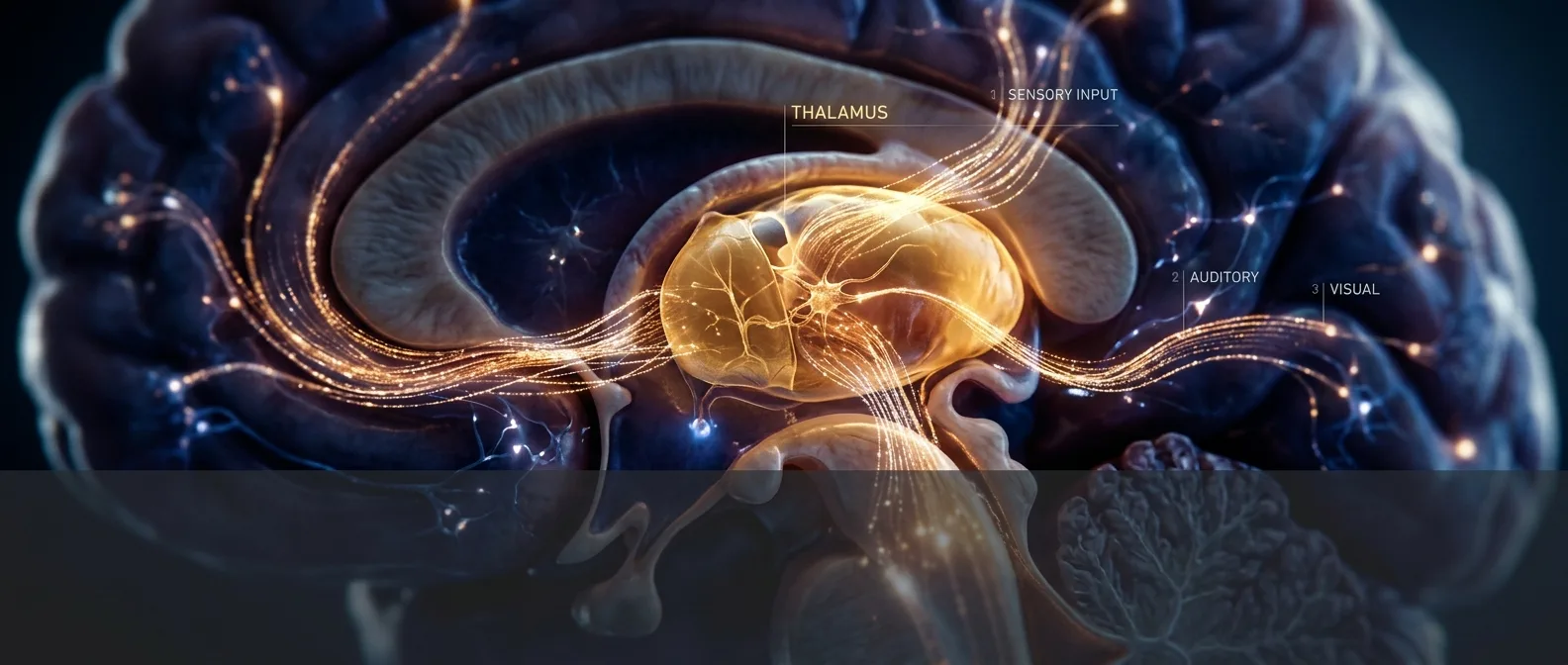
Picture your brain as a high-security office building. Every second, hundreds of "visitors" — light hitting your retina, sound waves reaching your ears, pressure from your clothes, internal status reports from your organs — try to get inside. The thalamus sits at the front desk, deciding which messages are important enough to reach the cortex where conscious processing happens. This "gateway to perception" houses a special region called the **thalamic reticular nucleus**. For decades, neuroscientists assumed this area finished developing in childhood. They were wrong. Researchers discovered that a specific protein, **LRRTM3** (leucine-rich repeat transmembrane neuronal protein 3), continues "sculpting" neural connections throughout adult life. Think of it as an architect who keeps refining a building's design long after the ribbon-cutting ceremony.Why This Discovery Rewrites Neuroscience
The old model said brains complete their basic architecture by adolescence. Kids start with millions of neural connections that get "pruned" to create more specialized circuits. Case closed. But the thalamus operates on a different timeline. It's like a garden that requires constant tending — unnecessary connections get removed, important ones get strengthened. This process doesn't stop at 25. It doesn't stop at 45. It keeps going.Think of it this way: A child's thalamus is like an inexperienced bouncer who lets everyone through. An adult's thalamus becomes a security expert — it knows exactly what to keep out and what deserves your conscious attention.
📖 Read more: 20-Minute Cardio Triggers 'Brain Ripples' That Boost Memory
🔬 The Science Behind the "Wisdom Filter"
The study published in Neuron showed something remarkable. When researchers compared mice lacking the LRRTM3 protein to normal mice, the results were crystal clear. On the surface, the mice looked identical. They remembered where food was hidden, played normally, interacted socially. But when asked to perform tasks requiring fine touch discrimination, the LRRTM3-deficient mice failed spectacularly. Why? Their brains never learned to ignore. They remained stuck in a childlike state of sensory confusion, unable to focus on subtle details because they couldn't filter out the noise.The Numbers That Matter
⚡ Maturation as the Art of Ignoring
Here's the paradox of wisdom. We usually associate it with accumulating knowledge, but neuroscience tells a different story: biological maturation is actually the ability to ignore more effectively. A child's brain is like a sponge absorbing every color, sound, and movement with equal intensity. An adult brain becomes like a laser — it can cut through static to find the specific pieces of information that actually matter. This transformation doesn't happen overnight. It's a long, invisible process of "pruning" irrelevant inputs.How This Plays Out Daily
Consider how you can read a book in a noisy coffee shop. Or hold a conversation at a party despite dozens of other conversations happening around you. What you think of as "concentration" is actually the result of thousands of neural decisions made every second by your thalamus.For the ancient Greeks, wisdom wasn't just accumulating facts. They used "sophia" to describe a deeper capacity: the ability to perceive what truly matters and distinguish signal from noise in life's complexity."The only true wisdom is in knowing you know nothing"
— Socrates
📖 Read more: BrainIAC AI Predicts 10 Brain Diseases From Single MRI Scan
🎯 When the System Breaks Down
When LRRTM3 doesn't function properly, the results are dramatic. The brain gets trapped in a state of "sensory blur." It's like trying to hear a specific voice while everyone around you talks simultaneously — and having no ability to turn down the volume on the others. This discovery might explain several puzzling phenomena: - Why some people struggle more with focus and attention - How ADHD might connect to thalamic function - Why "wisdom" often comes with ageThe Dementia Connection
LRRTM3 has also been linked to Alzheimer's risk. This means the same mechanisms that help us focus in adulthood might be undermined by neurodegenerative diseases. Maybe dementia isn't just "memory loss" but also the loss of this fundamental ability to filter the world.📖 Read more: Gratitude: How It Literally Changes Your Brain
🧠 Practical Applications: Helping Your Thalamus
While we can't directly influence LRRTM3 production, we can support our thalamus in other ways:Meditation Practice
Regular practice trains the brain in selective attention and sensory filtering
Limiting Multitasking
Focusing on one task at a time strengthens natural filtering mechanisms
Quality Sleep
During sleep, the brain "cleans up" unnecessary neural connections