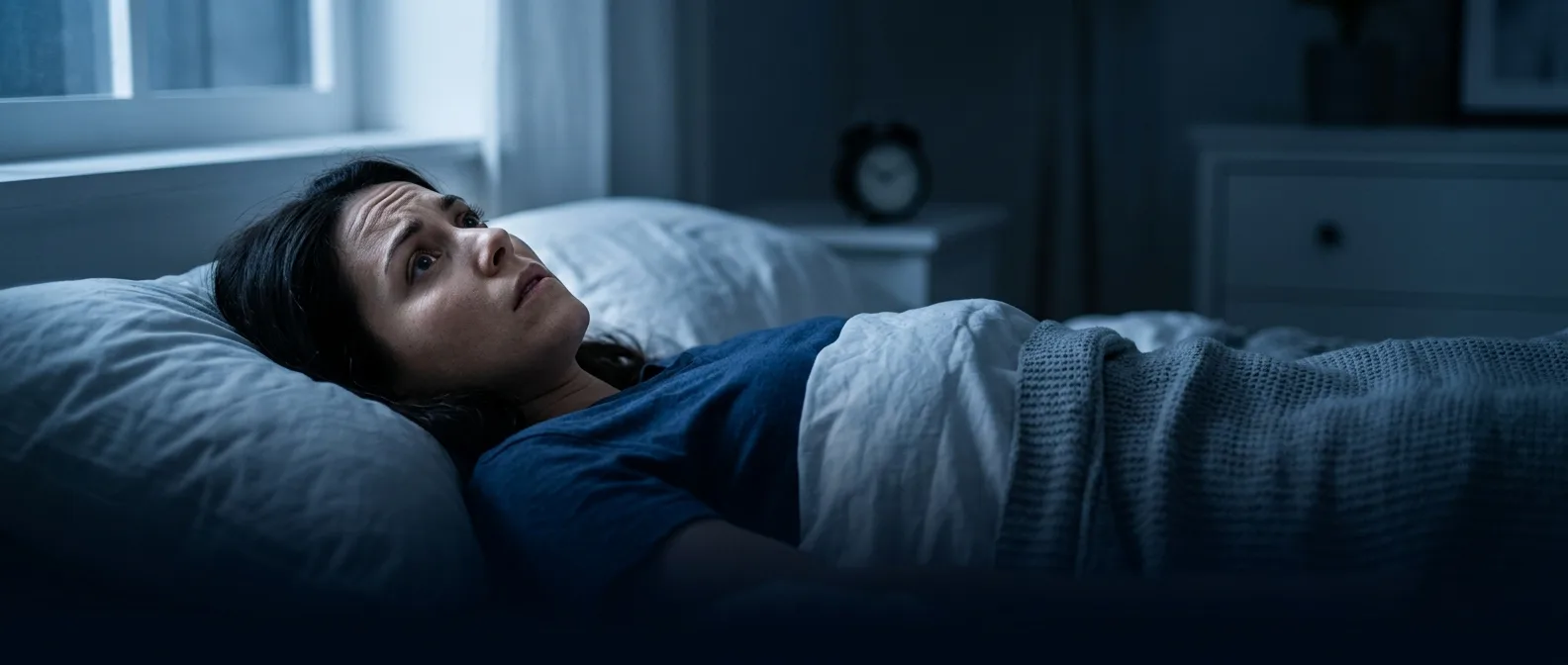
You lie in bed one night. Tomorrow you have a job interview, an exam, or some other stressful obligation. Even though you initially fall asleep, toward the morning hours you start having anxious dreams — and your sleep becomes restless. If this scenario sounds familiar, you're not alone. Recent research from Switzerland shows that when we anticipate something stressful, our brain literally reprograms our dreams.
📖 Read more: Childhood Stress Rewires Your Gut for Life, Study Finds
🧠 What Happens in the Brain When We Fear Tomorrow
The relationship between sleep anxiety and stress dreams is not coincidental. Researchers Sandrine Baselgia and Björn Rasch from Switzerland in 2026 studied exactly this phenomenon. Participants spent three nights in a sleep laboratory — one adaptation night, one expecting a stressful activity, and one expecting a relaxing experience.
When a stressful situation was expected the next day, dreams became increasingly anxious as dawn approached. This is not just an impression. It is a measurable change in how the brain functions.
Why Do the Worst Dreams Come Toward Morning?
The brain, it seems, doesn't just recall the past in dreams — it also prepares for the future. When we expect something stressful, it reactivates related thoughts and emotions to prepare us for the upcoming challenge. This function, however, can become destructive for sleep quality.
📊 The Evidence on Anticipatory Stress
Sleep problems due to anticipation are not a new phenomenon. A French study found that about 60% of medical students had dreams related to entrance exams the night before the exams — mostly nightmares.
Stanford Medicine research in 2025 confirmed that the relationship between sleep and mental health is bidirectional. As Andrea Goldstein-Piekarski, assistant professor of psychiatry at Stanford, explains, "it's becoming increasingly clear that sleep and mood have a bidirectional relationship."
The Neuroscience Behind the Worry
When the brain prepares for stress, several interesting things happen. Studies with functional MRI show changes in the regions that process emotions. These changes appear mainly in the late phases of sleep — where we should be in the deepest, most restorative sleep.
Rebecca Cox from Washington University, who studies the intersection of sleep and mental health, puts it simply: "People are more likely to feel anxious if they haven't slept well." But — plot twist — the reverse direction is weaker. Daytime anxiety affects subsequent sleep less than poor sleep affects the next day's anxiety.
🌙 The "Mind After Midnight" Theory
One of the most fascinating findings concerns bedtime. Jamie Zeitzer, a professor at Stanford, studied nearly 75,000 people in the United Kingdom and found something remarkable: going to bed early and waking up early is better for mental health, even if you're a "night owl."
"There's a theory called 'mind after midnight' — the idea that after midnight, your brain makes decisions it wouldn't make at noon."
— Jamie Zeitzer, Stanford Medicine
What happens? Late at night, you have fewer social "guardrails" because everyone is asleep. You've been awake for 16 hours, so the cumulative experiences and stress of the day alter your decision-making processes. These bad decisions after midnight can affect mental health the next day.
The Vicious Cycle of Anxiety
Mental health and sleep issues often reinforce each other. They create a vicious cycle where mental health problems worsen sleep problems, which in turn further exacerbate sleep disorders.
It's like playing ping-pong with yourself — but instead of fun, each volley makes you feel worse.
📖 Read more: Lucid Dreaming: How to Control Your Dreams
⚡ Teenagers and the Problem of Sleep Anxiety
16% of workers in the US are shift workers — they work outside regular schedule hours. But the real victims of the modern lifestyle are teenagers. When puberty hits, there is a natural shift in circadian rhythms — melatonin production is delayed by about two hours.
Biological Change
Puberty brings a natural delay in melatonin production
Increased Needs
Teenagers need at least as much sleep as adults
System Pressure
School schedules and activities that start early
The result? Teenagers' mental health has deteriorated since before the pandemic, and depression symptoms in high school students jumped to even higher levels since 2020. Part of this may be the result of increased chronic sleep deprivation.
🎯 How to Break the Cycle of Sleep Anxiety
The good news is that there are several effective non-medication approaches that can improve sleep. The treatment with the strongest evidence to date is cognitive behavioral therapy for insomnia (CBT-I).
Practical Strategies for Better Sleep
Stanford Medicine researchers recommend specific steps. First, avoid caffeine and other stimulants after the first half of the day. Second, avoid alcohol before bedtime — it can reduce sleep quality and cause more frequent disruptions.
Third, keep the bedroom a comfortable and calming environment. Fourth — and this is critical — try to go to bed and wake up at the same time every day, even on weekends.
The "Weekend Warrior" Myth
Many people think they can "patch" their sleep on weekends. Wrong. Maintaining a consistent sleep schedule is healthier than trying to be a weekend warrior with your sleep.
Technology and Screen Time
Avoid screen time before bed. Apps are designed to keep you awake and can replace sleep. If you can't fall asleep, don't panic. You can't force sleep when it's not happening. It's better to give up the struggle and pick up a book to read until you feel sleepy.
🔬 The Science of Anticipatory Memory
A fascinating element of this research is that our brain during sleep may not just replay the past — it can also prepare us for the future. When we anticipate something stressful, the brain may reactivate related thoughts and emotions in dreams to prepare us for the upcoming stressful event.
Something similar happens during the day when we want to remember an intention — what psychologists call a prospective memory task — such as remembering to take a pill. Research on this "intention-superiority effect" shows that intentions exhibit higher activation in memory than other memory contents.
In other words, both in our sleep life and in our waking life, our brain unconsciously anticipates future events. But during sleep, this can be disruptive.
🎯 Frequently Asked Questions
How can I know if my anxiety is actually affecting my sleep?
If you find that you initially sleep fine but wake up at 3-4 AM with anxious dreams or thoughts about the next day, it's likely that anticipatory stress is affecting your sleep. This happens mainly during the late phases of sleep, not at the beginning.
Does CBT-I really work for everyone?
Cognitive behavioral therapy for insomnia is the "gold standard" treatment and has the strongest scientific support. It teaches behavioral changes to regulate the two biological systems involved in sleep: the circadian system and the sleep drive system.
What can I do if anxiety keeps me awake?
Beyond basic sleep hygiene principles, stress reduction techniques such as mindfulness meditation, progressive muscle relaxation, and various therapeutic methods can help. If sleep problems last for weeks or months, it may be time to see a specialist.
The most important thing this research reveals is that our dreams are not just random images from the day. They are an active process of preparation for tomorrow — which can, unfortunately, sabotage our sleep tonight. The good news? If we understand this process, we can influence it. And perhaps, ultimately, sleep a little better — even when tomorrow brings challenges.