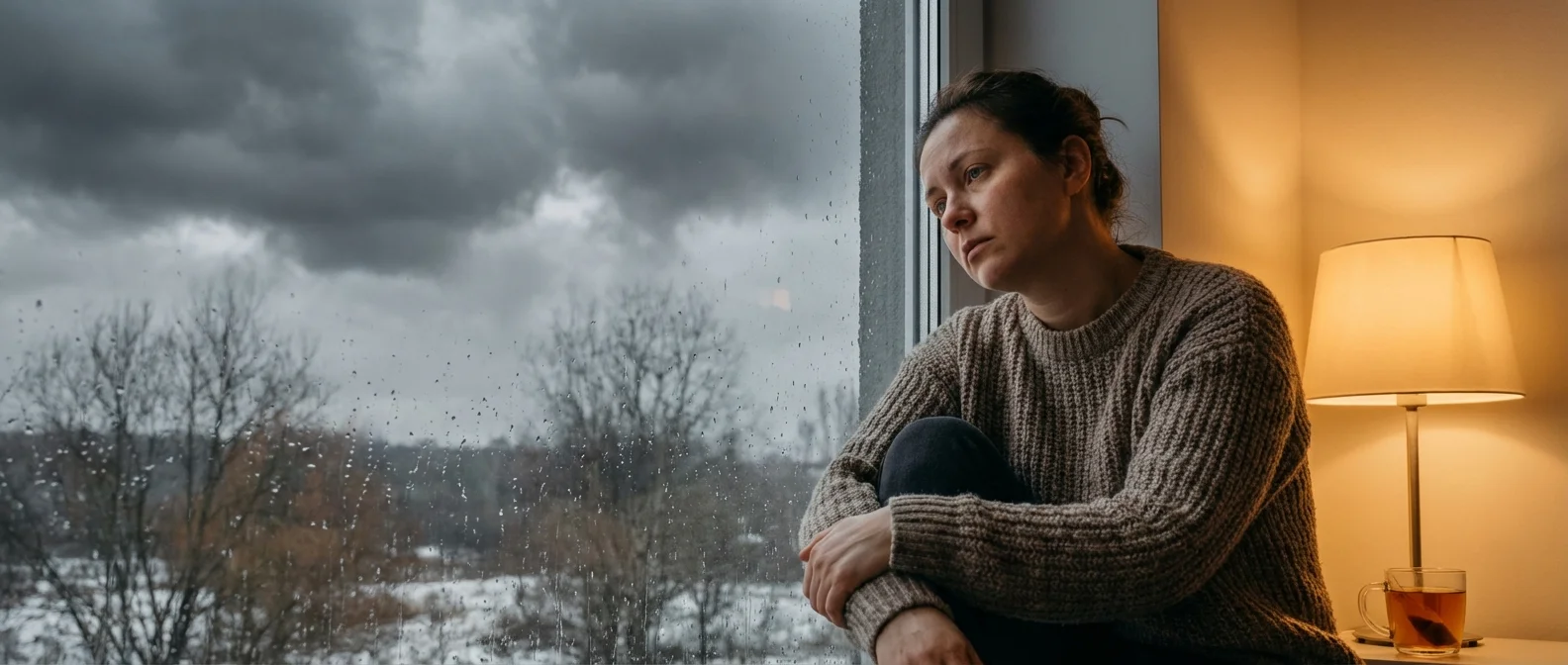
Every year, as seasons shift, millions of people worldwide experience an inexplicable heaviness. It's not just “winter laziness” — Seasonal Affective Disorder (SAD) is a recognized mental health condition affecting approximately 5% of adults, with women being 4 times more likely to be affected.
📖 Read more: Psychedelics & Therapy: The New Scientific Approach
What Exactly Is SAD?
Seasonal Affective Disorder is a form of depression that appears during a specific season — primarily autumn and winter, when days grow shorter. It's not a bad mood: it's full clinical depression with an expiration date.
Sleeping 10+ hours yet waking exhausted. The bed becomes a refuge.
The brain “demands” sugar and starches — an illusion of energy.
Even simple tasks feel monumental. Energy depletes rapidly.
Avoiding friends, canceling plans. Craving only solitude.
📖 Read more: Bipolar Disorder: What You Need to Know
What Happens in the Brain
The biological explanation lies in our biological clock — the suprachiasmatic nucleus (SCN) in the hypothalamus, a cluster of just 20,000 neurons that regulates our circadian rhythms.
Longer days → increased serotonin → energy, optimism, sociability
Shorter days → excess melatonin → drowsiness, sadness, isolation
SAD in Numbers
Scandinavian countries serve as a natural “laboratory” — in Sweden, up to 8% of the population meets criteria for clinical SAD, while another 15% experience milder “winter blues.”
📖 Read more: Gaslighting: How to Recognize Manipulation
Treatment Options
The most evidence-based treatment: exposure to a 10,000 lux lamp for 20-30 minutes every morning. It mimics natural sunlight and “wakes up” the SCN. Results appear within 3-5 days.
Even 30 minutes of walking on a cloudy day provides 10,000 lux — equivalent to a light therapy lamp.
In winter, vitamin D synthesis drops dramatically. Supplementation (1,000-2,000 IU/day) appears to help mood regulation.
A specialized version of CBT adapted for seasonal depression. Studies show equal effectiveness to light therapy, with even better outcomes in the following winter season.
Wake at the same time every day — even weekends. Consistency helps the circadian rhythm synchronize properly.
When to Seek Help
If symptoms last more than 2 weeks, affect your work or relationships, or make you feel hopeless — talk to a professional. SAD isn't a weakness; it's a biological response of your brain to light. And effective solutions exist.
Winter ends. But you don't have to wait for it helpless.
1. Porcu A, Dulcis D et al. (2022). Day-length-dependent neurotransmitter switching in the SCN-PVN network, Science Advances, DOI: 10.1126/sciadv.abn9867
2. Rosenthal NE et al. (1984). Seasonal affective disorder: A description of the syndrome and preliminary findings with light therapy, Archives of General Psychiatry, DOI: 10.1001/archpsyc.1984.01790120076010
3. Rohan KJ et al. (2016). Cognitive-behavioral therapy vs light therapy for SAD: Randomized controlled trial, American Journal of Psychiatry, DOI: 10.1176/appi.ajp.2015.15060773