📖 Read more: Burnout: 10 Signs You've Reached Your Limit
📊 Remote Work in Numbers
According to data from Gallup (2024), Buffer (State of Remote Work), and the McKinsey Global Institute, remote work remains a major issue:
Sources: Gallup State of the Workplace (2024), Buffer State of Remote Work (2023)
⚖️ Pros & Cons: What the Research Shows
Remote work is neither just “freedom” nor just “loneliness.” The truth lies somewhere in between, and research proves it:
The Positives
- Flexibility: You control your schedule — less commuting stress
- Autonomy: According to a Stanford study (Bloom et al., 2015), remote work increased productivity by 13%
- Work-life balance: More time with family, hobbies, exercise
- Reduced commute: Saving 40-80 minutes/day — time redirected to sleep and relaxation
- Fewer interruptions: No “random” office chatter — more deep work
The Negatives
- Loneliness: 23% report it as the #1 problem (Buffer 2023)
- Blurred boundaries: You don't know when work ended — overwork without realizing it
- Zoom fatigue: The state of exhaustion from excessive video calls (Stanford VHL, 2021)
- Social isolation: Fewer opportunities for spontaneous social interaction
- Burnout: A Microsoft study (2022) shows that remote workers work an average of 2.5 more hours per day
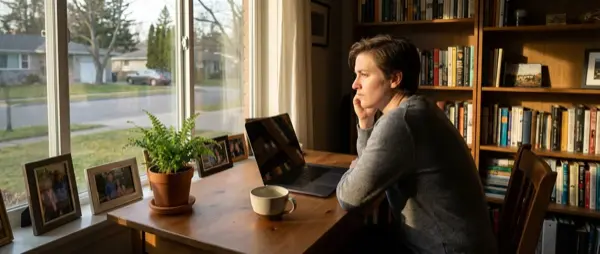
🧠 The Psychology of Loneliness in Remote Work
Loneliness in remote work isn't simply “I miss my colleagues.” It has deep neurobiological roots. According to Dr. Vivek Murthy, former U.S. Surgeon General, loneliness constitutes an "epidemic" that affects both physical and mental health:
Loneliness in Numbers
- Chronic loneliness increases the risk of premature death by 26% — equivalent to smoking 15 cigarettes a day (Holt-Lunstad, 2015)
- Increases the risk of heart disease by 29% and stroke by 32%
- Associated with a 65% increased risk of depression
- According to a Cigna study (2020), 61% of adults feel lonely — a percentage that rose during the pandemic
"Loneliness doesn't mean you're alone in a room. You can be in a hall full of people and still feel lonely. Loneliness is the gap between the connection you have and the connection you want."
Why Remote Work Intensifies Loneliness
It's not just about fewer meetings. Remote work removes casual social interactions — what psychologists call “weak ties” (loose social bonds). The coffee break, the elevator chat, the laughter in the kitchen. According to Mark Granovetter (1973, The Strength of Weak Ties), these bonds are critical for emotional well-being, creativity, and even career advancement.
😴 Zoom Fatigue: The New Workplace Illness
In 2021, researchers at the Stanford Virtual Human Interaction Lab (Bailenson, 2021) analyzed why video calls exhaust us more than in-person meetings:
Excessive Eye Contact
On a Zoom call, you're looking directly into everyone's eyes — simultaneously. In real life, this would be socially aggressive. The brain perceives this constant eye contact as a threat.
Real-Time Self-Evaluation
You see yourself constantly on camera. It's like staring in a mirror 8 hours a day. Studies show this increases self-criticism and stress, especially in women.
Reduced Mobility
In a physical room you move around, write on the whiteboard, grab coffee. On Zoom, you sit motionless in front of a camera — your brain feels trapped.
Cognitive Overload
Decoding non-verbal cues through a camera requires significantly more brain power. Latency issues, frozen screens — your brain is working overtime.
📖 Read more: Digital Detox: A Complete Guide to Screen Detoxification
🏢 Hybrid Model: The Best Solution?
The data shows that the hybrid model (hybrid work) can offer the benefits of remote work without the drawbacks. According to a Gallup study (2024):
- Hybrid workers report higher engagement levels than both fully remote AND fully on-site workers
- The ideal ratio appears to be 2-3 days in the office, 2-3 days at home
- Flexibility (being able to choose) matters more than the absolute number of days
The Microsoft Work Trend Index (2022) confirms: 73% of workers want flexible remote work options, but at the same time 67% want more in-person collaboration. This “paradox” shows that people want neither full remote work nor a full return to the office — they want choice.
🛡️ 8 Strategies for Healthy Remote Work
Based on the research findings, here are the most effective strategies:
1. Create a “Commute”
Even if you don't go to an office, create a start-and-end-of-work ritual. A 15-minute walk before and after work acts as a psychological boundary.
2. Virtual Coffee Breaks
Schedule informal calls with colleagues without an agenda. 15 minutes of casual chat replaces the random office interactions.
3. Separate Workspace
Don't work from bed or the couch. A separate desk (even just a corner) creates a physical work-home boundary.
4. Camera-Off Meetings
Turn off your camera in some meetings. Stanford research shows it reduces Zoom fatigue by 14%. They don't need to see your face on every call.
5. Strict Schedule
Shut down your computer at 6:00 PM — literally. The biggest risk of remote work isn't laziness, it's overworking.
6. In-Person Socializing
Go to a coworking space 1-2 times a week, grab coffee with friends, do outdoor activities. Offset the physical loneliness.
2 More Tips
- 7. Digital disconnect: Don't have Slack/email notifications on your phone after work. Being “always connected” kills relaxation.
- 8. Movement throughout the day: Every 90 minutes, get up, do some stretching or take a walk. A sedentary lifestyle worsens both physical and mental health.
🧪 Conclusion: Remote Work Requires Planning
Remote work is neither paradise nor hell. It's a tool — and like any tool, its value depends on how you use it.
Science tells us: give yourself structure (schedule, space, routine), connection (socializing physical + virtual), and boundaries (disconnection). If you do these things, remote work can truly be freedom. Otherwise, it becomes an elegant prison.
Sources & References
- Bloom N. et al. — Does Working from Home Work? (Stanford, 2015)
- Bailenson J.N. — Nonverbal Overload: Causes of Zoom Fatigue (Stanford VHL, 2021)
- Gallup — State of the Global Workplace Report (2024)
- Buffer — State of Remote Work Report (2023)
- U.S. Surgeon General — Our Epidemic of Loneliness and Isolation Advisory (2023)