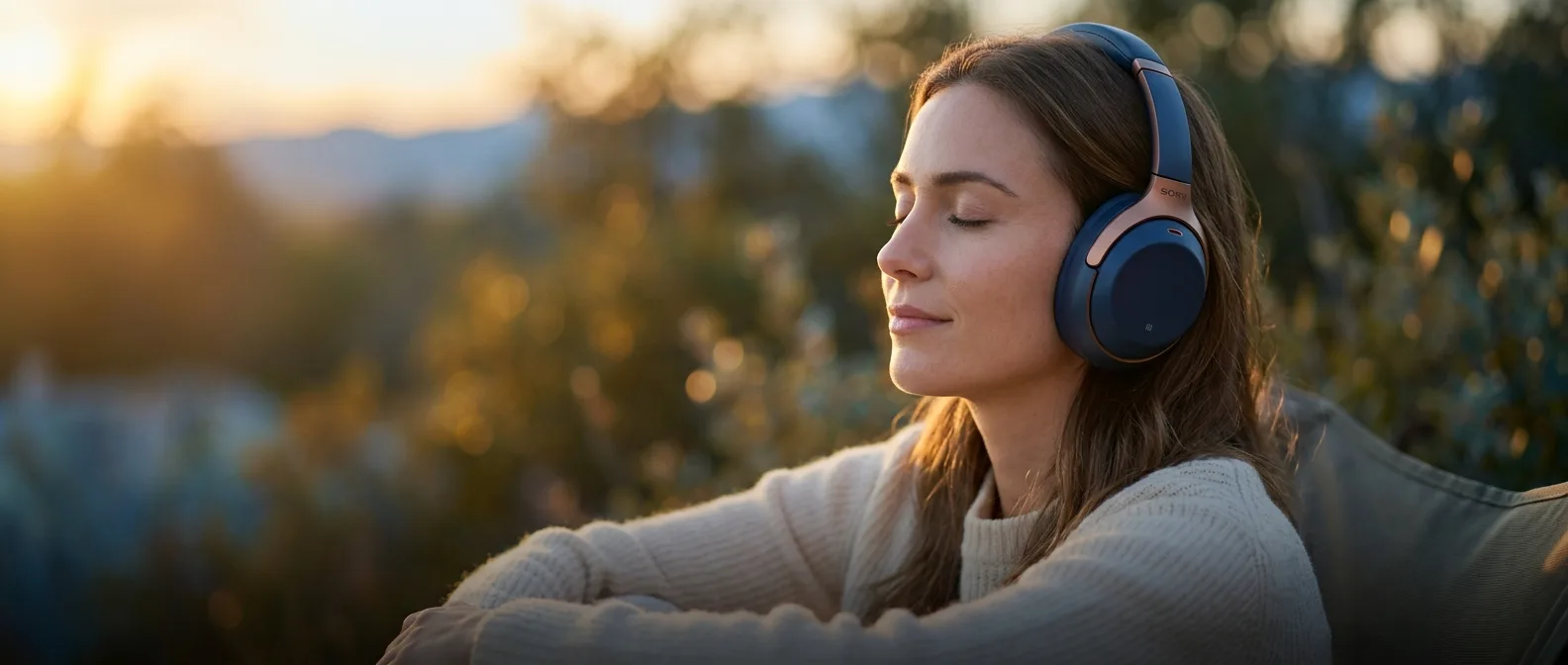
A specific piece of music lasting exactly 24 minutes can reduce anxiety as effectively as anti-anxiety medications. This isn't wishful thinking. It's the conclusion of a clinical study published in PLOS Mental Health in January 2026 that challenges conventional anxiety treatment.
Researchers at Toronto Metropolitan University discovered that auditory beat stimulation (ABS) combined with specially designed music creates a dose-response effect that dramatically reduces anxiety symptoms. The 24-minute duration proved optimal — long enough to rewire brain function, short enough to fit into daily life.
🧬 The Science Behind Auditory Beat Stimulation
Auditory beat stimulation isn't just music therapy. It's neurotechnology delivered through stereo headphones. When your left ear hears a 200 Hz tone and your right ear receives 210 Hz, your brain creates a phantom third sound at 10 Hz — the mathematical difference between the two frequencies.
This pulse doesn't exist in the outside world. Your brain generates it internally and then "entrains" your brainwaves to synchronize with this rhythm. The process can shift your state of consciousness within minutes.
The Frequencies of Calm
The study used alpha frequencies (around 10 Hz), which correlate with relaxed alertness and focused attention. Previous 2022 research showed similar results with theta waves (4-7 Hz), which induce deeper relaxation states.
According to psychology professor Frank Russo, who co-authored the study: "We see a dose-response pattern where about 24 minutes of music with ABS appears to be the sweet spot." Long enough to change anxiety levels, short enough to be practical.
📊 Results That Surprised Researchers
The clinical trial was meticulously designed. All 144 participants had moderate anxiety and were already taking medications. They were randomly divided into four groups:
- Pink noise for 24 minutes (control group)
- Music with ABS for 12 minutes
- Music with ABS for 24 minutes
- Music with ABS for 36 minutes
Before and after listening, anxiety levels were measured using standardized tests. The results were clear: all three music groups outperformed pink noise, but the 24-minute group showed the greatest symptom reduction.
Mind and Body Relief
The treatment didn't just calm racing thoughts. Music with auditory beat stimulation reduced both cognitive anxiety (endless worry loops) and physical symptoms (rapid heartbeat, muscle tension, sweating). It also improved mood and decreased negative emotions across the board.
"This approach could offer an accessible, drug-free option for people seeking additional ways to manage stress and regulate emotions"
— Toronto Metropolitan University research team
⚡ Why 24 Minutes and Not More?
The answer lies in neurophysiology. Your brain needs time to adapt to the auditory stimulus. During the first few minutes, normal mental processes and anxious thoughts continue. Gradually, brain activity synchronizes with the music's rhythm.
At 24 minutes, you achieve sufficient duration for brainwave entrainment without taxing attention spans. The 36-minute group showed similar results but not significantly better — meaning extra time doesn't provide additional benefits.
The Mystery of Brainwave Entrainment
When we hear binaural beats, neurons in the auditory cortex begin "firing" at the same rhythm. This phenomenon, called frequency following response, can influence broader brain regions and alter our state of consciousness.
🔬 Comparing Traditional Anxiety Treatments
Anxiety affects millions globally. Traditional treatments — medications and cognitive behavioral therapy (CBT) — work well but often come with barriers.
Anti-anxiety drugs can have side effects, create dependency, or take weeks to work. Therapy is excellent but has long waiting lists and high costs.
The Digital Alternative
Music therapy with auditory beat stimulation offers immediate benefits without these obstacles. You can use it anywhere with headphones. It doesn't replace professional care but works as a complementary tool.
Especially for people already taking medications (like the study participants), adding 24 minutes of specialized music can enhance treatment effectiveness.
Immediate Action
Benefits appear within 24 minutes, no adjustment period needed
Available Everywhere
Only requires smartphone and headphones, no doctors or pharmacies
No Side Effects
No chemical intervention, no dependency, no drug interactions
🎯 How to Apply This in Practice
The study used carefully designed music from LUCID, a company that emerged from the Toronto Metropolitan University ecosystem. But other options exist.
Many apps and digital platforms offer binaural beats at alpha frequencies (8-12 Hz) targeting relaxation. The key requirement is stereo headphones — without them, the phenomenon doesn't work.
Practical Guidelines
- Timing: Schedule 24 uninterrupted minutes
- Environment: Quiet space, avoid multitasking
- Position: Sitting or lying down, never while driving or operating machinery
- Volume: Moderate level, shouldn't hurt your ears
- Frequency: Daily use for best results
Some users report drowsiness or mild nausea during the first few minutes — this is normal as the brain adjusts to new stimuli.
🌟 The Future of Digital Therapeutics
If 24 minutes of specialized music can produce results comparable to medications, researchers are now testing other frequencies for insomnia and focus disorders.
Research teams worldwide are examining how different frequencies affect other conditions — from insomnia to focus and creativity. Auditory beat stimulation technology could evolve into an entire "pharmacy" of sounds.
Of course, like any new technology, caution is needed. This isn't a cure-all and doesn't replace professional help for severe anxiety or depression.
Questions That Remain
Research continues. How long do benefits last after listening? Does it work equally well for other anxiety types? Can it combine with other therapies for even better results?
In coming years, we expect more studies clarifying the mechanisms and optimizing sound prescriptions. Perhaps soon, the "prescription" for anxiety won't just include pills but specific musical doses.
Until then, the idea that 24 minutes of carefully selected music can calm as effectively as pharmaceuticals shows how technology and neuroscience are opening pathways that recently sounded like science fiction. Anxiety remains a problem, but solutions are getting more creative.
Sources: