📖 Read more: Decision Fatigue: Why Decisions Exhaust You
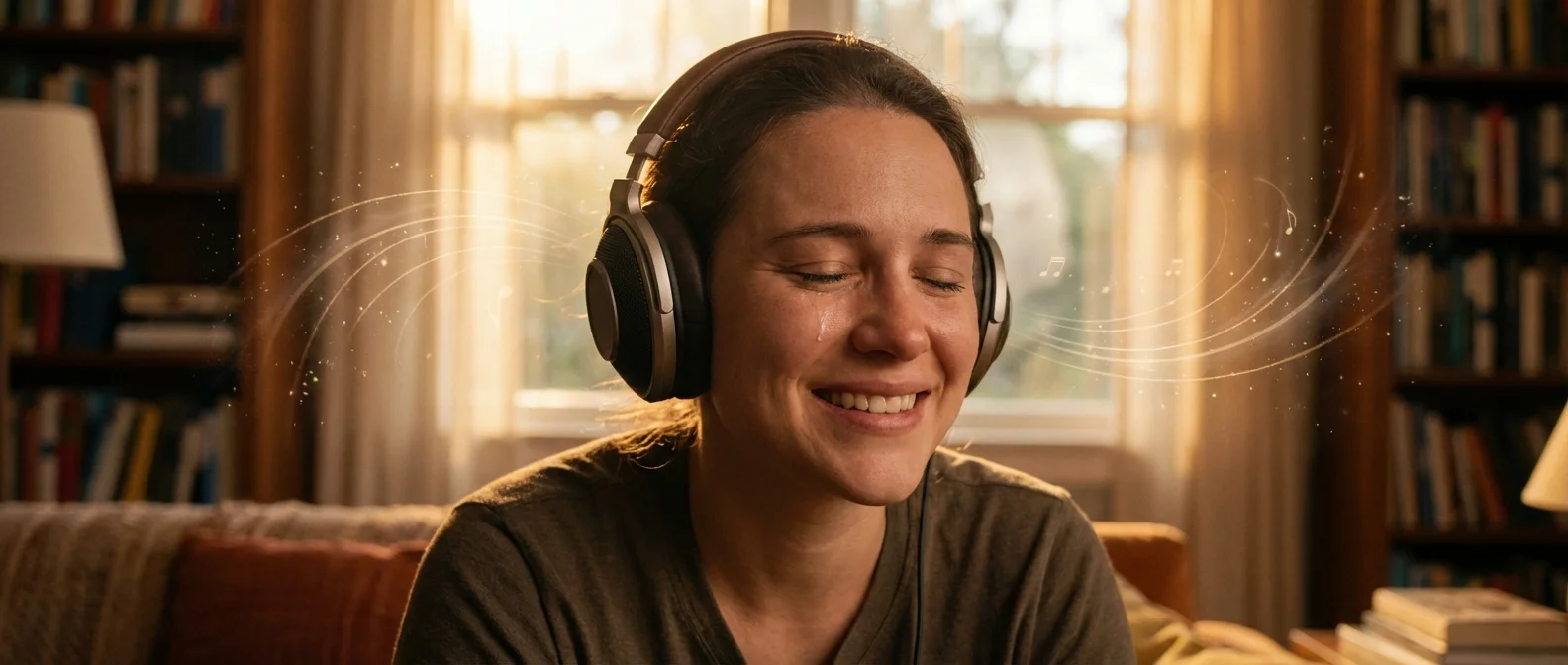
What Happens in Your Brain When You Listen to Music
Music is one of the few activities that activates simultaneously nearly every region of the brain. The auditory cortex processes sounds, the motor cortex responds to rhythm, the prefrontal cortex analyzes structure, and the limbic system — the emotional center — floods with neurotransmitters.
According to research by Zatorre published in PNAS, music triggers dopamine release in the striatum — the very same region activated by food, sex, or psychoactive substances. Essentially, the brain treats a beloved melody as a biological reward.
The study by Salimpoor et al. (2011) in Nature Neuroscience revealed something remarkable: dopamine is released not only at the peak moment of a song, but also before it — during the anticipation phase. When the brain “predicts” it will hear the melody it expects, the pleasure begins earlier. This explains why familiar songs provoke such powerful reactions.
Music and Emotions: Why We Cry or Rejoice
Stefan Koelsch, in a comprehensive review in Nature Reviews Neuroscience (2014), described six core mechanisms through which music evokes emotion:
Acoustic properties — intensity, tempo, sudden changes — trigger automatic physiological responses. A loud, unexpected chord increases muscle tone and heart rate.
Music is inextricably linked to the hippocampus — the memory center. A song can activate memories spanning decades, along with their accompanying emotions. That's why certain sounds “transport” you to forgotten moments.
📖 Read more: Dopamine & Your Phone: How Screens Make You Addicted
We tend to internally “mimic” the emotion that music expresses. A slow, melancholic melody activates neural networks of sadness — even when there's no real reason to feel sad.
Music as Therapy: What Research Shows
Music therapy isn't alternative or pseudoscience — it's evidence-based clinical practice. The study by Thoma et al. (2013) in PLOS ONE examined the effect of music on 60 healthy adults and found that listening to relaxing music before a stressful situation significantly reduced cortisol levels and subjective feelings of anxiety.
In Alzheimer's disease, studies show that patients who can't remember their own names respond to songs from their youth. Musical memory appears to resist neurodegeneration more than any other form of memory.
Practical Tips: How to Use Music Strategically
For Focus
Instrumental music without lyrics, 60-80 BPM. Classical, lo-fi, or ambient works best. Music with lyrics competes with the brain's language processing.
📖 Read more: Flow State: How to Enter the Zone of Peak Performance
For Exercise
Fast tempo, 120-140 BPM. Music with a strong beat synchronizes movement and increases endurance by up to 15% according to studies.
For Sleep
Slow music below 60 BPM, without abrupt changes. Studies show that 45 minutes of relaxing music before sleep improves its quality.
For Emotional Release
Don't avoid sad music. Research shows that “pleasant sadness” helps with emotional processing without real pain.
Why Music Connects Us
Music isn't just an individual experience. Group listening or musical performance synchronizes brain waves between individuals — a phenomenon known as inter-brain synchrony. This synchronization enhances feelings of community, trust, and cooperation.
This explains why concerts create such powerful collective emotions, why soldiers sing together, why every culture in history developed its own musical tradition. Music is, from an evolutionary perspective, a tool for social bonding.
Music doesn't just change your mood — it changes how your brain operates. Use it consciously, and gain an ally you always carry with you.
Scientific Sources
- Salimpoor, V. N. et al. (2011). Anatomically distinct dopamine release during anticipation and experience of peak emotion to music. Nature Neuroscience, 14, 257–262. DOI: 10.1038/nn.2726
- Koelsch, S. (2014). Brain correlates of music-evoked emotions. Nature Reviews Neuroscience, 15, 170–180. DOI: 10.1038/nrn3666
- Thoma, M. V. et al. (2013). The Effect of Music on the Human Stress Response. PLOS ONE, 8(8), e70156. DOI: 10.1371/journal.pone.0070156
- Zatorre, R. J. & Salimpoor, V. N. (2013). From perception to pleasure: Music and its neural substrates. PNAS, 110(Supplement 2), 10430–10437. DOI: 10.1073/pnas.1301228110