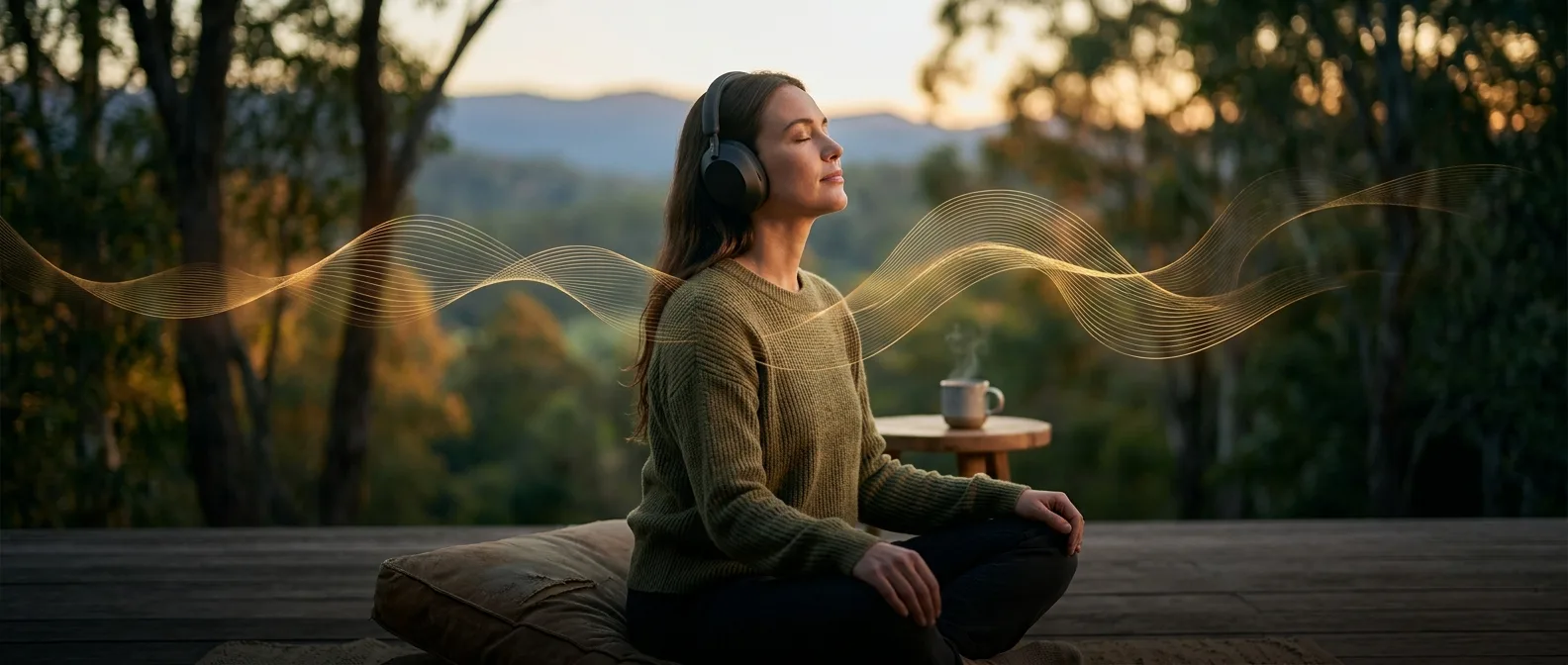
You read about anxiety and perhaps think the same old things — medications with side effects, psychotherapy with waiting lists, expensive sessions. But what if there were something simpler?
A new clinical study from Toronto Metropolitan University reveals that 24 minutes of specially designed music can reduce anxiety as effectively as medication. The secret combination? Music with auditory beat stimulation — a technique that uses rhythmic sound patterns to influence brain activity.
📖 Read more: Cortisol Hijacks Your Brain's GPS: Why Stress Makes You Lost
🔬 The Study That Changes the Rules
Psychologists Danielle K. Mullen and Frank A. Russo tried something truly original. They partnered with digital therapeutics company LUCID to examine whether music can become a complementary anxiety treatment.
The trial included 144 adults who were already taking anxiety medication. After random assignment, they listened to:
- Pink noise (24 minutes) — control group
- Music with ABS for 12 minutes
- Music with ABS for 24 minutes
- Music with ABS for 36 minutes
The results were published in PLOS Mental Health in January 2026, and the findings are impressive.
⚡ Auditory Beat Stimulation: What It Is and How It Works
Auditory beat stimulation is not some sci-fi trick. It works like this: it plays two slightly different, low-frequency tones — one in each ear or both simultaneously. Your brain perceives a pulsating rhythm that aims to stimulate specific brain regions.
Think of it as a subtle massage for your nerves. The technique has been tested in previous studies, but this time the researchers wanted something more specific: what is the ideal music "dosage"?
Why 24 Minutes Is the Sweet Spot
"We see a dosage pattern where approximately 24 minutes of music with ABS appears to be the sweet spot," explains Frank Russo, Professor of Psychology at TMU. "It's enough to significantly change anxiety levels, but not so long that you need to dedicate a huge amount of time."
Indeed, 12 minutes was too short. 36 minutes had similar results to 24, but why wait longer?
📊 The Results in Numbers
Participants who listened to music with ABS saw significant reductions in both cognitive and somatic symptoms of anxiety compared to the control group. But what does this mean in practice?
Cognitive symptoms: Worrying thoughts, obsessions, difficulty concentrating
Somatic symptoms: Rapid heartbeat, sweating, muscle tension, nausea
The study used standardized assessment scales before and after the sessions. The improvements were statistically significant — not merely a placebo effect.
A Reliable Alternative?
We're not talking about a miracle. The researchers are careful to emphasize that music with ABS is not a panacea. It offers a "medium effect" in reducing anxiety on average — but that's nothing to dismiss.
Consider the benefits: no side effects, no cost, no waiting for appointments. It's something you can try even if you're taking medication — in the study, all participants were already on anxiolytics.
📖 Read more: Binaural & Monaural Beats: Which Sounds Reduce Stress?
🧬 How Music "Hacks" the Brain
Previous research shows that calming music can serve as an intervention for psychological conditions. Auditory beat stimulation adds another mechanism: it targets specific brainwave frequencies associated with relaxation and calm.
The 2022 study had shown similar results, but the researchers wanted to confirm them and explore different durations. In 2026, the results were replicated with even greater precision.
It's Not Just Relaxing Music
What makes the difference is not simply the "relaxing music" we know. It's the combination of music with specialized auditory beats that affect brain activity in a measurable way.
Think of it differently: it's not that music makes you feel better because you enjoy it. It literally changes the way your brain works for those 24 minutes.
"This study provides further support for the position that listening to music can be used to reduce state anxiety in individuals with clinically significant levels of trait anxiety."
PLOS Mental Health, 2026
🎯 Who Can Try It?
The study focused on people who were already taking anti-anxiety medication. However, this doesn't mean the technique is limited to that group.
The researchers see music therapy with ABS as "a potential addition to existing anxiety treatments, especially when access to common behavioral health interventions is limited."
In other words: if you have an anxiety problem but can't see a specialist, or if you're waiting for an appointment, or if you want something complementary — this approach might interest you.
Time-Efficient
24 minutes a day — you can do it during a break from work
Affordable
No recurring session costs or prescription medications
Accessible
Anything with headphones and internet — no special equipment needed
Are There Limits?
Obviously, music is not going to replace serious treatments for clinical anxiety levels. But for many people looking for ways to manage daily stress, it appears to be a promising option.
The researchers note that more — and larger — studies are needed to confirm the early results. But the starting point is quite promising.
🎵 What Exactly Did Participants Listen To?
The study does not describe the musical content in detail, but refers to "specially designed music" combined with auditory beat stimulation. In other words, it's not random ambient music from Spotify.
The company LUCID, which partnered on the study, develops digital therapeutic solutions. Their music is likely designed with specific goals — frequencies, rhythms, and sound patterns aimed at reducing anxiety.
This explains why they didn't see the same results with the pink noise played to the control group. It sounds like a waterfall, but clearly doesn't have the same neuroscientific properties.
How to Apply It in Your Life
Since the research is so recent, there aren't many commercially available apps based on these specific findings yet. But the logic is simple: calming music + auditory beat stimulation + 24 minutes of listening.
The key is consistency. It's not a one-time fix — it's a tool you can use whenever you need it.
🌟 The Future of Music Therapy
If the findings are confirmed in larger studies, we could see an entirely new field of digital therapeutics. Imagine applications that adapt music to your current anxiety level, or even AI-generated soundscapes that learn your brain's preferences.
2026 may be just the beginning. Music has always had therapeutic properties — now we're starting to understand exactly how and why it works.
And the best part? You don't need to wait for complex clinical approvals or doctor's prescriptions. Twenty-four minutes, a pair of headphones, and a little curiosity to try something different.
Perhaps the next time you feel anxious, instead of reaching for the pill box, you'll reach for your headphones.
Sources: