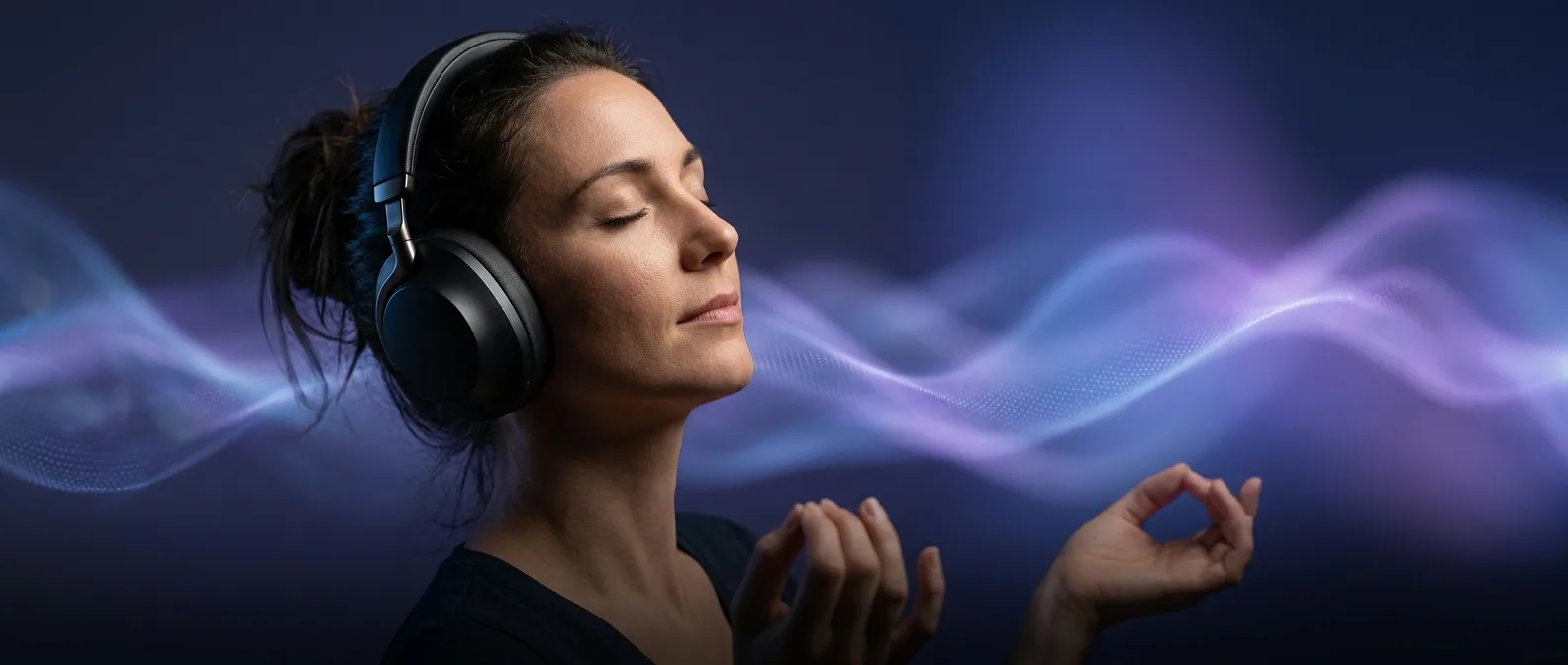
Imagine being able to reduce your anxiety as much as medication, without side effects, in just 24 minutes. A new clinical study from Toronto Metropolitan University shows that Auditory Beat Stimulation (ABS) — a specialized technique combining music with rhythmic auditory pulse frequencies — can deliver results comparable to anxiolytics. And the best part? You don't need a prescription.
In the study published in January 2026 in the journal PLOS Mental Health, 144 adults with moderate anxiety who were already taking anti-anxiety medication listened to specially designed music. The results? Those who listened for 24 minutes showed the most significant reduction in both cognitive and somatic anxiety symptoms.
📖 Read more: Auditory Beat Stimulation: Scientific Application Guide
🔬 Auditory Beat Stimulation: The Science Behind the Method
Auditory Beat Stimulation is a technique that uses two slightly different low-frequency tones. When these play simultaneously — either one in each ear or both together — the brain perceives a pulsating rhythm that appears to affect neural activity.
How it works in practice: If you play a 40 Hz tone in the left ear and a 44 Hz tone in the right, the brain will "hear" a 4 Hz beat — a frequency associated with relaxation states.
The method is not new. Researchers have been studying it for decades, but this particular study provides something that was missing: a specific "dosage." As Frank Russo, Professor of Psychology at TMU and chief scientist at the company LUCID which participated in the research, explains: "We see a dose-response pattern where 24 minutes appears to be the sweet spot."
Why 24 Minutes and Not More?
The researchers tested four different conditions: pink noise (control) for 24 minutes, and music with ABS for 12, 24, and 36 minutes. The results were clear. The 24-minute session significantly outperformed the 12-minute one, while there was no substantial difference from the 36-minute session.
This means that beyond a certain point, additional exposure doesn't provide extra benefits. It's like caffeine: after the third cup of coffee, you don't get more alert — just more jittery.
📖 Read more: 24 Minutes of Music Cuts Anxiety: New ABS Study
📊 Clinical Study: Numbers That Speak
The study design was particularly careful. All participants had already been diagnosed with anxiety and were receiving pharmacological treatment — which makes the results even more impressive. In other words, the music therapy added extra benefit on top of existing treatment.
"The findings support music with ABS as a potential addition to existing anxiety treatments, especially when access to conventional behavioral interventions is limited."
— Researchers, PLOS Mental Health 2026
It's worth noting that the study didn't only examine the participants' subjective feelings. They used standardized measurement tools that evaluate both cognitive (thoughts, worries) and somatic (rapid heartbeat, muscle tension) anxiety symptoms.
How Does It Compare to Medication?
This is where things get interesting. The researchers describe the effect as "moderate-level." This doesn't mean it's weak — on the contrary, many anti-anxiety medications show similar effect sizes in clinical studies.
The difference? Zero side effects, immediate availability, and costs approaching zero after the initial investment in headphones.
⚡ Digital Therapeutics: The Future of Mental Health?
This research is part of a broader movement toward so-called "digital therapeutics." These are interventions that use technology to deliver therapeutic benefits, often as a supplement — not a replacement — for traditional treatments.
Immediate Availability
No appointment needed. You can use it anytime you feel anxious.
Low Cost
After the initial investment in an app or headphones, usage is practically free.
No Side Effects
No drug interactions or adverse effects.
Of course, not everything is rosy. Digital therapeutics don't work with the same effectiveness for everyone. Some people may need more intensive intervention or a combination of therapies. Furthermore, while the results are encouraging, larger and longer-term studies are needed to confirm effectiveness.
The Problem with Waiting Lists
One of the main reasons researchers are interested in digital therapeutics is the accessibility crisis in mental health. In many countries, waiting lists for psychologists and psychiatrists often exceed several months.
Meanwhile, the cost of private psychotherapy ranges from €40-80 per session. For someone who needs weekly sessions, this means expenses that can reach €3,000-4,000 annually.
📖 Read more: Sound Therapy 2026: Alternative to Anti-Anxiety Medication?
🧬 Neuroscience: What Happens in the Brain?
Although this particular study did not examine brain activity directly, previous neuroimaging research has shown interesting things about how music affects anxiety.
When we listen to relaxing music, there is reduced activity in the amygdala — the brain region that processes fear and threat. At the same time, areas associated with dopamine and serotonin production are activated — neurotransmitters linked to feelings of well-being.
Interesting fact: Music is one of the few stimuli that activates virtually all regions of the brain. That's why its therapeutic applications range from Alzheimer's disease to post-stroke rehabilitation.
Auditory Beat Stimulation appears to add an extra dimension, synchronizing neural activity in a way that enhances the relaxing effects of music. It's like tuning the brain to a calmer frequency.
What Makes Music Therapeutic?
Not all music is equally effective. The specially designed music used in the study had specific characteristics: slow tempo, minimal melodic and rhythmic changes, and of course the auditory beats.
For comparison, listening to heavy metal or techno — even if you enjoy it — wouldn't have the same relaxing effects. The brain needs predictability and smoothness to enter a relaxation state.
📖 Read more: Anticipatory Stress: How It Changes Your Brain While You Sleep
💡 Practical Applications and Limitations
Could one completely replace anti-anxiety medication with 24-minute sessions of specialized music? The answer is complex. The researchers are clear that the method works best as a supplement, not as a replacement for existing treatments.
For individuals with mild to moderate anxiety, music therapy could genuinely reduce the need for pharmacological treatment. For those with more severe anxiety disorders, it will likely function as a useful emergency management tool.
Another advantage: there are no drug interactions. You can combine music therapy with any other treatment without concerns.
When Is It NOT Enough on Its Own?
There are clear cases where music therapy should not be considered sufficient on its own:
- Severe anxiety disorders: Panic disorder, generalized anxiety disorder with significant functional impairment
- Comorbidity: When anxiety is accompanied by depression, addictions, or other psychiatric disorders
- Suicidal thoughts: Any indication of self-harm requires immediate professional help
Music therapy is a tool, not a panacea. Just as a good dietary supplement can improve your health but doesn't cure a serious illness.
🔮 Future Developments and Questions
This research opens more questions than it answers. Could we improve effectiveness with personalized music based on each individual's neural responses? Would the method work equally well for different forms of anxiety?
Furthermore, the study focused on individuals already receiving pharmacological treatment. What would happen with people not on medication? Would the results be stronger or weaker?
Genetic Adaptation
Future research will examine genetic markers that influence response to music therapy.
Real-time Neurofeedback
Apps that monitor brain activity and adjust the music in real time.
Long-term Data
Longitudinal studies that will examine the results of months or years of systematic use.
Another element worth attention: the study did not examine long-term adherence. That is, if someone uses the method daily for months, do the results maintain the same potency? Or does the brain adapt and the benefits diminish?
Commercial Applications on the Horizon
Apps like Brain.fm and Endel already use similar principles. The company LUCID, which participated in the research, is expected to launch a commercial application based on the study's findings in 2026.
The question is whether such apps will be regulated as medical devices — which would require clinical studies and approval — or as wellness tools without therapeutic claims.
In any case, the results are encouraging enough to justify further investment in research. And perhaps, in a few years, the prescription "24 minutes of music twice a day" will be as common as the recommendation for daily walking.
In a world where anxiety has become nearly epidemic, a side-effect-free treatment that fits in your pocket sounds not only promising but necessary. The question is no longer whether it will work, but how quickly it will become accessible to the people who need it.
Sources: