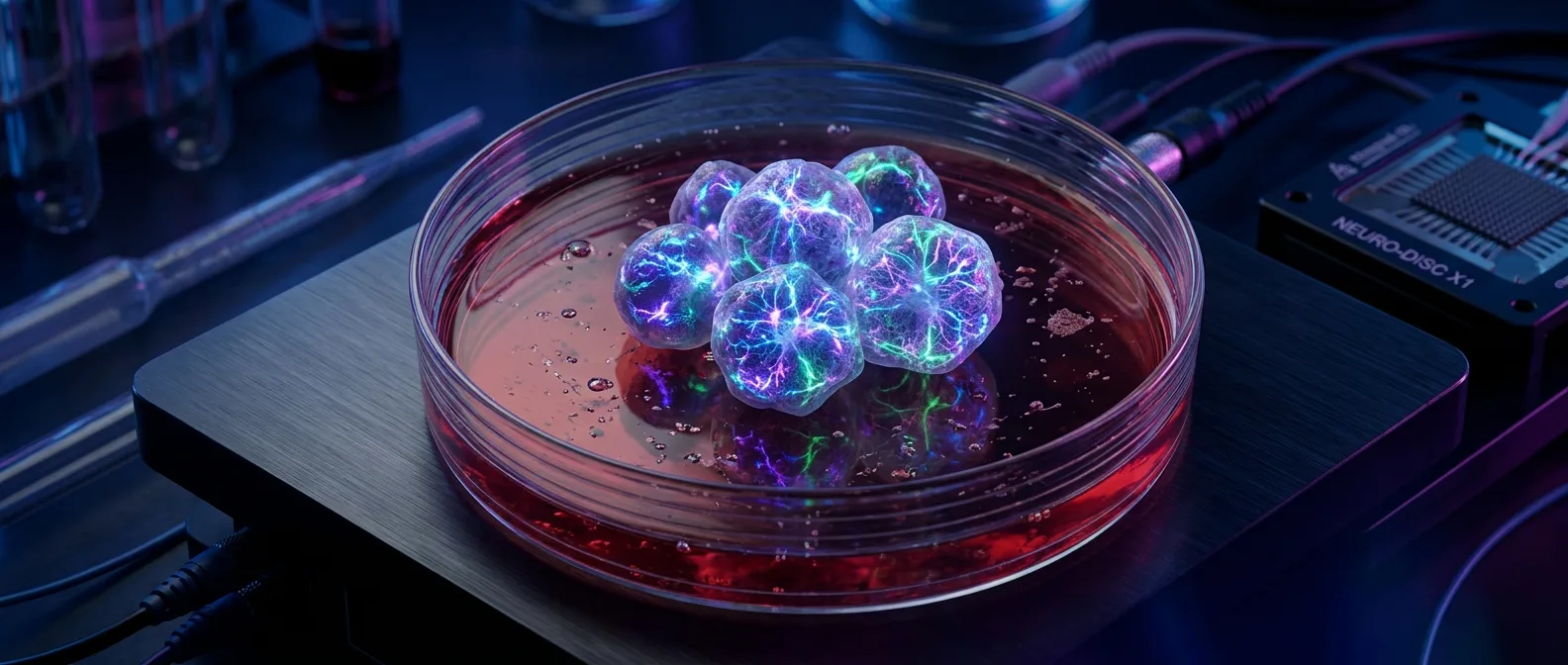
Brain organoids grown from patient cells can distinguish schizophrenia from bipolar disorder with stunning precision. Johns Hopkins researchers decoded the electrical signatures of psychiatric illness using AI algorithms that read neural firing patterns like fingerprints.
🧬 Brain Organoids: Growing Minds in Petri Dishes
Ten years ago, growing a brain in a lab sounded like science fiction. Today, brain organoids have become one of the most powerful tools for understanding psychiatric disorders.
Annie Kathuria's team at Johns Hopkins created these "mini brains" using blood and skin cells from patients with schizophrenia, bipolar disorder, and healthy volunteers. They reprogrammed the cells into pluripotent stem cells, then coaxed them into three-dimensional structures that mimic the human brain.
These aren't just clumps of neurons. The organoids develop multiple types of brain cells, produce myelin for efficient signal transmission, and replicate functions of the prefrontal cortex — the brain region most affected by psychiatric illness.
Brain Organoid Specifications
- Size: approximately 3 millimeters in diameter
- Contains multiple neural cell types
- Produces myelin for signal transmission
- Replicates prefrontal cortex functions
⚡ Electrical Signatures That Betray Mental Illness
Neurons communicate through electrical pulses. In psychiatric disorders, this conversation changes dramatically.
Microchip Measurements
To capture neural activity, researchers placed organoids on specialized microchips embedded with electrode arrays. Think of it as a microscopic EEG recording every electrical signal from hundreds of neurons simultaneously.
The results were striking. Neurons from schizophrenia and bipolar patients showed unusual firing spikes and timing changes across multiple electrical measurements. Each disorder left its own distinct signature in the neural chatter.
🔬 Machine Learning Decodes Psychiatric Biomarkers
AI became the translator that helped scientists decode complex neural patterns. Machine learning algorithms analyzed thousands of electrical recordings, hunting for distinguishing features of each disorder.
When organoids received mild electrical stimulation — a technique that reveals more neural activity — recognition accuracy jumped to 92%. It's like forcing the brain to "speak louder" so you can hear the differences more clearly.
Each Disorder's Unique Neural Fingerprint
Every psychiatric condition left its own "signature" in electrical patterns. Neurons from schizophrenia patients showed specific firing rhythms that differed from bipolar disorder — and both were distinct from healthy brains.
At least molecularly, we can control what goes wrong when we make these brains in a dish and distinguish between organoids from a healthy person, a schizophrenia patient, or a bipolar patient.
— Annie Kathuria, Johns Hopkins University
🎯 Toward Personalized Psychiatry
If current psychiatry was a guessing game, this discovery could transform it into precision medicine. Instead of trying medications for months on a patient — the familiar "trial and error" approach — doctors could first test how the patient's organoids respond.
The Clozapine Problem
Take clozapine, the most commonly prescribed drug for schizophrenia. About 40% of patients don't respond to it — but we only learn this after months of trials. With brain organoids, we might predict this upfront.
Time Savings
Instead of 6-7 months of trials, immediate indication of the right medication
Targeted Dosing
Determine optimal drug concentration for each patient
🧪 Technical Challenges Ahead
We're not ready to deploy this technology in clinics yet. The study included samples from just 12 patients — a number that needs significant expansion to validate results.
Next Steps
Kathuria's team now collaborates with neurosurgeons, psychiatrists, and neuroscientists to collect more samples. They're studying how different drug concentrations affect organoid electrical activity — research that could lead to improved dosing strategies.
Even with this limited sample size, researchers believe they can already suggest drug doses that help restore healthy neural patterns. The potential is enormous, but the path to clinical application remains long.
🔍 The Bigger Picture: Schizophrenia vs Bipolar Disorder
This discovery tackles a longstanding psychiatric dilemma. Schizophrenia and bipolar disorder share many characteristics — heritability, symptoms, age of onset. Some researchers argue they belong to a common spectrum rather than being separate diseases.
The new research shows distinct molecular signatures for each disorder. Something that might finally settle the debate about "dimensional" approaches to mental illness.
A Pulmonology Analogy
As Kathuria explains, asthma and COPD affect the same organ — the lungs — but they're separate diseases with different causes and treatments. Calling them "unified lung disease" wouldn't help any patient.
Why Is Psychiatric Diagnosis So Difficult?
In schizophrenia and bipolar disorder, no specific brain region "breaks" in an obvious way. There are no specific enzymes that drop, like dopamine in Parkinson's. That's why diagnosis relies on clinical judgment and symptom observation.
🚀 What This Means for the Future
If this technology develops as promised, it could fundamentally change psychiatric care. Imagine a world where psychiatric diagnosis relies on objective biological data, not just symptoms and observation.
Obstacles remain, of course. Brain organoids don't fully replicate human brain complexity. The study needs replication in larger populations. And the cost and practicality of the technology must become manageable for health systems.
But the idea that we could "test" drugs on a personal model of each patient's brain before giving them to the patient sounds like science fiction becoming reality. And maybe that's exactly what psychiatry needs — a little more science, a little less guesswork.
🎯 Frequently Asked Questions
How accurate are organoid-based diagnoses?
With current techniques, accuracy reaches 83% at baseline and 92% with electrical stimulation. These are very encouraging initial results that need further validation.
When will this technology be available in clinical practice?
Researchers estimate several more years are needed for clinical trials and validation. The technology is in experimental stages and requires extensive further study.
Can organoids replace traditional diagnosis?
Not entirely. Brain organoids could function as a complementary diagnostic tool, providing objective biological data to support doctors' clinical assessments.