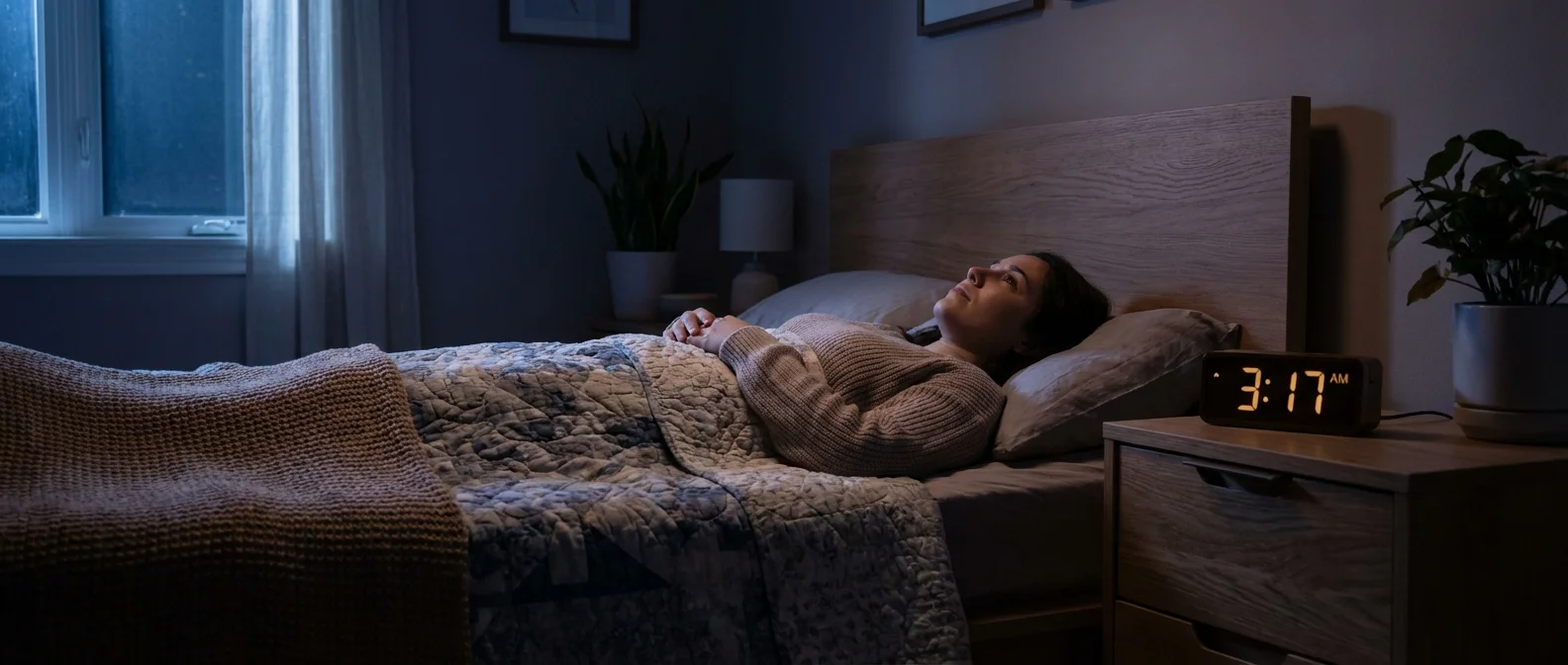
It's 3:17 AM. You know the exact time because you're checking your phone — again. Your heart beats a little faster than it should, your mind runs in a loop of thoughts, and your only certainty is that tomorrow you'll be exhausted. If you recognize this scenario, you're not alone. Insomnia and anxiety feed each other in a vicious cycle that traps millions of people worldwide — but science now understands very well how this mechanism works, and how you can break it.
The Vicious Cycle: How It Works
The insomnia-anxiety relationship isn't linear — it's circular. Anxiety activates the sympathetic nervous system, raises cortisol levels, and keeps the brain in a state of hyperarousal. This makes sleep nearly impossible. The next day, sleep deprivation boosts amygdala activity — the brain's fear center — by 60%, according to fMRI studies. And so the cycle closes: less sleep → more anxiety → less sleep.
What makes this cycle particularly persistent is cognitive hyperarousal — the state where the mind won't stop analyzing, predicting dangers, and recycling worries. “What if I can't sleep?” “Will I manage tomorrow?” These thoughts aren't just a result of anxiety — they become the cause of insomnia.
What the Numbers Say
Insomnia isn't rare — it's an epidemic. According to large meta-analyses, chronic insomnia prevalence ranges between 4% and 22% of the population, while in people with psychiatric disorders the rates skyrocket.
What Insomnia Does to the Brain
A major Mayo Clinic study that followed 2,750 adults for an average of 5.5 years revealed that chronic insomnia doesn't just affect mood — it literally changes brain structure. Chronic insomniacs showed faster accumulation of amyloid plaques (proteins linked to Alzheimer's disease) and more white matter damage — the “cables” that carry messages between brain regions.
Even more alarming: according to a British study of civil servants, regularly sleeping under 6 hours in your 50s is already linked to higher dementia risk two decades later. This means prevention must start far earlier than most people think.
The Body Clock & Mental Health
An extensive 2024 review, published in the Proceedings of the National Academy of Sciences, by researchers from the Universities of Southampton, King's College London, and Stanford, reached a critical conclusion: sleep-circadian disturbances are the rule, not the exception, across every category of psychiatric disorder.
During adolescence, physiological sleep changes combine with behavioral shifts — later bedtimes, less sleep on school nights, sleeping in on weekends. This “misalignment” between the biological clock and actual sleep schedule can significantly increase the risk of mental health disorders.
Insomnia is more common in people with mental health disorders compared to the general population — during remission, acute episodes, and especially in early psychosis, where it affects over half of individuals. In bipolar disorder, the body clock can “run” 7 hours ahead during manic episodes and lag 4-5 hours behind during depressive phases — a striking finding showing how tightly sleep and mental health are intertwined.
Exercise as Sleep Medicine
A large network meta-analysis from 2025, published in BMJ Evidence-Based Medicine, compared 13 different therapeutic approaches to insomnia across 22 randomized clinical trials with 1,348 participants. The results were striking: exercise can be equally effective — or even superior — to medication.
Yoga
Increased total sleep time by nearly 2 hours, improved sleep efficiency by 15%, and reduced time awake after falling asleep by nearly an hour. The mechanism? Yoga may alter brain activity, alleviating anxiety and depressive symptoms that interfere with sleep.
Tai Chi
Reduced poor sleep quality scores by over 4 points, increased sleep time by 50+ minutes, and shortened sleep latency by 25 minutes. Remarkably, Tai Chi significantly outperformed all other treatments across both subjective and objective measures — for up to 2 years. Its combination of controlled breathing and physical relaxation decreases sympathetic nervous system activity, deactivating “mental chatter.”
Walking & Jogging
Reduced insomnia severity by nearly 10 points on the ISI scale. These improve sleep through increased energy expenditure, reduced cortisol production, improved emotional regulation, enhanced melatonin secretion, and more deep sleep.
CBT-I: The Gold Standard Therapy
Cognitive Behavioral Therapy for Insomnia (CBT-I) remains the treatment of choice according to international guidelines. It's not medication, but a structured psychological intervention that addresses the thoughts and behaviors fueling the insomnia-anxiety cycle.
CBT-I improves sleep in 70% of patients and — crucially — simultaneously reduces symptoms of anxiety, depression, and even post-traumatic stress. It can be delivered in person or digitally through apps. According to a small clinical trial, even in patients with mild cognitive impairment, CBT-I improved executive function.
7 Practical Strategies to Break the Cycle
New Horizons: What's Coming
Science isn't stopping at traditional therapies. Recently, UCSF researchers are testing a pharmaceutical form of LSD, known as MM120, for generalized anxiety disorder. In a clinical trial published in JAMA, a single dose reduced symptoms by 5-6 points on the anxiety scale — enough to reclassify moderate anxiety as mild in some cases. The mechanism of action? Neuroplasticity: MM120 increases communication between brain regions and loosens the “frozen” thought patterns that feed anxiety.
Meanwhile, innovative interventions like Trans-C (Transdiagnostic Intervention for Sleep and Circadian Dysfunction) combine modules addressing different aspects of sleep and circadian rhythms into a unified therapeutic framework — applicable across multiple mental health disorders.
The First Step
If you find yourself in this vicious cycle, remember: the goal isn't perfect sleep, but reducing hyperarousal. You don't need to “force” yourself to sleep — that only amplifies anxiety. You need to create the conditions that allow sleep to come on its own.
Light, movement, routine, addressing your thoughts — these are the tools. And if the condition persists for more than 3 months or seriously affects your daily functioning, seeking professional help isn't weakness — it's the smartest move you can make.
1. Mayo Clinic Study — Chronic insomnia & brain biomarkers, PMC 2025
2. Bu et al. (2025). Exercise interventions in insomnia: Network meta-analysis, BMJ Evidence-Based Medicine, DOI: 10.1136/bmjebm-2024-113512
3. Meyer et al. (2024). The sleep–circadian interface: A window into mental disorders, PNAS, DOI: 10.1073/pnas.2214756121
4. Robison et al. (2025). Single Treatment With MM120 in Generalized Anxiety Disorder, JAMA, DOI: 10.1001/jama.2025.13481
5. Sabia et al. (2021). Sleep duration & dementia risk at age 50, Nature Communications, DOI: 10.1038/s41467-021-22354-2