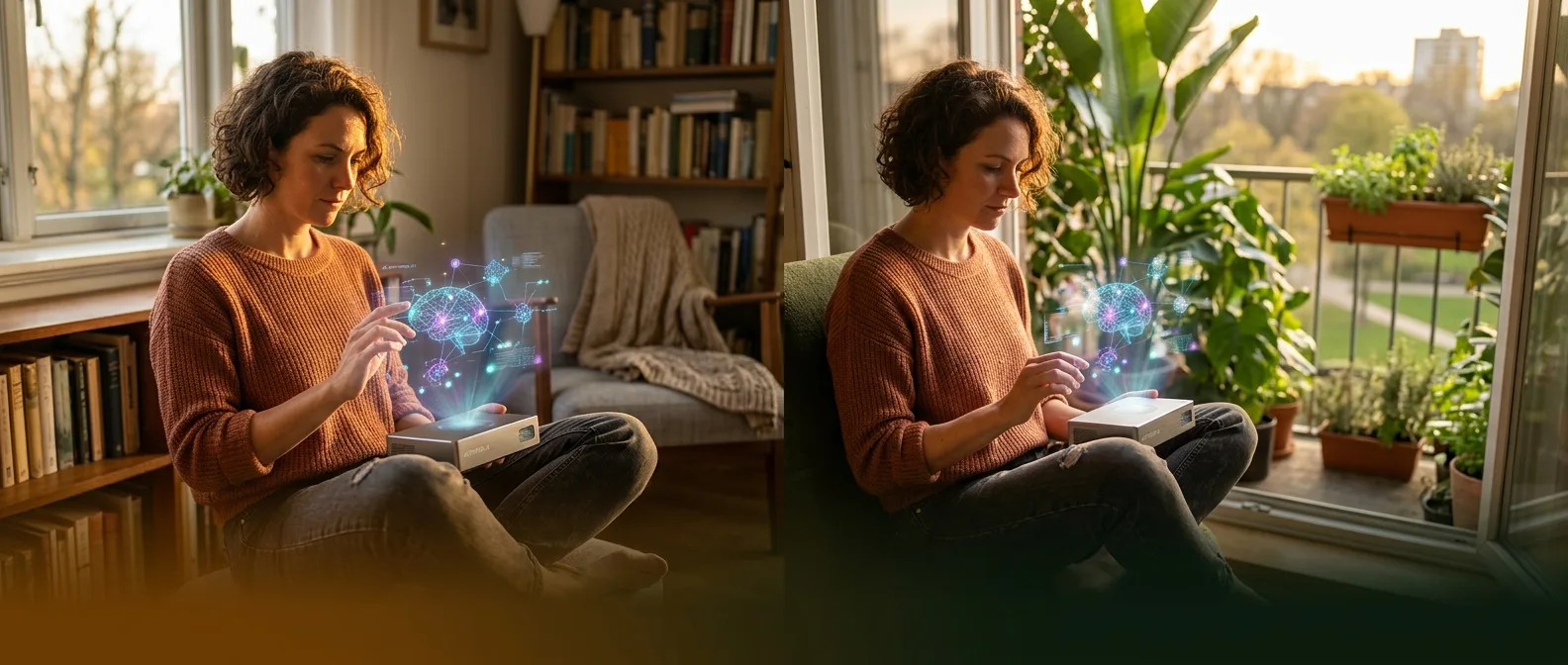
If what makes you happy comes from an algorithm — does it really make you happy? Welcome to the age of hybrid happiness, where artificial intelligence isn't just a tool but a partner in our pursuit of fulfillment. In 2026, we find ourselves outsourcing to machines: outsourcing to machines large chunks of what once created meaning — creativity, the gradual construction of something from nothing, the effort that had shape.
🧠 How AI Redefined Happiness Itself
Aristotle split it cleanly 2,400 years ago. On one side, hedonia — pleasure, comfort, the satisfaction of desire. On the other, eudaimonia — a word we clumsily translate as "happiness" but means something closer to flourishing, becoming fully what you can be.
The distinction still matters in 2026. Maybe more than ever. Because now we have systems that can produce music in five seconds, write poems in ten, design logos in twenty-five. What's left for the human who once needed sleepless nights to hear their inner voice?
Psychologist Mihaly Csikszentmihalyi proved that the state most connected to deep satisfaction — flow — requires precise balance between challenge and skill. Remove the challenge and flow evaporates.
What remains looks more like cognitive consumption. Like ordering inspiration from a delivery platform.
⚡ The Technology of Human Connection
The largest scientific study of happiness in adult life — the Harvard Study of Adult Development, now running 85 years — found something utterly simple. Good relationships keep us healthier and happier. Not wealth. Not fame. Not even physical health.
Now we have AI companions. Systems designed to be endlessly patient, always available, always kind. Millions use them — many lonely, depressed, socially anxious.
The Trap of False Intimacy
A 2023 study showed regular AI companion use correlated with reduced loneliness short-term — but increased social avoidance after six months. The pattern is disturbingly similar to social media: made you feel more connected while, gradually, making you feel more alone.
The difference between a relationship that can surprise you and one calibrated to agree with you isn't small. It's the difference between the world and a mirror.
🎯 Hybrid Intelligence as the Answer
The concept of hybrid intelligence offers a way of thinking that sees AI neither as a replacement for human intelligence nor as a simple tool. Instead, it recognizes the complementary strengths of both forms.
This isn't about technology controlling us. It's about the choices we make.
The Four-Dimension Framework
Psychologists identified four internal dimensions that shape intention in the AI world: pursuit, emotion, thought, and sensation. When these dimensions align, humans demonstrate greater autonomy and moral awareness.
Pursuit provides direction. Emotion supplies energy. Thought structures meaning. And sensation offers feedback from the body — something intelligence researchers rarely consider.
"Technology won't save us from ourselves. We must consciously choose which values to embed in AI systems and work actively to implement them."
Cornelia C. Walther, Psychology Today
🔬 The Neurons of the Hybrid Era
Neuroscience makes clear something that seems contradictory: emotion isn't noise in decision-making but the source of its energy. Antonio Damasio showed that without emotional signals, humans struggle to set priorities or act decisively.
In everyday AI use, emotional dynamics often remain unspoken. People turn to AI to reduce discomfort, cognitive load, or the effort of starting from scratch. Over time, this can subtly shift autonomy: decisions feel smoother, but less ours.
Cognitive Load
AI can reduce cognitive load — but at what cost to critical thinking?
Emotional Intelligence
Recognizing emotions in our relationship with AI becomes key to maintaining autonomy.
The Body as Intelligence System
The most neglected dimension in intelligence discussions is the body. Yet sensation continuously shapes attention, judgment, and emotional regulation. Research on embodied cognition shows thinking isn't confined to the brain.
AI interaction has a bodily signature: prolonged stillness, shallow breathing, visual fixation, subtle muscle tension. These physical states affect patience, openness, and critical distance.
📊 Survival Guide for the Hybrid Era
How do we find happiness in a world where a chatbot can write better emails than us? Psychologists propose a four-step framework — not to resist change, but to direct it:
Awareness
Notice where you find meaning today versus the past. Has automation silently removed activities that once gave you a sense of achievement? Name them. You can't reclaim what you haven't noticed losing.
Appreciation
Not all friction that creates meaning needs to be productive. Play. Physical effort. Cooking from scratch. Learning an instrument badly. These matter precisely because the effort itself is the meaning, not the outcome.
Acceptance
AI companions serve real human needs. Pretending otherwise isn't useful. But also accept the difference between a relationship that can surprise you and one calibrated to agree with you.
Accountability
You're responsible for the quality of your connections — not just digital ones. Who have you called this week? Who calls you?
The critical question: Which parts of this process am I unwilling to delegate, and why? The answer will tell you more about your happiness than any algorithm.
🎯 Frequently Asked Questions
Can an AI companion really make me happy?
Short-term, yes — it can reduce loneliness and provide emotional support. Long-term, studies show mixed results. Quality beats quantity and availability, even in relationships.
Am I losing my creativity if I use AI for art?
Depends how you use it. If you stay inside the work instead of standing outside it and directing it, hybrid creativity can emerge. The keyhole is maintaining reflection.
How do I know if AI is helping or replacing me?
Ask yourself: does this interaction expand or limit me? Make me more autonomous or more dependent? The answer is usually bodily before it's mental.
In 2026, as we walk the tightrope between human and artificial intelligence, happiness isn't something we find — it's something we create. And that creation, even in the world of algorithms, remains deeply human. The question is whether we'll choose to keep it that way.