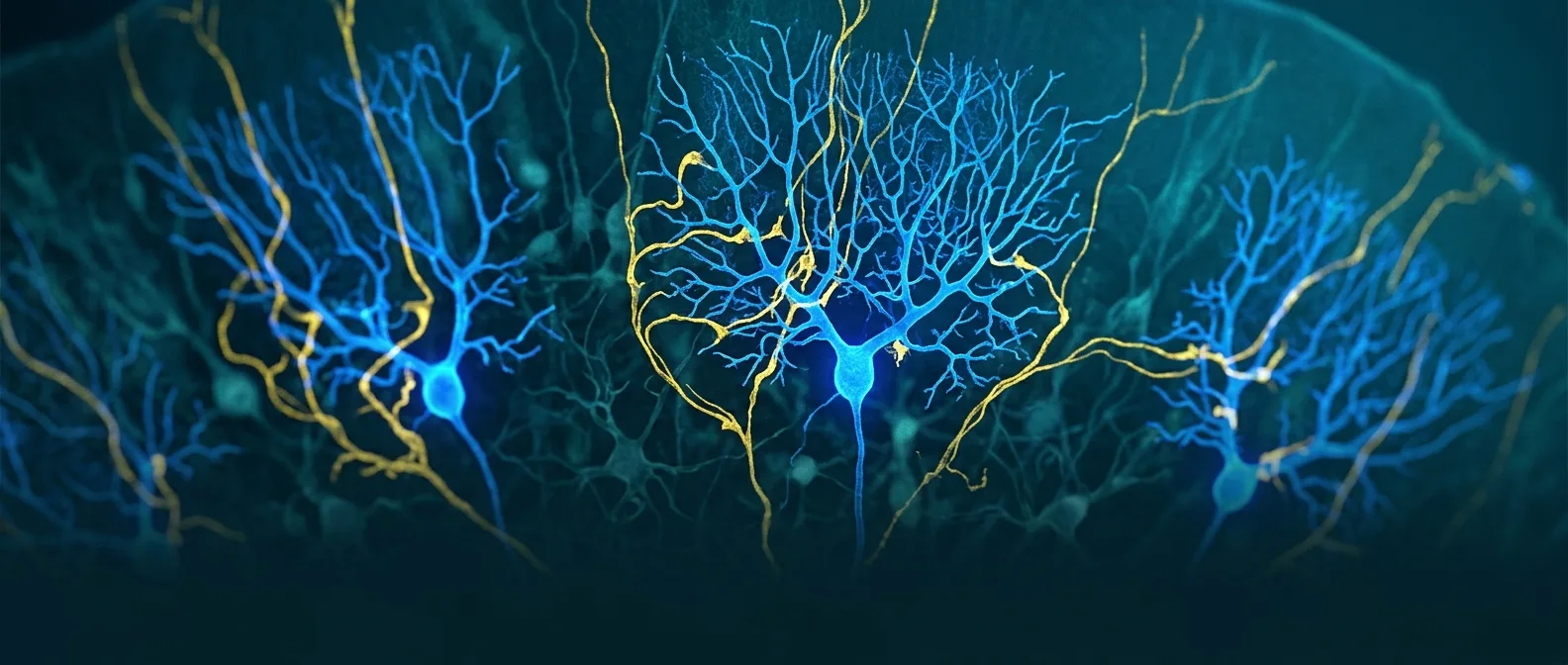
A mouse stumbles through a timing task at Duke University. Every time it screws up, millions of neurons in its **cerebellum** fire in perfect synchrony. March 2026 brought the breakthrough that explains why: scientists discovered a hidden **brain circuit** that transforms spectacular failures into accelerated **learning from mistakes**. Your brain doesn't just tolerate big errors — it craves them.
📖 Read more: Brain Microplastics: 5 Ways They Trigger Alzheimer's & Dementia
🔬 The Cerebellum's 50-Year Paradox
Neuroscientists have known for decades that **neuroplasticity** depends on specialized nerve fibers called climbing fibers. Miss a tennis serve or hit a wrong piano note, and these fibers blast powerful error signals to **Purkinje cells** in the cerebellum.
But here's what made zero sense. Those same climbing fibers simultaneously activated inhibitory cells that should block learning. How can your brain promote and prevent learning at the exact same moment?
Picture a car with the gas pedal and brake wired to the same switch. Every time you try to accelerate, you also slam the brakes. That's the paradox that stumped researchers for half a century.
The Paradox: Climbing fibers in the cerebellum send simultaneous signals that promote learning (via calcium) and signals that inhibit it (via inhibitory neurons). How does the brain resolve this contradiction?
⚡ The Hidden Circuit That Releases the Brakes
The March 2026 Nature study from Court Hull's Duke team and Wade Regehr's Harvard lab solved the puzzle. Using ultra-detailed electron microscopy and live recordings from mouse brains, they uncovered a mechanism that works like a sophisticated brake system.
Lead author Fernando Santos Valencia discovered that climbing fibers don't activate all inhibitory cells equally. Instead, they target a specific group called MLI2 cells. But these cells don't directly shut down the Purkinje cells that drive learning.
The Disinhibition Chain Reaction
MLI2 cells do something smarter: they silence another group of inhibitory neurons called MLI1 cells, whose normal job is blocking learning. One type of neuron "turns off" another that usually prevents learning.
Think of it as a double-brake system. MLI1 cells are the main brakes keeping learning under control. MLI2 cells are the mechanism that "releases" those brakes when you need rapid adaptation.
When you make a massive error — completely whiff a golf swing or stumble on flat ground — climbing fibers fire in unison. This synchronized blast activates MLI2 cells, which silence the MLI1 "learning brakes," opening a brief window for **neuroplasticity** to rewire your motor circuits.
🧬 Why Spectacular Failures Trump Small Mistakes
The key lies in synchronization. When multiple climbing fibers fire together — which happens during obvious errors — the hidden circuit "opens a learning window." Small, barely noticeable mistakes don't trigger enough climbing fibers to activate this system.
Consider a novice tennis player learning to serve. Tiny, imperceptible errors don't activate the system sufficiently. But when the ball sails completely out of bounds — what Billie Jean King called a "doozy" — dozens of climbing fibers fire simultaneously.
"The key is having 'brakes' that can control neural plasticity. Rather than constantly increasing error messages, a braking mechanism allows the brain to open a window for learning when needed."
— Fernando Santos Valencia, Duke University
When Your Brain Demands Attention
This synchronized activation happens during situations like:
- Tripping over an unexpected obstacle
- Loud unexpected sounds that startle you
- Sudden movement in your peripheral vision
- Completely botched movements in sports or music
In these moments, your brain decides it needs to learn something important. The brakes release for milliseconds, allowing Purkinje cells to generate powerful calcium signals that rewire neural connections.
🎯 From the Court to Real Life
This discovery explains why certain learning methods work better than others. In music, teachers who dramatically highlight mistakes — instead of letting them pass unnoticed — might help students learn faster.
In sports, training that makes errors "loud and clear" could be more effective than repetitive practice without feedback. This explains why flight simulators that create dramatic failure scenarios are so effective.
Music
Rhythm mistakes activate the circuit more than slight pitch inaccuracies
Languages
Completely wrong pronunciation or grammar creates stronger learning signals
Driving
Hard braking and missing turns teach more effectively than minor corrections
Revolutionizing Educational Design
This discovery changes how we should design training programs. Instead of trying to avoid mistakes, we might need to make them unavoidable and obvious, then provide immediate, crystal-clear feedback.
Virtual reality systems that create controlled "catastrophic" errors might prove to be exceptional learning tools. Imagine a surgical simulator that amplifies the consequences of mistakes instead of hiding them.
🧭 The Neuroplasticity We Never Knew Existed
The research provides new paths to understanding neurological disorders. Court Hull explains that an imbalance of excitation and inhibition in the cerebellum could lead to motor dysfunction or learning problems.
Specifically, disorders like ataxias — which cause coordination problems — might relate to dysfunction in this circuit. Even autism spectrum disorders, which many researchers believe connect to the cerebellum, could gain new therapeutic targets from this discovery.
Future Therapeutic Interventions
If we understand how to activate or deactivate this hidden circuit, we could develop targeted therapies. Techniques like transcranial magnetic stimulation might someday "tune" these learning brakes.
Pharmaceutical interventions affecting MLI1 and MLI2 cells could improve learning in people with motor function problems. Of course, we're talking about future applications — in 2026, we're still in the early phases of understanding these mechanisms.
🔄 Overturning "Perfect Practice"
Traditional thinking held that repeating perfect movements leads to mastery. What this new research reveals is that we need balance: enough practice to develop basic competency, but enough obvious errors to activate deep learning mechanisms.
This doesn't mean we should make mistakes on purpose — but when they happen, we should embrace them instead of ignoring them. The key is immediate, clear feedback that makes the error undeniable.
"If you're going to make a mistake, make it a doozy."
— Billie Jean King
The New Learning Philosophy
Maybe we need to change our approach to education and training. Instead of trying to avoid mistakes, we could design experiences that make them necessary and obvious.
This could explain why highly competitive environments — where mistakes have clear consequences — often produce such capable people. Pressure and stress aren't necessarily bad for learning, as long as they're combined with appropriate support.
🎯 Frequently Asked Questions
Does this circuit only work in the cerebellum?
The cerebellum is highly "conserved" across species, meaning similar mechanisms likely exist in humans. Other brain regions might also have comparable "learning brakes," but this remains under investigation.
Can we enhance this mechanism?
Currently, the best approach is creating conditions that produce clear, immediate feedback for errors. Future technologies might allow more direct interventions.
Are there risks from too many mistakes?
The circuit has natural regulatory mechanisms — the "brakes" exist for good reason. Chronic stress or excessive failure can lead to counterproductive effects on learning and mental health.
This discovery changes how we view the relationship between failure and success. It's not just about psychological resilience — it's biological necessity. Our brains evolved to use mistakes as fuel for improvement, as long as they're clearly recognized.
The next time you make an obvious mistake — whether on the court, at the piano, or learning a new language — remember that in that exact moment, millions of neurons in your cerebellum are synchronizing to make you better. The brakes released for a few milliseconds, and your brain just "opened a window" for real learning. Maybe mistakes aren't obstacles to learning after all — they're the engine itself.