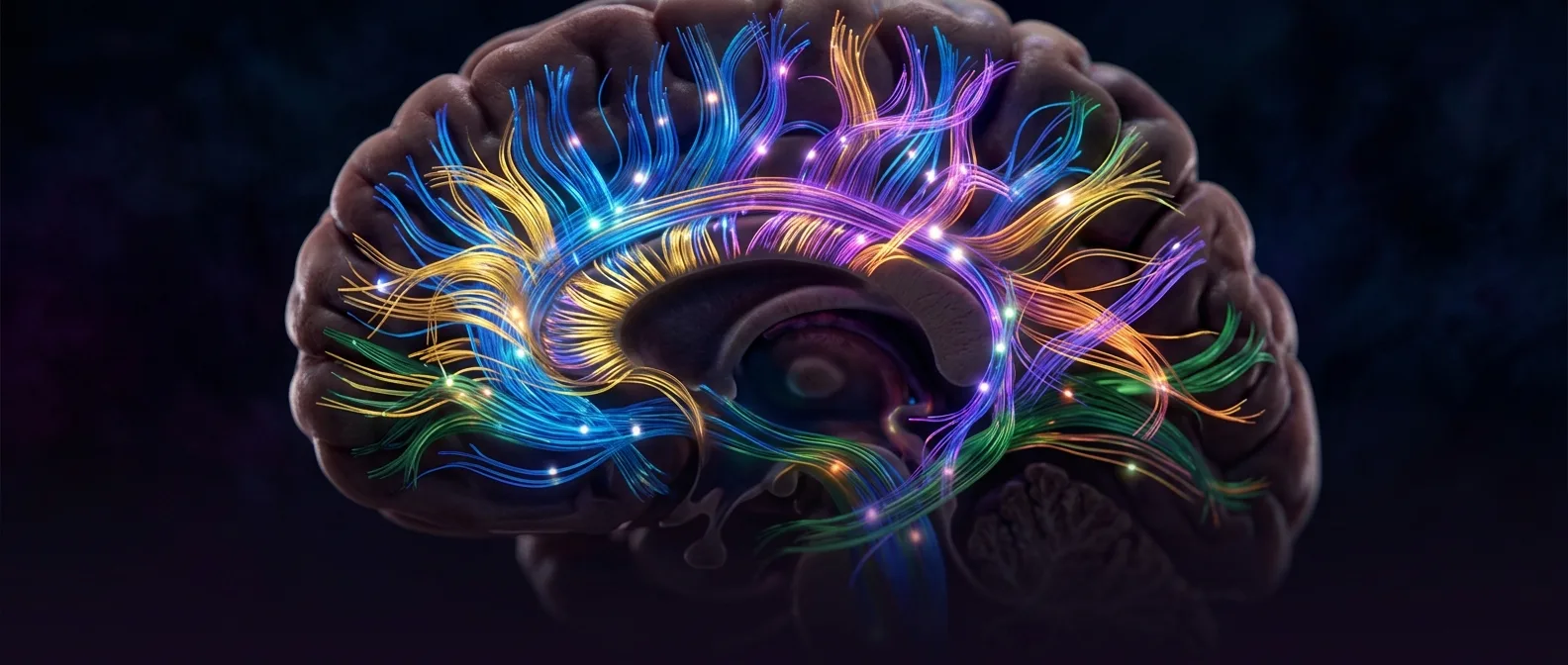
Brain Timing Secrets: How Speed Shapes Intelligence
Picture yourself listening to music. You catch the melody, the rhythm, and the background instruments all at once. How does your brain pull this off? Rutgers University researchers have discovered a timing mechanism in the brain that shapes cognitive abilities. The study focuses on intrinsic neural timescales and how white matter connections sculpt intelligence itself.
Researchers led by Professor Linden Parkes analyzed data from 960 people to understand how different brain regions process information at wildly different speeds. The research, published in January 2026 in Nature Communications, reveals a fundamental mechanism of brain function.
🧬 The Brain's Internal Clocks
Not every brain region processes information at the same speed. Some fire instantly — like your visual cortex spotting a moving target. Others work deliberately, parsing meaning and context over longer stretches.
These different speeds are called intrinsic neural timescales. They reflect how long a brain region holds onto information before moving to the next piece. "To influence our environment through action, our brain must combine information processed across different timescales," Parkes explains.
From Lightning Reflexes to Deep Thought
Imagine driving. You see a car suddenly merge into your lane — your reaction is instant. Simultaneously, you're thinking about your route home, planning dinner. The brain juggles all this in parallel, something neuroscientists have only recently begun to decode.
Primary sensory regions — like visual and auditory cortex — operate on shorter timescales. Higher-level areas, like the default-mode network, work across longer time horizons.
📊 Mapping Brain Connections
The Rutgers team examined brain connections — connectomes — in nearly a thousand people. They used mathematical models that describe how complex systems evolve to track how information flows through neural networks.
What is a Connectome?
A connectome maps every neural connection in the brain. Think of it as the "wiring diagram" linking different regions — but with hundreds of millions of connections.
"Our work examines the mechanisms of this process in humans, directly modeling regional timescales from their connectivity," Parkes notes. This creates a direct link between how brain regions process information locally and how they share that processing globally.
White Matter as Information Highway
White matter functions as the brain's communication system. Researchers discovered these connections aren't just "cables" — they actively influence how different regions combine fast and slow information streams.
⚡ Brain Timing and Intelligence
The researchers found something unexpected. Researchers found that brain timing isn't identical across people. The arrangement of neural timescales across the cortex plays a central role in how efficiently the brain switches between different activity patterns.
Why does this matter? Because this flexibility connects directly to cognitive abilities. "We found that differences in how the brain processes information at different speeds help explain why people differ in their cognitive abilities," Parkes observes.
"People whose brain networks better match how different regions handle fast and slow information tend to show higher cognitive ability."
Linden Parkes, Rutgers University
From Genes to Behavior
The study connected brain timing to genetic, molecular, and cellular characteristics of brain tissue. This isn't just a psychological phenomenon — it has biological roots.
Even more striking? Similar patterns appeared in mouse brains. This suggests brain timing mechanisms are shared across species — an evolutionary "inheritance" we all carry.
🎯 Mental Health Applications
The discovery opens doors for understanding psychiatric disorders. The team now applies the same approach to conditions like schizophrenia, bipolar disorder, and depression.
Schizophrenia
Exploring how connectivity changes disrupt information processing
Bipolar Disorder
Studying temporal changes in brain networks
Depression
Searching for biomarkers in brain timing organization
The goal is understanding how changes in brain connections might disrupt information processing across time. This could lead to entirely new therapeutic approaches.
From Lab to Clinic
Imagine an era when we can "measure" someone's brain timing efficiency. Or predict who's at risk for specific disorders based on their brain's temporal patterns.
🔬 Collaborations and Future Directions
The research involved collaboration with Avram Holmes, also from the Rutgers Brain Health Institute, and researchers from Cornell University. The team used data from the Human Connectome Project — a massive catalog of brain data.
What's next? Researchers want to see if they can "train" the brain to improve its timing organization. Or develop new neurostimulation methods targeting specific temporal patterns.
Artificial Intelligence and Brain Rhythms
The findings might also improve artificial intelligence. If we understand how the brain manages multiple timescales, we might create more efficient AI systems.
When ChatGPT generates text, it processes each word separately, in sequence. The human brain combines different temporal scales in parallel — from rapid letter recognition to slow meaning comprehension.
🎯 Frequently Asked Questions
Can someone improve their brain's timing organization?
Currently, no proven methods exist. Research is in early stages and focuses on understanding mechanisms. However, researchers are exploring potential neurostimulation applications.
Do intrinsic neural timescales relate to IQ?
The study shows correlation with cognitive abilities but doesn't specifically reference IQ. Brain timing appears to affect overall brain function efficiency more broadly.
How does this differ from other brain studies?
The innovation lies in connecting structural connectivity (white matter) with temporal dynamics of brain regions. Previous research examined these aspects separately.