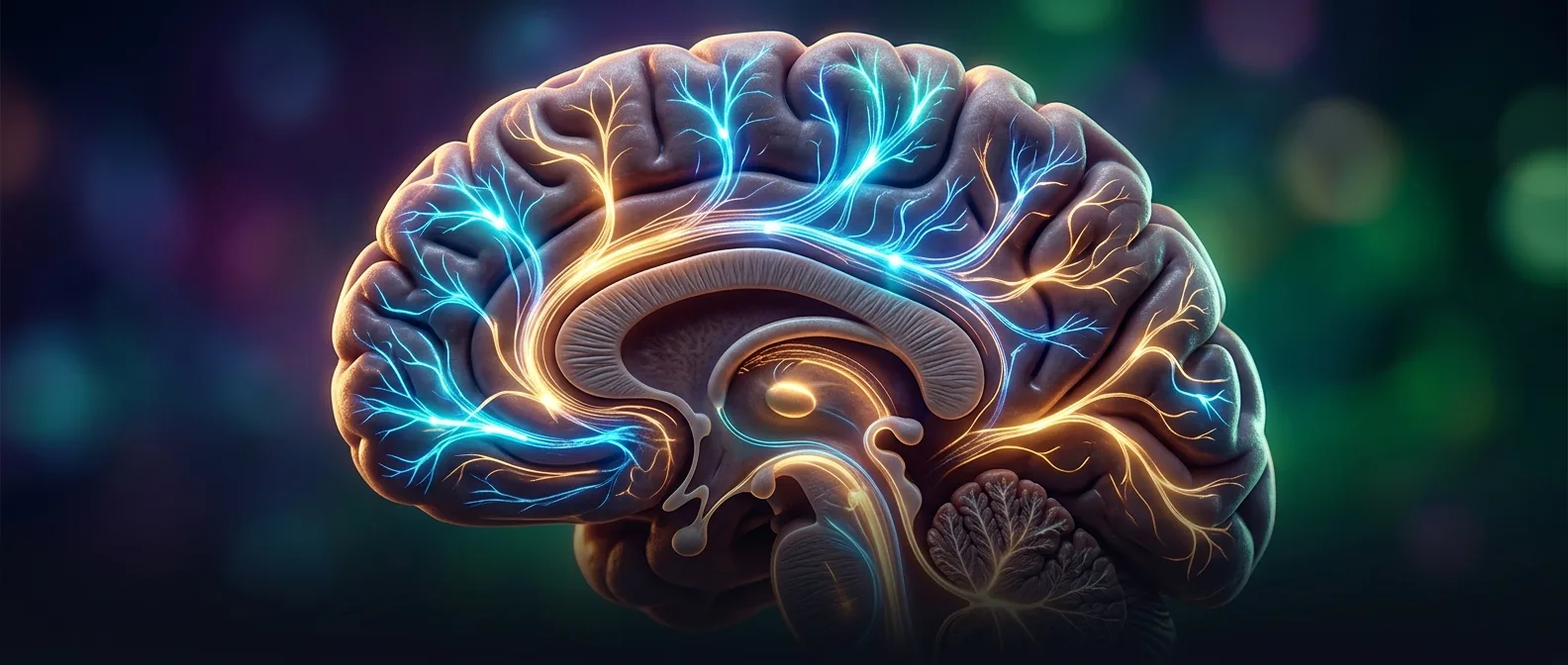
Your brain runs on dozens of different clocks. Some tick every few milliseconds. Others take minutes to complete a cycle. New research from Rutgers Health reveals that the synchronization between these neural timescales determines how effectively you think — and why some people are naturally faster decision-makers than others.
A car speeds toward you. Your visual cortex registers the motion in milliseconds. Your brain identifies it as a vehicle, estimates its speed, and decides whether to step back — processes that unfold over seconds or even minutes. How does your brain coordinate these wildly different processing speeds into coherent thought?
The answer lies in a sophisticated system of **neural timescales** that scientists are only now beginning to decode. Each brain region operates with its own characteristic "time window" for processing information — from hundredths of a second in sensory areas to full seconds in higher cognitive regions. Think of it as an orchestra where every section plays at a different tempo, yet somehow produces harmony.
But here's what makes it work: the brain's white matter connections don't just carry signals between regions. They act as temporal translators, allowing fast-processing areas to communicate with slow-thinking zones despite their radically different operating speeds.
🧬 The Hidden Network That Synchronizes Your Mind
A groundbreaking 2026 study published in Nature Communications analyzed brain data from 960 people to map exactly how this timing system functions. Researchers at Rutgers Health discovered something remarkable: **white matter connections** in the brain aren't just "cables" that transmit signals — they're the tools that allow different brain regions to "talk" to each other despite operating at completely different speeds.
"To influence our environment through action, our brain must integrate information processed across different timescales," explains Linden Parkes, assistant professor of Psychiatry and lead researcher. But the mechanics of this integration have remained mysterious until now.
The team used advanced mathematical models to predict how information travels through this complex network. By applying **Network Control Theory**, they could "see" how the brain transitions from one activity state to another — and which regions are critical for these transitions.
What Are Intrinsic Neural Timescales (INTs)?
Every brain region "holds onto" information for a specific duration before moving to the next thought. This characteristic time window is called an Intrinsic Neural Timescale (INT) — and it determines how fast or slow a region "thinks."
Speed vs Depth: The Brain's Trade-off
Primary sensory regions — those processing vision, hearing, touch — operate like high-speed messengers. They refresh their information every few milliseconds, constantly updating your awareness of the immediate environment. Meanwhile, prefrontal cortex regions responsible for decision-making and planning run much slower rhythms — they might "hold" a piece of information for seconds or even minutes.
This difference isn't accidental. It's why you can react instantly to a loud noise but need more time to decide whether to change careers. Fast regions handle the "what's happening now" while slow regions tackle the "what should I do about it."
The breakthrough came when researchers discovered that people whose brain connections are better "tuned" to the needs of different regions — meaning optimal matching between processing speed and connectivity — showed higher cognitive abilities across the board.
⚡ The Architecture of Mental Synchronization
The study's real achievement was developing mathematical models that predict how information flows through this timing network. Using data from 960 participants, the team found that **neural timescales** aren't random — they follow predictable patterns that correlate with genetic, molecular, and cellular characteristics of brain tissue.
In other words, how fast a brain region "thinks" depends partly on which genes are expressed there and what types of neurons exist in that area. Your cognitive speed isn't just about practice or training — it's built into your brain's architecture.
But here's the most striking discovery: when the researchers allowed their model to "learn" optimal neural timescales for each region — instead of assuming all areas operate at the same speed — its performance improved dramatically. It could predict actual brain states observed in scanners far more accurately.
From Lab to Genetics
The research didn't stop at connections. The team discovered that these timing patterns link to genetic, molecular, and cellular characteristics of brain tissue. The speed at which a region "thinks" depends partly on which genes are active there and what kinds of neurons populate that area.
This suggests that your personal cognitive profile — whether you're naturally quick at decisions or prefer deliberate analysis — reflects the unique timing architecture of your brain. Some people have better balance between fast and slow regions. Others have more efficient connections between different "speed zones."
🔬 From Human Brains... to Mouse Models
To confirm this wasn't just a statistical fluke, researchers repeated their analysis on completely different datasets. First on another human sample (MICA-MICs dataset), then — unusually for this type of research — on mouse brains.
The results were crystal clear: the same mechanisms operate in both species. This means the brain's timing system isn't some "luxury feature" of human cognition — it's a fundamental mechanism preserved across evolution. Even mouse brains coordinate fast sensory processing with slower decision-making through similar white matter connections.
"Our work reveals a fundamental link between the brain's white matter connectivity and its local computational properties."
Linden Parkes, Rutgers Health
The Next Generation of Brain Research
This understanding opens new avenues for studying mental disorders. Parkes' team is now applying the same approach to neuropsychiatric conditions like schizophrenia, bipolar disorder, and depression. The hypothesis: disruptions in connectivity or timing organization might explain how information flow changes in these conditions.
Imagine if we could "see" exactly where timing synchronization breaks down in a patient with depression — and target therapy there specifically. That's the kind of precision medicine this research could enable.
🎯 What This Means for You
Beyond scientific curiosity, this research has practical implications. Understanding how brain "clocks" work helps explain why some people are naturally faster at decision-making while others excel at deep, reflective thinking.
The difference isn't simply "intelligence" — it's how your brain is "wired." Some people have better balance between fast and slow regions. Others have more efficient connections between different speed zones. Neither is inherently superior; they're different cognitive strategies optimized for different challenges.
Personal Timing Profiles
Each person has a unique organization of neural timescales that influences their cognitive strengths and processing style
White Matter Connectivity
The quality of connections between brain regions determines how well fast and slow areas can coordinate
Questions That Remain
Despite this progress, many mysteries persist. Can we "train" our brains to synchronize better? Are there specific exercises that improve these connections? Most importantly: how "plastic" is this timing system in adult life?
Researchers hope their new approach will answer these questions in coming years. Particularly intriguing is that their model can be applied at the individual level — meaning it could potentially "map" the timing profile of your specific brain.
🧩 The Bigger Picture of Intelligence
This discovery adds another piece to the giant puzzle we're trying to solve: how consciousness and intelligence emerge from biological matter. In 2026, we have a much clearer picture of the brain as a multi-layered, temporally organized system — not just a simple "computing machine."
Each new study adds detail to our understanding. With help from modern technologies — from advanced MRI scanners to machine learning algorithms — we're beginning to see the brain as it really is: a stunning orchestral work coordinating billions of neurons in perfect harmony.
What remains now is figuring out how to use this knowledge to help those facing challenges — and perhaps enhance our own mental abilities. The brain's timing system might hold keys to both treating disorders and optimizing human potential.