📖 Read more: Attachment Theory: How Childhood Shapes Your Relationships
🧠 When Baby Chicks Do What We Thought Only Humans Could
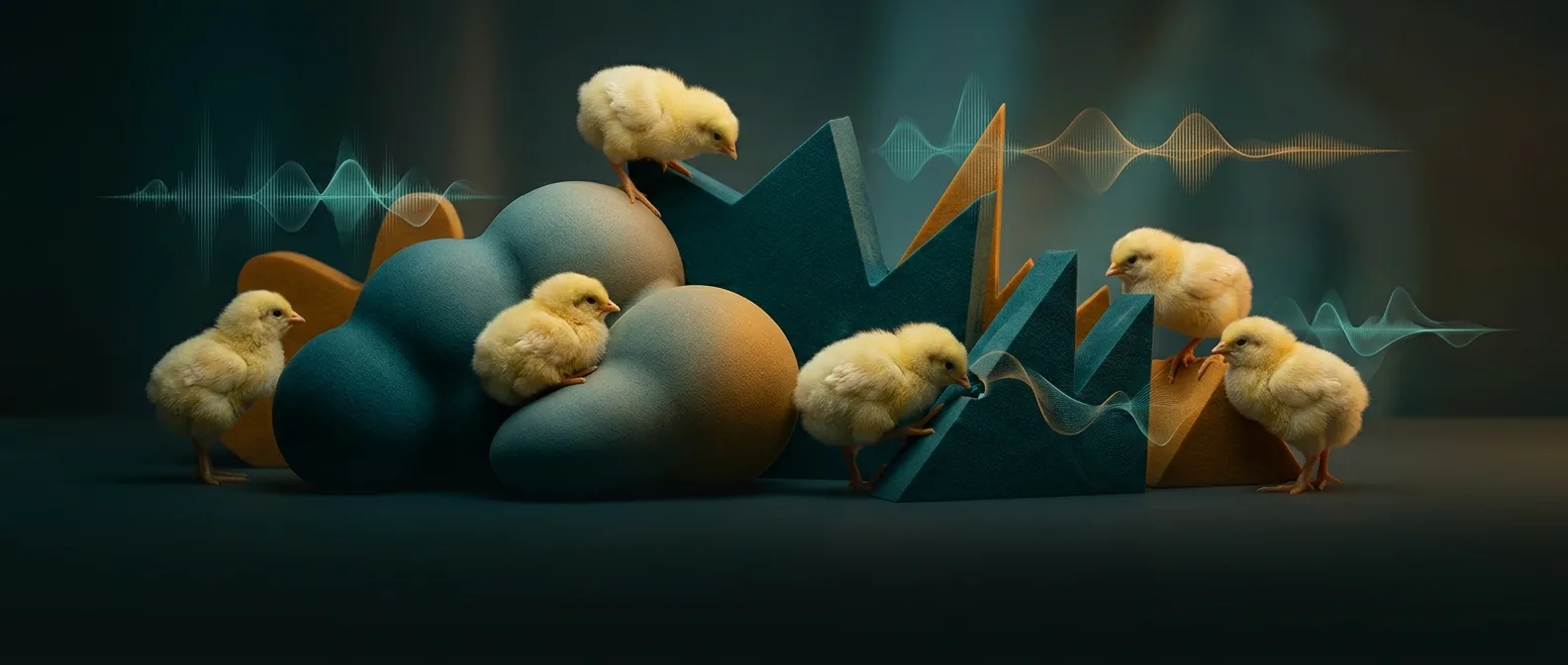
At the University of Padova, Maria Loconsole and her research team placed baby chickens in front of two shapes: one round and soft, one jagged and spiky. When they heard the sound "bouba," 80% of the birds moved toward the round shape. When "kiki" played, they preferred the sharp one. Cross-modal correspondences like Bouba-Kiki were considered hallmarks of human language until now. Linguists believed these connections between sounds and shapes helped early humans create the first words. They were a potential bridge from meaning to sound. But this theory just took a different turn. If chicks — separated from us evolutionarily 300 million years ago — make the same associations, then the phenomenon isn't about language. It's about something deeper.What is the Bouba-Kiki Effect?
An experiment repeated thousands of times worldwide: show someone two shapes — one round, one jagged — and ask which is "bouba" and which is "kiki." Almost always, regardless of culture, the answer is identical: bouba for round, kiki for sharp.
Newborn Animals and the Mystery of Cross-Modal Correspondences
The experiment published in 2026 in Science had one crucial difference: the chicks were tested just one day after hatching. They had no time to "learn" anything from their environment. If they showed the same preference as humans, it would mean this ability is innate — and much older than we imagined. "I watched the chicks move toward the round shape when 'bouba' played and couldn't believe my eyes," explains Loconsole. "It was like seeing an ancient code activate inside their brains." Her team tested two different versions of the experiment. In the first, three-day-old chicks were trained to find food behind a panel with a "neutral" shape — half round, half jagged. Then they were shown two clear shapes while playing the sounds simultaneously. In the second, day-old chicks watched moving shapes on screens. In all cases, the results were crystal clear.📖 Read more: Music & Psychology: How Sounds Change Your Mood
🔬 Why This Discovery Challenges Language Evolution Theories
For decades, scientists argued that the Bouba-Kiki phenomenon might be the "missing link" in language evolution. The logic was simple: if humans have some innate associations between sounds and shapes, these could form the foundation for the first words. A shared agreement about what "sounds" round versus sharp. But chicks don't have language. They don't even have vocal systems that mimic the sounds they hear. "If I had to guess whether chicks would show the Bouba-Kiki effect, I would have said no," admits Marcus Perlman from the University of Birmingham, who wasn't involved in the research. "I'm impressed by the result."When Apes Failed But Birds Succeeded
The most striking part? Previous experiments with chimpanzees and gorillas — animals much closer to humans evolutionarily — had failed. The great apes showed no preference for specific sound-shape combinations. How do we explain this reversal? One theory is that trained apes "misinterpret" the test as a linguistic puzzle, instead of following their intuition. Kanzi, a bonobo tested in 2022 who recently died, was accustomed to language experiments. Maybe he was trying to "solve" the riddle instead of responding spontaneously. Chicks don't have this "confused" approach. They respond based on something more primitive — and that's exactly what makes them such reliable witnesses.📖 Read more: 2026: 10 Mental Health Breakthroughs You Need to Know
⚡ What Drives Sound-Shape Connections in the Brain
If it's not language, what causes this connection? One explanation gaining ground relates to the physical properties of objects. Round objects that roll or hit produce continuous, low-frequency sounds. Sharp objects create more abrupt, high-pitched sounds. This connection between visual and auditory stimuli might help newborn animals understand their world quickly. To locate food, avoid dangers, recognize textures and forms without needing lengthy training. "It shows that the vertebrate nervous system is programmed to expect certain regularities in the world," explains Perlman. "This is something deeply rooted in evolution."From Bouba-Kiki to 2026 Cognitive Psychology
The research creates opportunities in cognitive psychology. If these associations are so ancient, what other "hidden" connections might our brains harbor? We already know that high-frequency sounds connect with smaller, lighter objects. Low frequencies with larger, darker ones. Recent studies showed that the "r" sound connects with rough surfaces, while soft sounds link to smooth textures. It's like our brains have a "dictionary" of cross-sensory connections inherited from very ancient ancestors.But humans have something extra: the ability to create new symbols that communicate meaning. To play "charades" with words, gestures, even drawings. "We're really good at this, and essentially, no other animal does anything similar," notes Perlman."We split from birds in the evolutionary line 300 million years ago. It's simply amazing."
— Aleksandra Ćwiek, linguist at Nicolaus Copernicus University
📖 Read more: Adult ADHD: The Symptoms Everyone Ignores
🧬 Why This Research Matters for the Future
The 2026 findings change our perspective on many issues. From artificial intelligence to educational psychology, understanding these deep, ancient connections could lead us to new approaches. For example, if AI systems can reproduce these cross-modal correspondences, they might become more "natural" in their communication. If we understand how babies are born with these preferences, we can improve language learning methods.What's Next for Cross-Modal Correspondences Research?
Loconsole's team proposes testing more species. If chicks do it, what about fish? Reptiles? Insects? How deep into the evolutionary tree does this ability reach? Each new answer will tell us more about how cognition is organized — not just in humans, but across the entire animal kingdom. Paradoxically, this research makes humans simultaneously less unique and more impressive. Less unique because we share this ability with three-day-old chicks. More impressive because we managed to take this ancient "software" and evolve it into something as complex as human language. It's like discovering that all brains have the same basic "chords." Humans just learned to play songs.🎯 Frequently Asked Questions
How exactly was the chick experiment conducted?
Baby chicks were placed in a controlled environment with two panels — one with a round shape, one with a jagged shape. Through speakers, researchers repeatedly played "bouba" or "kiki" sounds, and recorded which shape the chicks moved toward and how much time they spent there.
Why were chicks used instead of other animals?
Chicks are "precocial" — born relatively mature and able to move almost immediately. This allows testing within hours of hatching, before they can "learn" anything from their environment. They're ideal for testing innate abilities.
What does this mean for our understanding of language?
It challenges the idea that the Bouba-Kiki phenomenon explains human language origins. Instead, it shows it's a much older feature of cognition that humans later "exploited" to create language. Language remains uniquely human, but it was built on ancient foundations.
Sources: