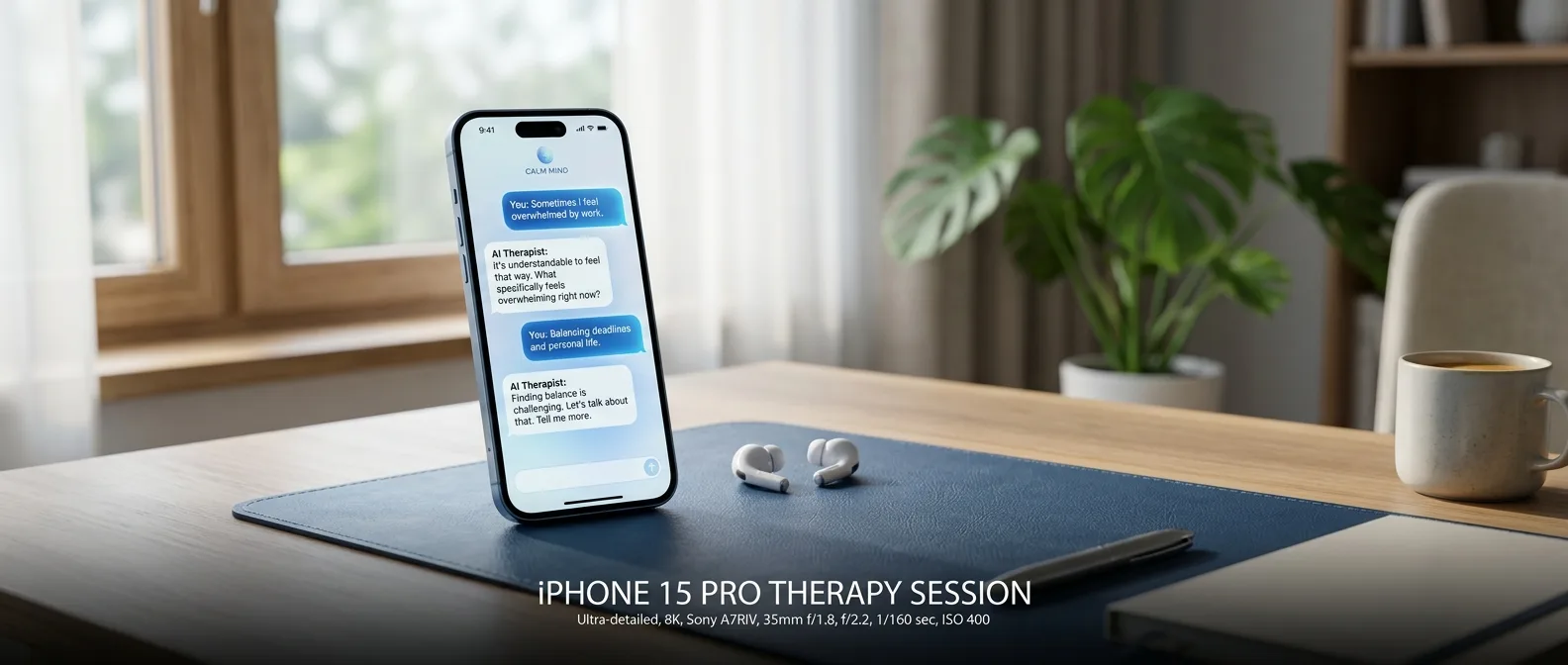
Six weeks. That's how long it took an AI therapy chatbot to slash depression symptoms by 51% in patients with major depressive disorder. Therabot — a digital therapist developed at Dartmouth — delivered results that rival traditional psychotherapy, according to the first clinical trial published in March 2025 in NEJM AI.
We're talking about the first randomized controlled trial (RCT) proving the effectiveness of a fully AI-powered chatbot for treating clinical-level mental health disorders. The numbers are impressive — but they also force tough questions about replacing human therapists with algorithms.
🔬 The Experiment: How Therabot Actually Worked
The study enrolled 210 adults across the United States with diagnosed conditions including major depression, generalized anxiety disorder, or eating disorders. Half used Therabot through a smartphone app for six weeks, while 104 people formed the control group.
Therabot isn't just another chatbot with canned responses. This is a generative AI system trained on mental health conversations created by specialists — clinical psychologists and psychiatrists at Dartmouth. The system relied primarily on cognitive behavioral therapy (CBT), one of the most effective forms of psychotherapy.
How it worked in practice: When someone with anxiety typed "I'm feeling really nervous and like a failure lately," Therabot could respond: "Let's take a step back and explore why you're feeling this way." Natural dialogue, not robotic responses.
Safety First
The Dartmouth team didn't overlook the risks. The system was programmed to detect high-risk content — like suicidal thoughts — and immediately provide emergency call buttons or crisis hotlines. Conversations were continuously monitored to ensure responses followed therapeutic best practices.
📊 Results That Rewrite the Playbook
The statistics from the eight-month trial reveal a picture that could reshape the digital mental health conversation:
But what do these numbers mean in practice? According to Nicholas Jacobson, lead researcher and associate professor at Geisel School of Medicine, the improvements are "comparable to what's reported for traditional outpatient therapy."
Even more striking? Seventy-five percent of participants weren't taking medication or receiving other therapeutic treatment during the trial. The results came exclusively from using the AI chatbot.
The Therapeutic Alliance
One of the most intriguing findings involves the concept of "therapeutic alliance" — the trust and collaboration between patient and therapist. Users reported levels of trust and cooperation with Therabot similar to those reported for human therapists.
What proves this? People didn't just respond to the bot's questions — they often initiated conversations themselves. Interactions were particularly frequent at midnight — hours associated with increased psychological distress.
⚡ The Secret Behind the Success
Why did Therabot work so well? The answer lies in how it was designed and trained.
"We didn't expect people to treat the software almost like a friend. It tells me they were really forming relationships with Therabot."
Nicholas Jacobson, lead researcher
Development began in 2019 at Dartmouth's AI and Mental Health Lab, with continuous consultation from psychologists and psychiatrists. The result was a chatbot that in previous evaluations gave responses consistent with therapeutic best practices over 90% of the time.
CBT in Action
Cognitive behavioral therapy, which Therabot was based on, was developed in the '60s and '70s by pioneers like Aaron Beck. Its core principles are that psychological problems stem partly from faulty thinking patterns and behaviors — and that we can learn better coping strategies.
Therabot translated these principles into a 24/7 digital therapist that can travel anywhere with the patient. It's not confined to an office and can provide coping strategies in real-time.
🧬 The Challenges and Risks
But Therabot's success doesn't mean everything is rosy. Michael Heinz, first author of the study, emphasizes critical points that require attention.
"While these results are very promising, no generative AI agent is ready to operate fully autonomously in mental health," says Heinz, who is also a psychiatrist at Dartmouth Hitchcock Medical Center.
The Double-Edged Sword of AI
The same capability that makes AI so effective — its ability to generate natural dialogue — is also the source of danger. Patients can say anything, and AI can respond with anything.
Essential Oversight
The research team had to be ready to intervene immediately if a patient expressed suicidal thoughts or if the software responded outside therapeutic practices.
Unpredictable Responses
Generative AI systems can produce unexpected responses, which is why they need strict safety and effectiveness controls.
🎯 A New Chapter for Mental Health?
What does all this mean for the future of psychotherapy? The numbers speak for themselves: for every available therapist in the US, there are on average 1,600 patients with depression or anxiety. A massive imbalance that AI therapy could help address.
"There's no replacement for personal care, but there aren't nearly enough therapists for everyone," explains Jacobson. "We'd like to see generative AI provide mental health support to the vast number of people who are outside the personal care system."
The Hybrid Model
The proposal isn't to replace human therapists with AI, but to collaborate with them. A hybrid model where technology provides immediate support and specialists intervene when needed.
This is particularly relevant globally in 2026, where access to mental healthcare remains limited for many. AI chatbots could serve as a first line of support — always with appropriate oversight.
"Our results are comparable to what we'd see for people with access to gold-standard cognitive therapy with outpatient therapists. We're talking about the possibility of giving people the equivalent of the best therapy you can get in the care system in shorter timeframes."
Nicholas Jacobson
Therabot's trial results land at a time when mental health apps already flood app stores — most without clinical evidence. This study provides the first proof that an AI therapist can match human therapy results. The technology is here. The question now is whether healthcare systems will adopt it.