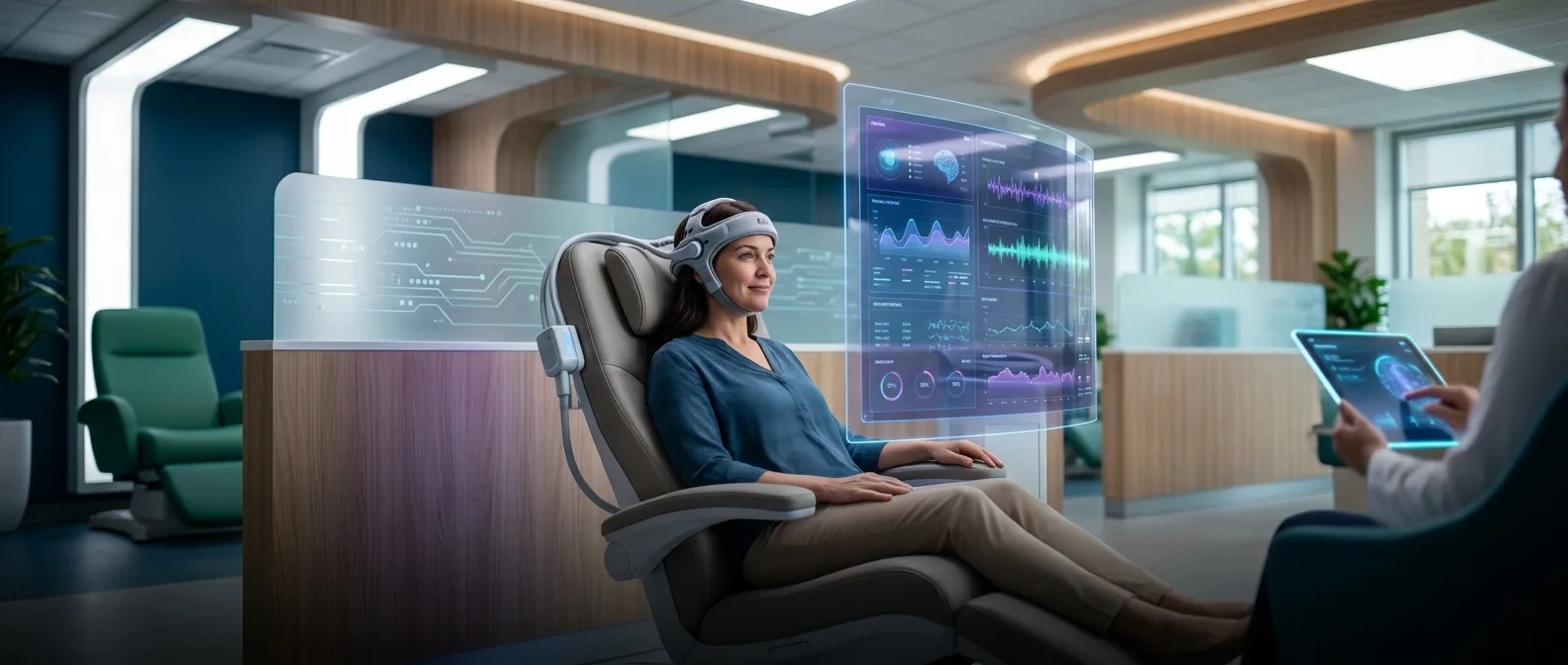
One psilocybin pill instead of six months of antidepressants. Algorithms that read your DNA to predict which psychiatric drugs will work. Electric stimulation that reboots the brain after years of treatment-resistant depression. 2026 is almost here, and mental health care is changing fast.
We're not talking about lab fantasies. We're talking about therapies that have already passed into Phase 3 clinical trials — the final stage before FDA approval. And while over 122 million Americans live in areas with mental health provider shortages, new tools promise to change not just how we treat, but how accessible treatment becomes.📖 Read more: 38% of Americans Plan Mental Health Resolutions for 2026
🍄 Psilocybin: The Mycopharmacology of Tomorrow
In February 2026, Compass Pathways announced positive results from the first of two Phase 3 trials for COMP360 — a synthetic form of psilocybin for treatment-resistant depression.
Patients who received a single 5mg dose showed statistically significant reduction in depression severity compared to placebo. The striking part isn't that it works — it's how long it lasts. One dose that works for months. If the second trial confirms the same results, FDA submission could happen this year. That would make COMP360 the first psilocybin-based drug approved in the US. Treatment-resistant depression affects roughly one-third of the 21 million Americans with major depression. For these people, conventional antidepressants simply don't work. A single-dose therapy that produces lasting improvement would be a genuinely new approach.LSD for Anxiety — No, You're Not Hallucinating
Meanwhile, a Phase 2b clinical trial published in JAMA in late 2025 found that a single dose of MM120 — a pharmaceutical form of LSD — significantly reduced anxiety symptoms in adults with moderate to severe generalized anxiety disorder. At the optimal dose of 100 micrograms, 65% of participants showed positive response and 48% saw symptom remission at three months. Here's the kicker: no new drug has been approved for GAD since 2007.⚡ Neural Stimulation and Electric "Reboots"
While psychedelics grab attention, neural stimulation is producing its own breakthrough results. Vagus nerve stimulation (VNS) isn't entirely new — FDA-approved VNS devices have existed for almost 20 years.80% of patients who improved after one year maintained or increased their gains
20% remained in complete remission at two years
📖 Read more: Hidden Mental Health Cost: How Social Media News Triggers Stress
🧬 Precision Psychiatry: When DNA Reveals the Treatment
Trying different drugs until you find one that works can take months or years. But what if we could "read" your DNA and predict which drugs would be effective from the start? That's exactly what pharmacogenomics tries to do. The technology analyzes your genetic profile to predict how you'll metabolize specific drugs, helping doctors avoid medications that are more likely to cause significant side effects or be ineffective.Genetic Mapping
Genetic profile analysis for drug metabolism
AI Prediction
Models combining DNA with clinical history
Personalized Drugs
Precise predictions for the right medication
A New AI Tool that Recognizes Disease from Mutation
Scientists at the Icahn School of Medicine at Mount Sinai developed an innovative artificial intelligence tool that not only recognizes genetic mutations that cause disease, but also predicts the type of disease these mutations might cause. The method, called V2P (Variant to Phenotype), is designed to accelerate genetic diagnosis and help discover new treatments for complex and rare diseases.In tests with real, anonymized patient data, V2P often ranks the actual disease-causing mutation among the top 10 candidates."Our approach allows us to identify the genetic changes that are most relevant to a patient's condition, instead of choosing among thousands of possible variants"
David Stein, first author of the study
📖 Read more: AI Psychology: Personalized Mental Health Revolution 2026
🤖 AI Transforms Clinical Workflows
The role of AI in mental health care is evolving rapidly — and it's not just about LLM-based chatbots. AI-driven platforms are being used to do everything from automating documentation to tracking patient outcomes over time, flagging early warning signs, and analyzing patterns in electronic health records. These tools haven't been designed to replace the therapeutic relationship between patient and provider. Instead, they aim to reduce administrative burden and enhance clinical decision-making. But here's the warning: providers need to continue properly vetting these tools, distinguishing real clinical value from what's primarily marketing.📱 Telemedicine and Digital Therapies
Telemedicine for behavioral health exploded during the 2020 pandemic. Now, most practices offer a combination of in-person and remote care options, expanding access for people across the country.Research shows telemedicine reduces missed appointments and improves treatment consistency, with continued focus from providers and payers to ensure clinical standards remain high for virtual appointments.
Meanwhile, measurement-based care — the practice of tracking symptoms and outcomes using validated tools — continues to advance with new digital tools for therapy and counseling. For years, mental health therapy lacked the kind of standardized outcome measurements that existed in other areas of medicine. Platforms that integrate symptom tracking, patient-reported outcomes, and clinical assessment help providers prove that the care they provide produces results.📖 Read more: Doom Scrolling: How It Destroys Your Mental Health
🔬 Genetic Mapping of Mental Illness
In early 2026, researchers published findings from a global genetic study that revealed deep genetic connections across 14 mental health disorders. These findings help explain why conditions like depression, anxiety, ADHD, and bipolar disorder often co-occur. The latest mental health research doesn't necessarily translate into immediate treatment changes, but works to reshape how the field as a whole understands mental illness. Scientists are moving toward models that account for common biological mechanisms across disorders — something that will help inform new approaches to adult and adolescent mental health care in the future.📖 Read more: Remote Work & Mental Health: Loneliness or Freedom?