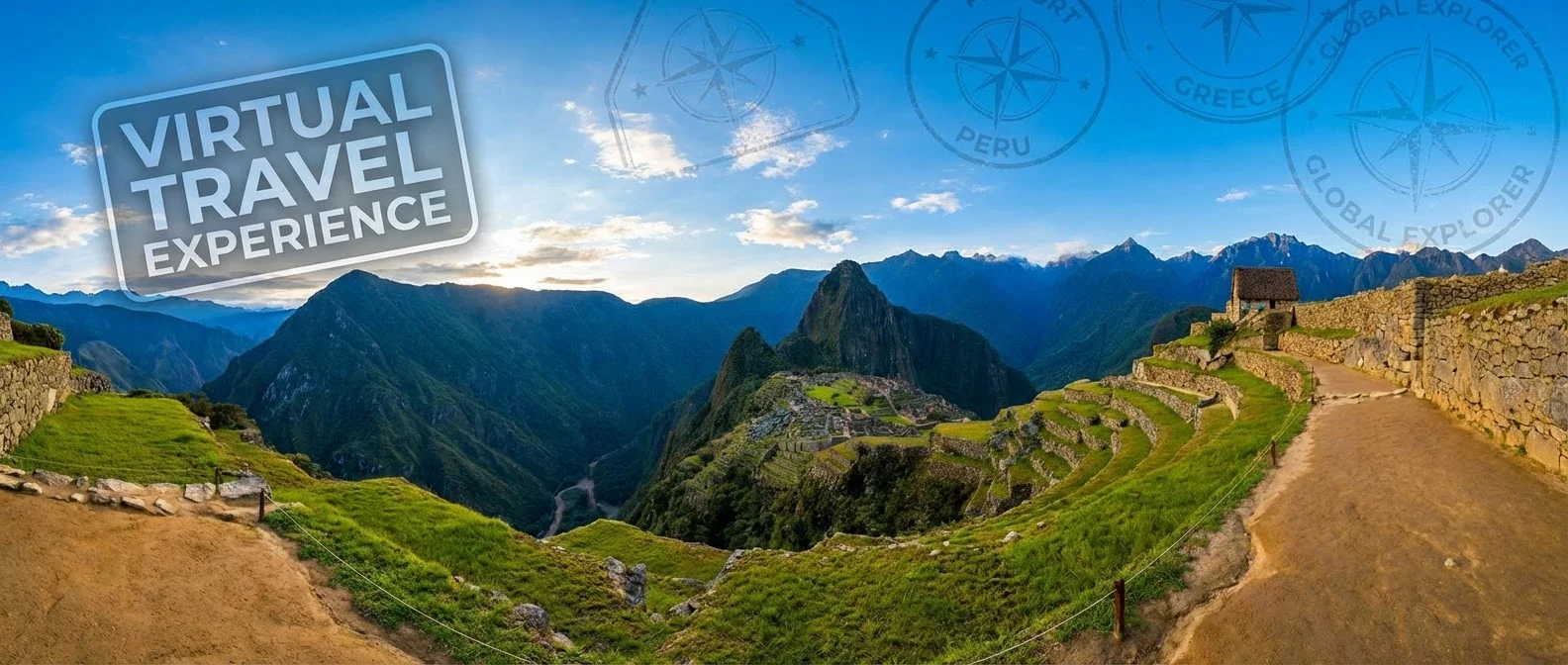
Imagine standing atop Machu Picchu, strolling through the streets of Tokyo, or exploring the galleries of the Louvre — all without leaving your living room. Virtual reality is transforming how we experience travel, creating immersive journeys so compelling they're reshaping the tourism industry. From free exploration of the entire planet to virtual museum tours in world-class institutions, VR tourism is no longer a futuristic concept — it's here, it's now, and it's evolving rapidly.
📖 Read more: VR Real Estate: How Agents Will Show Homes in the Future
Google Earth VR: The Entire Planet in Your Hands
Google Earth VR remains the most impressive free VR tourism application available. Compatible with PC VR headsets, it lets you fly over the entire Earth, descend to street level, and walk among iconic landmarks. The Eiffel Tower, the Grand Canyon, the Acropolis — all rendered with three-dimensional photogrammetry data that delivers stunning realism.
The sense of scale is what truly sets it apart. When you stand beside the Great Pyramid or look down from the Burj Khalifa, you genuinely feel the magnitude of these structures in a way no photograph can convey. You can even freeze the time of day, switching from sunrise to sunset over any city on the planet.
Wander: Time Travel Through Street View
For Meta Quest owners, Wander is the premier native VR travel app. Built on Google Street View, it transports you to millions of locations in full 360° quality. But the real killer feature is the Time Travel function: you can see how a location looked 5, 10, or 15 years ago using historical Street View imagery. Watch cities transform, landscapes shift, and time unfold before your eyes.
💡 Exploration Tip
In Wander, use the Random feature to teleport to random locations around the world. It's like digital hitchhiking — you might end up in a village in Vietnam or a fjord in Norway!
Virtual Tours of World-Class Museums
The world's greatest museums have opened their (virtual) doors to VR, offering experiences that often surpass even in-person visits in certain ways.
🏛️ The Louvre
The “Mona Lisa: Beyond the Glass” experience brings you face-to-face with the Mona Lisa — without tourist crowds. Examine every brushstroke in three-dimensional detail.
📖 Read more: VR Social: Social Life in Virtual Worlds
🏺 British Museum
Virtual galleries filled with archaeological finds from across the globe. The VR version lets you “pick up” and examine artifacts that are normally locked behind glass.
🎨 Smithsonian
With over 154 million objects, the Smithsonian museums offer VR exhibitions covering everything — from spacecraft to dinosaurs in stunning detail.
⛪ Vatican Museums
The Sistine Chapel in VR is a breathtaking experience. Look up and marvel at Michelangelo's frescoes in astonishing resolution, at your own pace.
Photorealistic Nature Explorations
BRINK Traveler: Photogrammetry at Another Level
BRINK Traveler uses photogrammetry technology to scan real-world locations and recreate them in VR with extraordinary fidelity. Bryce Canyon in Utah, the glaciers of Iceland, the caves of Thailand — each location is a photorealistic diorama you can freely explore. The sense of depth and space is so convincing you forget you're wearing a headset.
National Geographic Explore VR: Expeditions to Earth's Extremes
In partnership with Meta, National Geographic Explore VR takes you on two iconic expeditions. In Antarctica, you paddle among icebergs, photograph penguins, and climb frozen walls. At Machu Picchu, you scale ancient ruins and discover hidden trails that aren't accessible to regular tourists.
Blueplanet VR: Nature Documentaries in 360°
Blueplanet VR transforms nature documentaries into immersive VR experiences. Swim alongside whale sharks, walk through tropical rainforests, and observe volcanoes up close. The high-resolution 360° footage creates a sense of presence that no flat-screen documentary can achieve.
"Virtual reality doesn't replace travel — it extends it. It gives us access to places we could never physically visit, and inspires us to discover new destinations."
📖 Read more: Working in VR: The Future of Virtual Offices
— Dr. Jeremy Bailenson, Director of Virtual Human Interaction Lab, StanfordCultural Heritage: Reviving the Past
One of the most fascinating areas of VR tourism is the digital recreation of historical sites. Teams of archaeologists and developers collaborate to bring back to life places that no longer exist — or aren't accessible to the public.
Ancient Pompeii is being digitally restored to its original splendor: bustling streets, lively marketplaces, painted houses exactly as they were before Vesuvius erupted in 79 AD. Similarly, Egyptian temples like the Temple of Karnak are being recreated with their original colors intact. LiDAR scanning technology combined with historical records allows for remarkable accuracy.
🏛️ Did You Know...
UNESCO funds over 40 VR cultural heritage digitization projects, including sites threatened by climate change or armed conflict. VR is becoming a preservation tool, not just a tourism one.
VR in Real Estate & Hospitality
Beyond recreational tourism, VR technology is also transforming the hotel and real estate industries. Major hotel chains like Marriott, Hilton, and Four Seasons offer virtual room tours before you book. You're not just viewing photographs — you walk through the room, see the view from the balcony, and assess the space firsthand.
Similarly, real estate agencies use VR tours for overseas properties, allowing buyers to “visit” homes in another country without a plane ticket. Matterport 3D scanning technology creates faithful reproductions of interior spaces that save both time and travel costs.
📖 Read more: Haptic Gloves: VR Gloves That Let You Feel Touch
Accessibility: Travel for Everyone
Perhaps the most important aspect of VR tourism is the democratization of travel. For many people, physical travel is simply impossible:
👴 Elderly Individuals
Seniors in care homes use VR to “revisit” places they loved in their youth. Studies show significant improvements in mental health and reductions in loneliness.
♿ People with Disabilities
Locations that are physically inaccessible — stairs of ancient monuments, mountain trails — become fully accessible through VR technology.
💰 Financial Constraints
A VR headset costs about as much as a pair of plane tickets. But after that initial investment, you can “travel” to unlimited destinations at no extra cost.
📋 Trip Planning
Many travelers use VR to “test drive” destinations before booking flights. Preview the hotel, the neighborhood, the beaches — before committing financially.
📖 Read more: Metaverse 2026: What Happened to the Big Promise
Top VR Tourism Apps Compared
| App | Platform | Price | Key Feature |
|---|---|---|---|
| Google Earth VR | PC VR (Steam) | Free | Planet exploration, flight |
| Wander | Meta Quest | $9.99 | Street View, Time Travel |
| BRINK Traveler | Quest / PC VR | $9.99 | Photogrammetry locations |
| Nat Geo Explore VR | Meta Quest | $9.99 | Interactive expeditions |
| Blueplanet VR | PC VR / Quest | $9.99 | 360° nature documentaries |
The Future of VR Tourism
The next generation of VR tourism promises experiences that will blur the line between virtual and real travel. Three technologies will lead the way:
Photorealistic rendering through Gaussian Splatting and NeRF (Neural Radiance Fields) will gradually replace traditional scanning methods. Locations will be rendered with such fidelity they'll be indistinguishable from real photographs — but in full 3D with free movement.
Haptic gloves and suits (haptic feedback) will add a sense of touch: you'll feel the warmth of the sun on your skin, the coolness of a breeze, even the texture of objects. Companies like bHaptics and HaptX are already developing gloves with hundreds of haptic feedback points.
Finally, scent technology will bring smells into the experience — ocean breeze on a Greek island, lavender in Provence, street food in Bangkok. Prototype devices are already being tested in VR theme parks around the world.
"In 10 years, your first 'visit' to any new destination will happen in VR. It won't replace real travel, but it will become an integral part of planning every vacation."
— McKinsey “Future of Travel” Report, 2025Conclusion
VR tourism is no longer a gadget for tech enthusiasts — it's a genuine tool for exploration, education, and accessibility. Whether you want to explore the ruins of ancient civilizations, swim in tropical seas, or simply preview your hotel before booking, there's a VR app for you. And with each new generation of headsets, the experience becomes more convincing, more affordable, and more magical.
Put on your headset, spread your wings — the world awaits. 🌍