📖 Read more: AR vs VR 2026: Which Technology Will Dominate Our Future?
NBA in VR: A Game-Changing Viewing Experience
The NBA League Pass, in partnership with Meta, has been offering immersive game viewing via Meta Quest since the 2023-24 season. Viewers are virtually placed on the court — next to the players, under the basket, or in the front rows — with stereoscopic 180° cameras capturing every slam dunk, crossover, and buzzer beater in stunning detail.
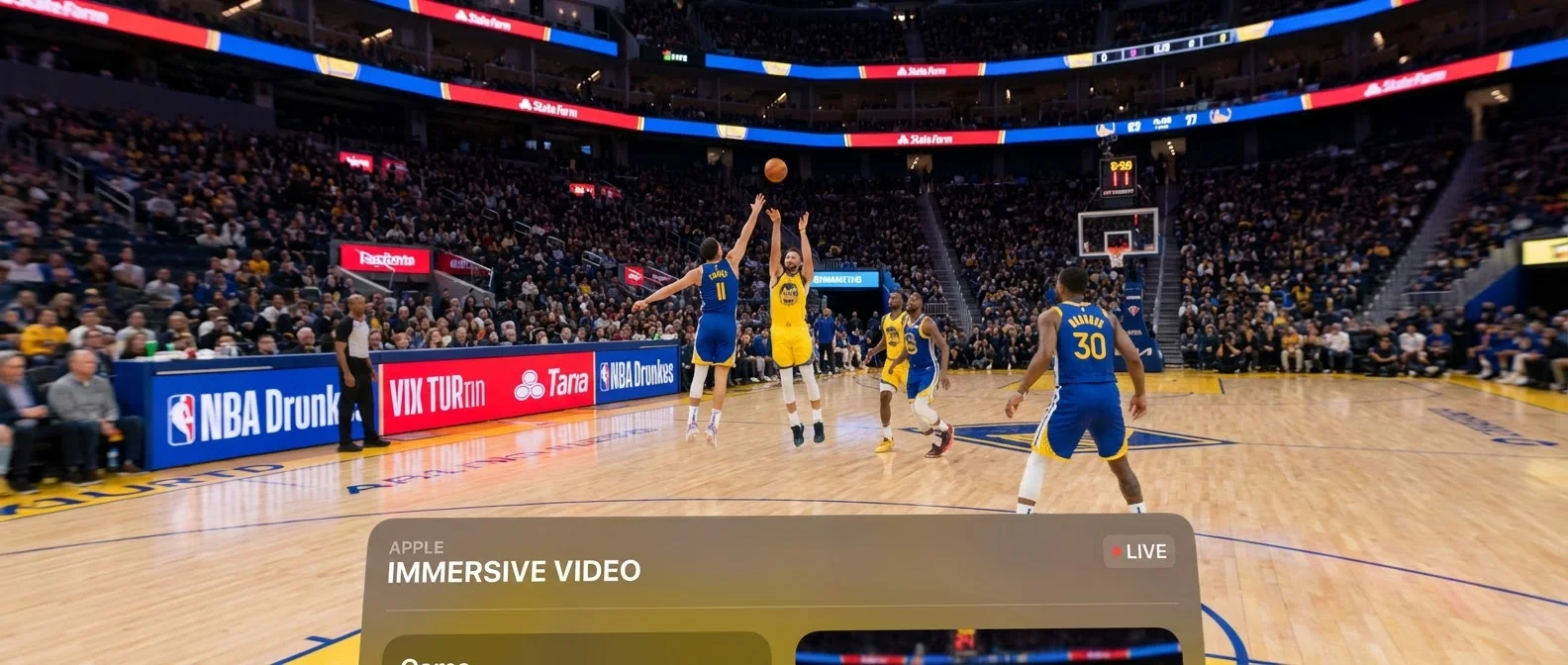
Apple took it a step further: through the Apple Vision Pro and the Apple Immersive Video platform, it offers NBA games in Spatial Video, where the viewer experiences the game in 3D space around them. The experience isn't just watching — it's presence. The user feels like they're sitting at Madison Square Garden or Crypto.com Arena, with spatial audio that reproduces crowd noise, whistles, and cheers in real time.
Statistics show that immersive viewing increases watch time by 40% compared to traditional television. Fans who tried VR NBA report that they “can't go back” to the conventional experience — the sense of scale, depth, and proximity to the game is unmatched.
Formula 1 VR: Inside the Cockpit
Formula 1 was among the first sports to embrace VR. The F1 TV app offers onboard cameras from every car, but the full VR experience goes much deeper: titles like F1 23 VR (Codemasters/EA Sports) allow users to drive Formula 1 cars on real circuits — Monza, Silverstone, Monaco — with realistic physics, dynamic weather, and pit stop strategy.
The sensation of speed in VR is breathtaking. At speeds exceeding 300 km/h, the headset's peripheral vision creates an authentic sense of motion (vection) that cannot be reproduced on a flat screen. Combined with a racing wheel (Logitech G Pro, Fanatec) and pedals, the experience rivals a professional simulator.
F1 itself uses VR simulators for driver training. Teams like Mercedes-AMG Petronas and Red Bull Racing utilize VR simulation systems worth millions of euros for track study, car setup optimization, and drivers' psychological preparation. Max Verstappen, three-time world champion, is well-known for his marathon sim racing sessions — both for training and for fun.
🏎️ F1 VR by the Numbers
Tracks: 24 real-world circuits recreated in VR
Speed: Up to 370 km/h sensation of speed via VR vection
Sim Racing: Over 8 million active F1 VR/sim players worldwide
Pro Setup Cost: Racing wheel + VR headset: €800-3,000
VR Sports Viewing: Beyond NBA & F1
VR viewing now extends to many sports. MLB (Major League Baseball) offers select games in VR, while UFC and professional boxing have experimented with immersive ringside experiences — imagine watching a UFC fight literally next to the octagonal ring, feeling every punch as if you're there.
Football (soccer) is following at a slower pace, but FIFA and the Premier League have announced piloting immersive viewing projects for the 2026-27 season. The concept: virtual seats in any stadium, with the ability to choose camera angles, on-demand replays, and real-time statistics within your field of view.
NextVR (now part of Apple after the 2020 acquisition) was a pioneer in live VR sports broadcasting. Their technology, now integrated into the Apple Vision Pro ecosystem, uses networks of multiple stereoscopic cameras strategically placed at venues, creating immersive feeds streamed in real time.
VR Sports Games: Play Instead of Watch
Viewing is only half the picture. VR sports games transform the user from spectator to athlete:
Gym Class VR — The most popular VR basketball game on Meta Quest, with multiplayer matches, a ranking system, and realistic ball physics. Over 3 million downloads by the end of 2025, with an active fan community organizing tournaments.
Eleven Table Tennis — Considered one of the most realistic VR sports games ever made. Its ball physics reproduce spin, speed, and trajectory with remarkable accuracy. Professional table tennis players have stated the experience is “surprisingly close to the real thing.” Supports online multiplayer and ranked play.
Golf+ — VR golf on the world's most famous courses: Pebble Beach, St Andrews, Augusta. Uses the controllers as golf clubs, with a physics engine simulating spin, wind effects, and terrain. So realistic that some golfers use it for off-season practice.
Walkabout Mini Golf — While more casual, it's one of the best-selling VR games overall. Beautifully designed mini golf courses, multiplayer support, and a relaxing atmosphere that few VR titles can match.
Ultimate Swing Golf / Premium Bowling — Additional titles proving that virtually any sport can be convincingly recreated in VR, from bowling to tennis.
📖 Read more: The 6 Best VR Headsets of 2026: Complete Comparison
VR Fitness: The New Era of Sports
The line between VR gaming and fitness is becoming increasingly blurred. VR fitness apps turn exercise into play — and the results are impressive:
FitXR — A virtual gym with boxing, HIIT, dance, and strength training classes. Over 1 million active subscribers. Users report they “forget they're exercising” thanks to the immersive experience.
Supernatural (Meta) — A premium VR fitness app with daily workouts in exotic locations. Real-time coaches, personalized routines, and music licensing from major labels. Categories include boxing, flow, stretching, and meditation.
Beat Saber Competitive — While originally a rhythm game, Beat Saber has evolved into a competitive sport. The Beat Saber League hosts tournaments with thousands of participants, rankings, and even cash prizes. A single session on Expert+ difficulty burns 6-8 calories per minute — equivalent to a fast-paced tennis match.
Les Mills Bodycombat — The VR edition of the famous group fitness program. Martial arts moves in VR, with scoring system and progression. Ideal for kickboxing enthusiasts who want a structured program.
"I'm not playing Beat Saber — I'm training. I burn 500+ calories in 45 minutes and I never get bored. No gym has ever given me this kind of consistency."
Athletes & VR Training: The Revolution
Professional athletes are increasingly using VR as a training tool. StatusPRO, a company founded by former NFL players, developed NFL Pro Era — a VR game/training tool used both by casual gamers and by real quarterbacks for studying opponents and improving real-time decision-making.
In the NBA, teams use VR replay platforms to relive key plays from the player's perspective — something impossible with traditional video analysis. In boxing, VR headsets are used for reaction time training, footwork analysis, and psychological preparation before major fights.
In football, Rezzil (now part of Virtuix) developed a VR cognitive training platform used by Premier League and MLS teams. The platform assesses decision-making, peripheral vision, reaction time, and spatial awareness — skills that cannot be effectively measured through traditional methods.
🏆 Athletes Using VR
NFL: Over 15 teams use VR training (StatusPRO, STRIVR)
NBA: VR replay analysis in 20+ teams
F1: Every team has a VR/sim racing facility worth millions
Football: Rezzil cognitive training in Premier League teams
Boxing: VR reaction training for champions (Tyson Fury, Canelo Álvarez)
Mixed Reality Sports: The Next Generation
Mixed reality (MR) takes sports beyond the headset. With the passthrough capability of the Meta Quest 3 and Apple Vision Pro, users can play sports in their real space with digital elements overlaid on the physical world.
Meta developed First Encounters and Spatial Sports — MR experiences where virtual objects interact with your real furniture. Imagine a ping pong table appearing on your kitchen table, or basketball hoops on your living room wall.
Body tracking technology is evolving rapidly. New headsets track the user's hands, feet, and torso without external sensors, enabling full-body sports interactions: kicks in VR football, serves in VR tennis, dance moves in VR fitness — all without controllers.
What the Future Holds
The VR sports market is projected to reach $28.7 billion by 2030 (Grand View Research). Major sports federations are investing in VR infrastructure, and headsets are becoming lighter, cheaper, and more capable.
Key trends for the coming years:
• 5G VR Streaming: Live broadcast of games in VR with zero latency, at 8K+ resolution per eye
• Haptic Suits: Touch sensors that reproduce impacts, vibrations, and the sensation of speed
• AI Coaching: Artificial intelligence that analyzes form, suggests improvements, and creates personalized training plans
• Social VR Stadiums: Virtual arenas with thousands of spectator-avatars watching together, cheering, celebrating
• E-Sports in VR: New competitive gaming categories exclusively in VR — VR boxing, VR racing, VR basketball
Sports have always been a social experience — from ancient stadiums to modern arenas. Virtual reality doesn't replace that experience — it democratizes it. A fan in Greece can now “sit” courtside at an NBA game, “drive” an F1 car in Monaco, or play basketball with friends in America — without leaving home. This isn't the future. It's today.