📖 Read more: VR for Seniors: Technology for the Elderly
🏥 What Is VR Physiotherapy?
The term “virtual rehabilitation” was coined in 2002 by Professor Daniel Thalmann of EPFL in Switzerland and Professor Grigore Burdea of Rutgers University in the United States. It encompasses both physical therapy and cognitive interventions, using three-dimensional virtual environments as a therapeutic framework. Since 2008, the global community has been supported by the International Society on Virtual Rehabilitation.
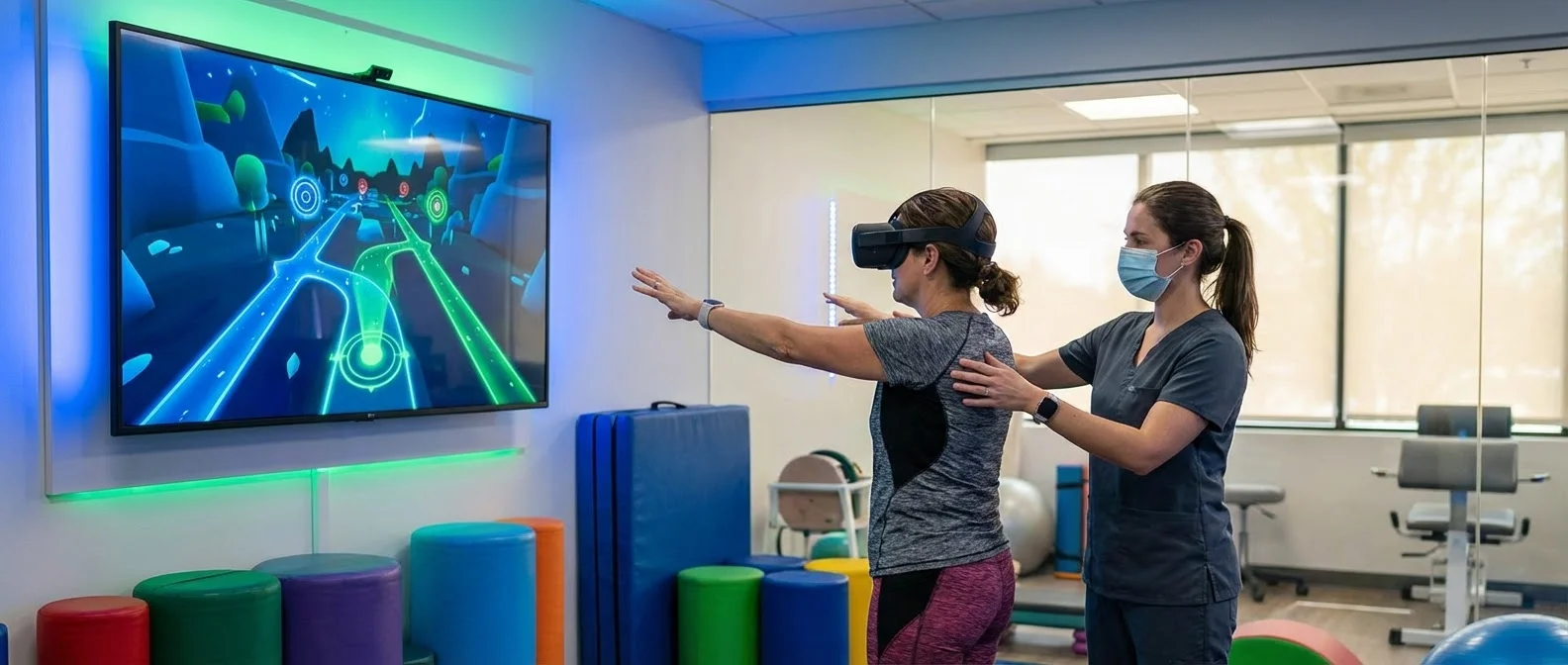
The core principle is simple yet powerful: patients wearing a VR headset perform therapeutic exercises inside digital environments that keep them engaged and motivated. Unlike conventional physiotherapy — which often demands intensive, repetitive exercises several days a week — VR adds a layer of gamification: scores, achievements, and real-time visual feedback. This dramatically improves patient compliance, one of the biggest challenges in physical rehabilitation.
The benefits are objectively measurable: limb velocity, range of motion, error rates, and game scores are all automatically stored by the computer and can be monitored remotely, effectively converting physiotherapy into telerehabilitation.
🧠 Stroke Recovery — The Biggest Success Story
Post-stroke rehabilitation is arguably the field where VR physiotherapy has shown its most impressive results. Patients often need to relearn how to control specific muscles — a process that relies on intensive, repetitive, task-specific practice. Traditional protocols tend to be physically demanding, expensive, and monotonous enough to produce only modest improvements.
According to a systematic review and meta-analysis (de Rooij et al., 2016), VR training significantly improves gait speed, Berg Balance Scale (BBS) scores, and Timed Up & Go Test times — particularly when VR replaces time-matched conventional therapy. In a 2024 study, patients who participated in a VR therapy program improved their motor function abilities by 20% in just four weeks.
VR enhances neuroplasticity — the brain's ability to rewire itself — by delivering continuous visual feedback that a human therapist simply cannot provide uninterrupted throughout every session. A Cochrane Review confirmed that visual feedback significantly aids balance recovery following stroke. Furthermore, a 2019 study (Oh et al.) demonstrated that VR combined with real instrument training strengthens wrist power, reduces elbow spasticity, and improves fine motor function.
One notable example is the “Reh@City” platform — a virtual urban environment developed in 2016 — where patients perform daily activities in VR while simultaneously engaging memory, attention, visuospatial abilities, and executive functions. The study showed superior results in improving activities of daily living (ADL) compared to conventional methods.
"Virtual rehabilitation doesn't replace the therapist — it empowers them with tools that make therapy more effective, more measurable, and more engaging for the patient."
🦴 Parkinson's, Musculoskeletal & Cardiovascular Rehabilitation
Beyond stroke, VR physiotherapy is delivering meaningful results across multiple rehabilitation domains. Parkinson's disease is a prime example: according to a Cochrane Review, VR therapy in Parkinson's patients improved gait, balance, activities of daily living (ADL), cognitive function, and overall quality of life. The reduction in fall risk reaches 30% — a critical improvement for elderly patients. Through VR, they practice balance and coordination in safe virtual environments without risking injury from actual falls.
In musculoskeletal rehabilitation, studies show that 80% of patients using VR for muscle and joint issues report improved mobility and pain relief. The immersive nature of VR makes exercises more appealing, increasing adherence to therapeutic protocols. Meanwhile, in cardiovascular rehabilitation, VR and video games serve as complementary physical training tools: they increase heart rate, physical activity levels, and adherence to cardiac rehabilitation programs.
The application in wound care deserves special mention. Data from Cedars-Sinai Medical Center shows a 1.7-point reduction on the pain scale when using VR, compared to traditional methods such as watching relaxing television or listening to soothing music. The immersive experience redirects the patient's attention away from pain while simultaneously improving psychological well-being during treatment sessions.
📖 Read more: VR & the Brain: How Neuroscience Reacts
Neurological Rehab
Stroke, cerebral palsy, traumatic brain injury. Neuroplasticity through immersive training in personalized virtual environments.
Orthopedic Rehab
Musculoskeletal conditions, post-surgical therapy. 80% mobility improvement and pain relief through gamified exercises.
Cardiovascular Rehab
Gamified cardiac rehabilitation. Increased heart rate, physical activity, and treatment program adherence.
Pain Management
Distraction therapy for injuries and burns. 1.7-point pain reduction demonstrated at Cedars-Sinai Medical Center.
🎮 Gamification: When Therapy Becomes a Game
One of the most significant advantages of VR physiotherapy is gamification — the application of game mechanics to therapy. High scores, in-game awards, rankings: these elements don't just motivate patients, they also provide objective data to therapists. Patients who “score” well can visualize their progress through charts, compare themselves with similar cases, and feel genuine motivation to continue — addressing a fundamental problem: declining compliance due to fatigue in long-term treatment protocols.
The data collected — limb movement velocity, range of motion, error rates — is automatically stored and can be leveraged for both clinical decision-making and research into optimizing therapeutic protocols. It's worth noting that VR therapy is now recognized at the regulatory level as well: in the United States, the FDA classified VR therapeutic devices as Class II medical devices, while in April 2023, CMS created HCPCS code E1905 for VR cognitive behavioral therapy devices — the first recognized reimbursement code for VR therapy. The company XRHealth already operates virtual VR/AR clinics for physical therapy, occupational therapy, and mental health care.
Why VR Works in Physiotherapy
- Entertains the patient → increased motivation and compliance
- Objective progress tracking — velocity, range of motion, error rates
- Telerehabilitation — home-based therapy with remote monitoring
- Safe environment — practice without risk of falls or injury
- Skills transfer — what you learn in VR carries over to real life
🔮 The Future: AI, Telerehab & A New Era
The major frontier for VR physiotherapy is telerehabilitation. With stable internet connections and VR headsets now costing less than $300, patients in remote areas will be able to receive personalized physical therapy from a distance — a crucial development given that roughly one-third of the world's population lacks easy access to specialized rehabilitation centers.
The integration of artificial intelligence is expected to deliver personalized treatment protocols: algorithms will analyze patient movements in real time, automatically adjusting exercise difficulty and type. This will reduce dependence on the physical presence of a therapist without replacing the human element entirely.
Pediatric neurology represents a particularly promising field. Randomized controlled trials in children with cerebral palsy have shown significant improvements in balance, walking, and upper extremity function — with results being more impressive in younger patients, likely due to greater neuroplasticity during development. fMRI studies even indicate structural neuroplastic changes in the sensorimotor cortex following VR therapy.
Challenges remain, of course: motion sickness (VR sickness) affects some patients, individuals with epilepsy are generally excluded from VR-based programs due to seizure risk, and therapists require specialized training in these new tools. Nevertheless, the trajectory is clear: VR physiotherapy is no longer a pilot technology, but a clinically validated tool with regulatory approvals that is transforming the rehabilitation field worldwide.