📖 Read more: The 6 Best VR Headsets of 2026: Complete Comparison
🧠 What Is Virtual Reality Exposure Therapy?
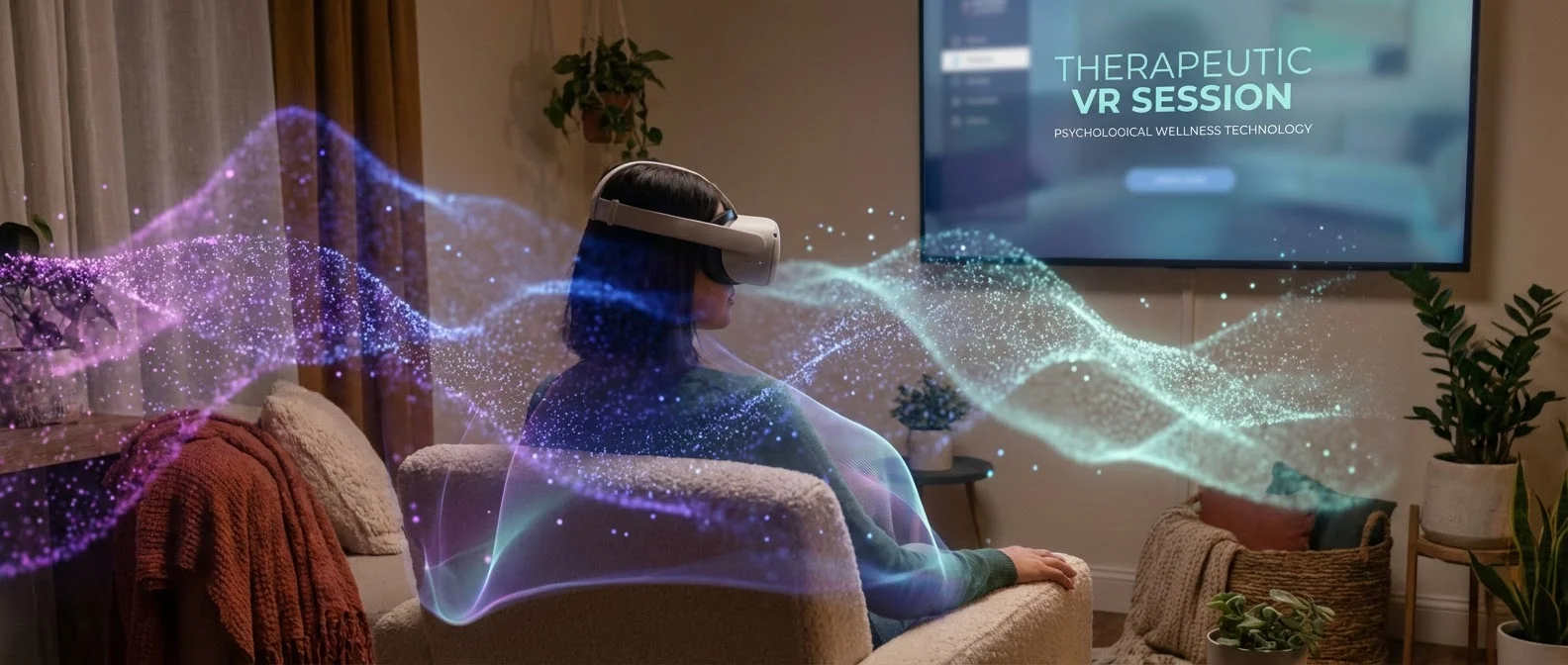
Virtual Reality Exposure Therapy (VRET) is a specialized form of cognitive-behavioral therapy. The patient puts on a VR headset and enters digitally recreated environments linked to their trauma. Under continuous therapist supervision, they are gradually exposed to triggering stimuli — sounds, visuals, even vibrations — so the brain learns to stop overreacting to them.
The approach builds on Prolonged Exposure (PE) therapy, one of the most evidence-backed treatments for PTSD and the standard of care recommended by the U.S. Department of Defense. The difference is that instead of closing their eyes and narrating what happened, VR visually transports the patient into the traumatic scenario — leading to greater activation of the traumatic memory and, consequently, more effective extinction of conditioned fear.
There are two main approaches in the literature. The first, known as “flooding,” starts immediately with the most intense stimuli — for a soldier, this might mean a virtual firefight scene. The second, graded-exposure, introduces the least anxiety-provoking stimuli first — perhaps just the sounds of war — and gradually escalates. The therapist selects the approach based on the individual patient.
📜 From the First Experiments to BRAVEMIND
The history of VR therapy goes back further than most people realize. In 1992, Max North at Clark Atlanta University, funded by the U.S. Army Research Laboratory, began the first systematic research into what he called Virtual Reality Therapy. His 1994 publication in the Electronic Journal of Virtual Culture marked the birth of a new field. In parallel, Ralph Lamson at Kaiser Permanente achieved a ~90% cure rate in acrophobia patients, using primitive VR systems in a controlled trial of 40 subjects.
The real turning point came after the wars in Iraq and Afghanistan. Up to 20% of returning veterans developed PTSD symptoms, yet only 23% sought help — avoidance, a core symptom of the disorder, acted as a barrier to accessing treatment. In 2005, Albert “Skip” Rizzo at USC's Institute for Creative Technologies, funded by the Office of Naval Research, created Virtual Iraq. Using graphical assets from the video game Full Spectrum Warrior, he built digital recreations of combat scenarios — Humvee convoys on Iraqi roads, Afghan villages, American military bases.
Virtual Iraq evolved into what we now know as BRAVEMIND (Battlefield Research Accelerating Virtual Environments for Military Individual Neuro Disorders). Developed in collaboration with the U.S. Army Research Laboratory, it includes 14 different virtual environments: military barracks, Iraqi marketplaces, desert roads, and even specially designed scenarios for military sexual trauma (MST) survivors, created in consultation with Emory University experts.
"VR doesn't replace the therapist — it empowers them. When a veteran refuses to close their eyes and recount what they lived through, virtual reality becomes the bridge."
📊 The Results That Are Changing Treatment
The clinical data is striking. In a Virtual Iraq evaluation study of 42 military personnel with chronic PTSD, 15 of the 20 who completed treatment no longer met the diagnostic criteria. Even more remarkably, the improvement held: at the three-month follow-up, 13 of 17 examined participants remained stable, maintaining a 50% reduction in their PCL-M (PTSD Checklist — Military) scores. In a separate BRAVEMIND clinical trial with 24 active-duty soldiers, after just 7 sessions, 45% no longer screened positive for PTSD, while the mean PCL-M score dropped from 54.4 to 35.6.
It's not just about veterans. In a study of 9/11 survivors, 10 participants underwent VRET with graded exposure to virtual recreations of World Trade Center events. The immediate results were positive, and at the six-month follow-up, 9 out of 10 available subjects had maintained their improvement. VRET has now been recognized by the Anxiety and Depression Association of America (ADAA) as an accepted therapeutic method.
📖 Read more: VR Art: Creating Works and 3D Worlds
Across the literature, VRET reduces PTSD symptoms by an average of 50%, with over 75% of participants no longer meeting PTSD criteria after treatment. By initial estimates, VR therapy costs roughly half as much as traditional cognitive-behavioral therapy — a crucial data point, considering that treating the 2.16 million Americans who served in combat zones between 2001–2010 carries an estimated cost of $1.54–$2.69 billion.
Key Research Findings
- 22% of combat-exposed military develop PTSD — only 23% seek help
- 75%+ of VRET clinical trial participants no longer met PTSD criteria
- 50% PCL-M score reduction in Iraq/Afghanistan veterans
- 830,000 Vietnam War veterans developed PTSD symptoms
- $12M ONR-funded study comparing VRET vs. Prolonged Exposure
🔬 Beyond PTSD: Broader Mental Health Applications
While PTSD treatment remains the flagship application, VR is increasingly being deployed across a spectrum of mental health conditions. Phobia therapy was the first use case — from acrophobia (fear of heights) to glossophobia (fear of public speaking) and aerophobia (fear of flying). Controlled trials demonstrated effectiveness exceeding 90% for acrophobia, and a 2018 Lancet Psychiatry study showed that even automated VR therapy — without a psychologist present in real time — can significantly reduce fear of heights.
In the area of depression, the UK's NICE (National Institute for Health and Clinical Excellence) recommended as early as 2006 the use of computerized CBT in virtual environments for patients with mild-to-moderate depression, even before considering antidepressant medication. In schizophrenia, VR is being used experimentally to reduce the intensity of auditory hallucinations, through avatar therapy — where the patient interacts with a digital representation of the “voice” they hear, gradually learning to disengage.
Particularly promising results have emerged in chronic pain management. AppliedVR developed RelieVRx, a skills-based VR program for chronic lower back pain that received De Novo FDA clearance in November 2021 — a historic moment, as it was the first time a VR therapy was recognized as a Class II medical device. In April 2023, the U.S. CMS created a dedicated HCPCS code (E1905), bringing RelieVRx into the Medicare reimbursement system.
🚀 The Future: AI, Personalization, and Universal Access
The next generation of VR therapy incorporates artificial intelligence for personalized treatment protocols. PsyTechVR is developing a platform that uses generative AI to create customized exposure scenarios — the therapist describes the traumatic event and the AI generates a digital environment tailored to the specific patient's needs. This solves one of VRET's biggest challenges: the difficulty of adapting a fixed set of scenarios to each person's unique traumatic experience.
The industry is consolidating rapidly. In December 2022, BehaVR and Oxford VR merged to create the largest VR digital therapeutics platform. In 2023, XRHealth completed its merger with Amelia Virtual Care (formerly Psious), creating the leading XR therapeutics platform for physical, occupational, and mental health. XRHealth then acquired InnerWorld, a VR mental health platform that also works on smartphones.
A particularly compelling development concerns remote therapy. In an era where access to mental health care remains inadequate — the U.S. Department of Veterans Affairs has faced chronic psychiatrist shortages for years — the ability to use a VR headset at home, combined with tele-guidance, could bring treatment to millions who currently go without. AppliedVR and XRHealth are already developing at-home therapy models, while a Cochrane Review has positively evaluated internet-based CBT for PTSD.
VR therapy doesn't replace the psychotherapist. Instead, it gives them a tool that no textbook or narrative can provide: the ability to transport the patient into the trauma — safely, in a controlled way, with hope. For the millions living daily with the imprint of PTSD, this technology isn't merely innovative — it's liberating.