📖 Read more: Metaverse 2026: What Happened to the Big Promise
🧘 Ancient Practice Meets Modern Technology
The history of meditation stretches back thousands of years, from the Upanishads of ancient India to Zen Buddhist practices and Christian contemplative methods. The modern definition — a technique for training attention and awareness aimed at achieving mental calm — has remained essentially the same for centuries. What’s changing is the medium.
In 1979, Jon Kabat-Zinn founded the Stress Reduction Clinic at the University of Massachusetts Medical Center, laying the groundwork for the MBSR (Mindfulness-Based Stress Reduction) program — an eight-week course combining mindfulness meditation, body scanning, and gentle yoga. By 2015, nearly 80% of medical schools in the United States incorporated mindfulness training elements, and by 2026, MBSR programs operate in over 30 countries.
Meanwhile, virtual reality therapy (VRT) was first introduced in 1992 by Max North at the Georgia Institute of Technology, initially for treating phobias. The concept was simple yet powerful: if we could create controlled digital environments convincing enough for the brain to treat them as real, why not use them for relaxation instead of stress?
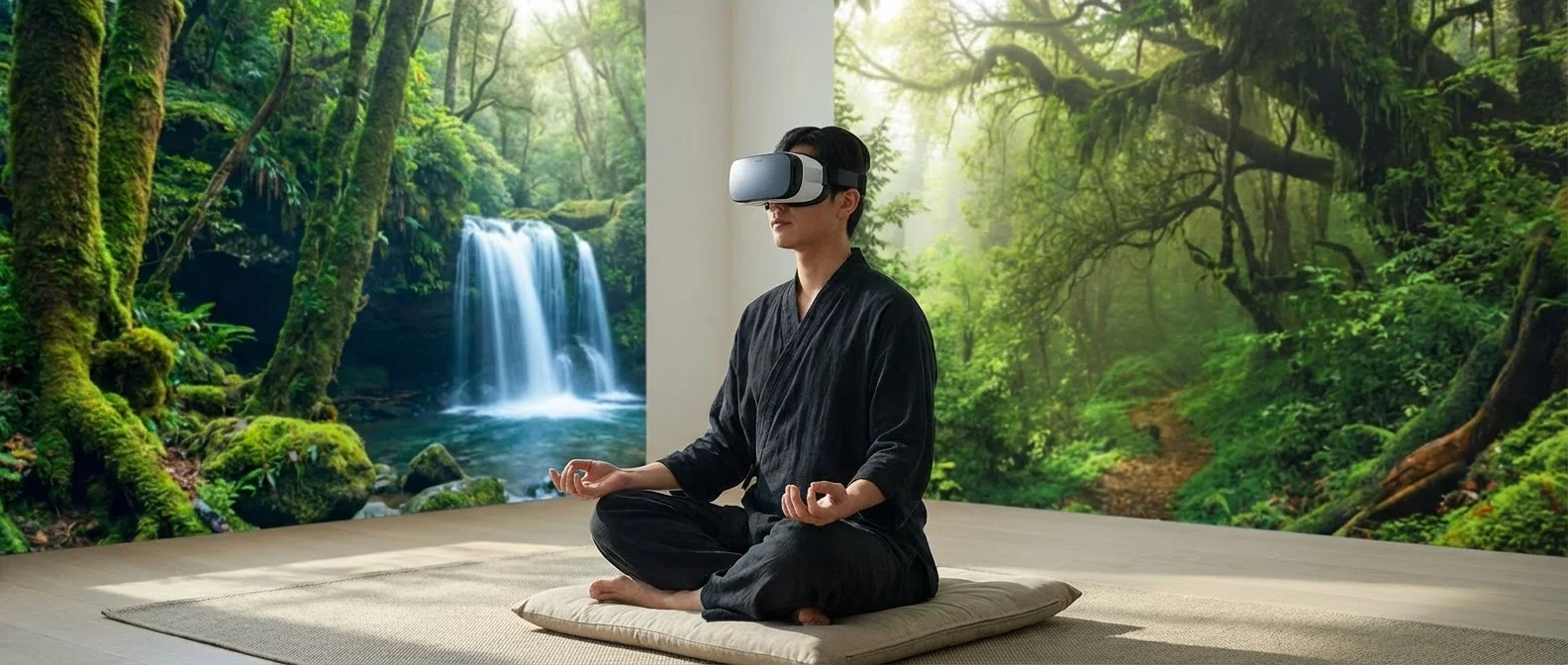
The convergence of these two worlds — ancient meditation and modern VR — created the field of VR meditation, where technology doesn’t replace the inner practice but facilitates it, offering controlled, immersive environments ideal for beginners and experienced meditators alike.
🌿 Shinrin-yoku: From Japanese Forests to VR Headsets
The term “Shinrin-yoku” (森林浴, literally “forest bathing”) was coined in 1982 by Tomohide Akiyama, then head of Japan’s Ministry of Agriculture, Forestry and Fisheries. The idea wasn’t physical exercise in nature, but sensory immersion in the forest environment — slow wandering among trees, inhaling plant compounds (phytoncides), listening to flowing water and birdsong.
Scientific evidence followed: studies demonstrated that exposure to nature reduces cortisol levels, lowers blood pressure, regulates heart rate, and improves mood. Finland recommends at least 5 hours per month in nature, South Korea has structured forest therapy programs for firefighters with PTSD, and Canada allows physicians to “prescribe nature.”
But what about the millions of people who lack access to forests? City dwellers, individuals with mobility issues, hospital patients? This is where virtual reality enters the picture. VR apps recreate forest environments, tropical islands, oceans, and mountain landscapes with impressive audiovisual realism — offering a “digital Shinrin-yoku” to anyone wearing a headset.
Research in “virtual rehabilitation,” a term coined in 2002 by Professors Daniel Thalmann (EPFL) and Grigore Burdea (Rutgers), shows that virtual natural environments can trigger calming responses similar to real ones — especially when combined with spatial audio, biofeedback sensors, and guided meditation.
🧠 The Science Behind VR Meditation
The connection between meditation and neurological changes is not theoretical. Functional magnetic resonance imaging (fMRI) and electroencephalography (EEG) techniques show that during meditation, brain activity shifts from rapid beta waves (normal wakefulness) to slower alpha and theta waves, associated with deep relaxation and heightened awareness.
A 2014 meta-analysis published in JAMA Internal Medicine, reviewing 47 randomized controlled trials, concluded that mindfulness meditation programs showed moderate but statistically significant improvements in anxiety, depression, and pain. The American Heart Association declared in 2017 that meditation may serve as a reasonable complementary intervention for reducing cardiovascular disease risk.
When virtual reality enters the equation, outcomes are enhanced by immersion. Unlike a guided meditation app on a phone — where the user hears a voice in their living room amid noise, notifications, and visual stimuli — a VR headset completely blocks out the external world. The user literally “enters” a calming landscape, dramatically reducing internal turmoil and enabling faster access to a relaxation state.
“Virtual reality doesn’t replace nature — but it can bring nature to those who cannot go to it. This isn’t just technology, it’s a right of access to tranquility.”
AppliedVR, a company specializing in VR therapies, received FDA (U.S. Food and Drug Administration) approval in 2021 for its EaseVRx system — a virtual reality program for managing chronic lower back pain. It was the first Class II Medical Device VR product approved for therapeutic use in pain management, paving the way for broader applications in stress, anxiety, and insomnia treatment.
In the military sector, the BRAVEMIND program at USC’s Institute for Creative Technologies uses VR exposure therapy for veterans with PTSD — with results showing a 50% reduction in symptoms and over 75% of participants no longer meeting PTSD criteria after treatment.
🎮 VR Meditation Apps and Platforms
By 2026, the VR meditation app market is mature, with multiple platforms serving different needs. TRIPP, founded in 2017, offers immersive meditation experiences featuring psychedelic cosmic landscapes and real-time biofeedback through wearables. The app employs breathwork techniques combined with dynamic visual environments that respond to the user’s breathing rhythm.
Nature Treks VR takes a different approach — realistic natural landscapes (tropical forests, northern lights, underwater depths) with ambient nature sounds, targeting recreational relaxation without structured guidance. It’s an ideal choice for beginners or anyone simply seeking an “escape” from daily routine.
Maloka (formerly Guided Meditation VR), one of the first VR meditation apps, offers guided sessions within specially designed virtual rooms, covering topics from stress management to sleep improvement. XRHealth, a VR telehealth platform, integrates meditation modules into broader therapeutic protocols for rehabilitation, chronic pain, and mental health.
Notably, platforms are emerging that incorporate real-time biofeedback. Heart rate sensors, respiration monitors, and galvanic skin response (GSR) sensors feed data into the VR environment, which dynamically adapts: if the user is stressed, sounds become softer, colors warmer, guided breathing slower. This closed-loop human-machine interaction makes sessions more effective than generic guided meditation.
⚠️ Challenges and Limitations
Despite its promise, VR meditation faces significant challenges. The first and most practical is VR sickness (cybersickness): eye dryness, headaches, nausea, and disorientation, especially during prolonged sessions. For a practice aimed at relaxation, this is ironically counterproductive.
Equipment cost remains a barrier: a standalone VR headset costs €300–800, while premium headsets exceed €1,000. Compared to a free meditation app on a smartphone, entering VR meditation requires a significant investment — though costs are steadily declining.
There’s also the concern of social isolation. If meditation becomes a solitary experience inside a headset, the communal dimension that many mindfulness practices consider essential is lost. Group VR sessions (multiplayer meditation rooms) offer one answer, but they don’t fully replace physical presence.
Ethical questions also arise: who has access to these tools? Can a digital nature experience replace the real need for preserving natural spaces? And how do we handle biofeedback data — which reveal a person’s most private biometric information?
💡 Key Numbers
According to a meta-analysis in JAMA Internal Medicine (2014, 47 studies), mindfulness meditation programs show moderate but statistically significant improvement in anxiety, depression, and pain. VR exposure therapy (VRET) achieves “cure” outcomes in roughly 90% of acrophobia cases, at half the cost of traditional CBT. AppliedVR’s EaseVRx, FDA-approved as a Class II Medical Device, significantly reduces chronic lower back pain.
🔮 The Future of VR Wellness
As headsets become lighter, cheaper, and more comfortable, access to VR meditation will expand. Technologies like foveated rendering reduce hardware requirements, while next-generation wireless standalone headsets eliminate cables and computers altogether.
Herbert Benson at Harvard Medical School identified the “Relaxation Response” as early as 1975 — a physiological state opposite to fight-or-flight that can be triggered through meditation. Today, virtual reality can serve as a “switch” for that response: completely cutting off stressful stimuli and replacing them with calming ones. This doesn’t replace deep spiritual practice — but it can make meditation more accessible to people who would otherwise never try it.
The integration of artificial intelligence (AI) into VR meditation platforms is expected to deliver personalized experiences: AI coaches that adapt sessions based on biometric data, usage history, and psychological profiles. Coupling with haptic feedback will add yet another sense — the feeling of a breeze, the coolness of water, the warmth of sunlight.
In a world of rising stress, insomnia, and mental fatigue, access to effective relaxation tools isn’t a luxury — it’s a necessity. If virtual reality can make meditation more appealing, more effective, and more accessible, then perhaps technology, rather than distancing us from ourselves, can ultimately bring us closer to who we truly are.