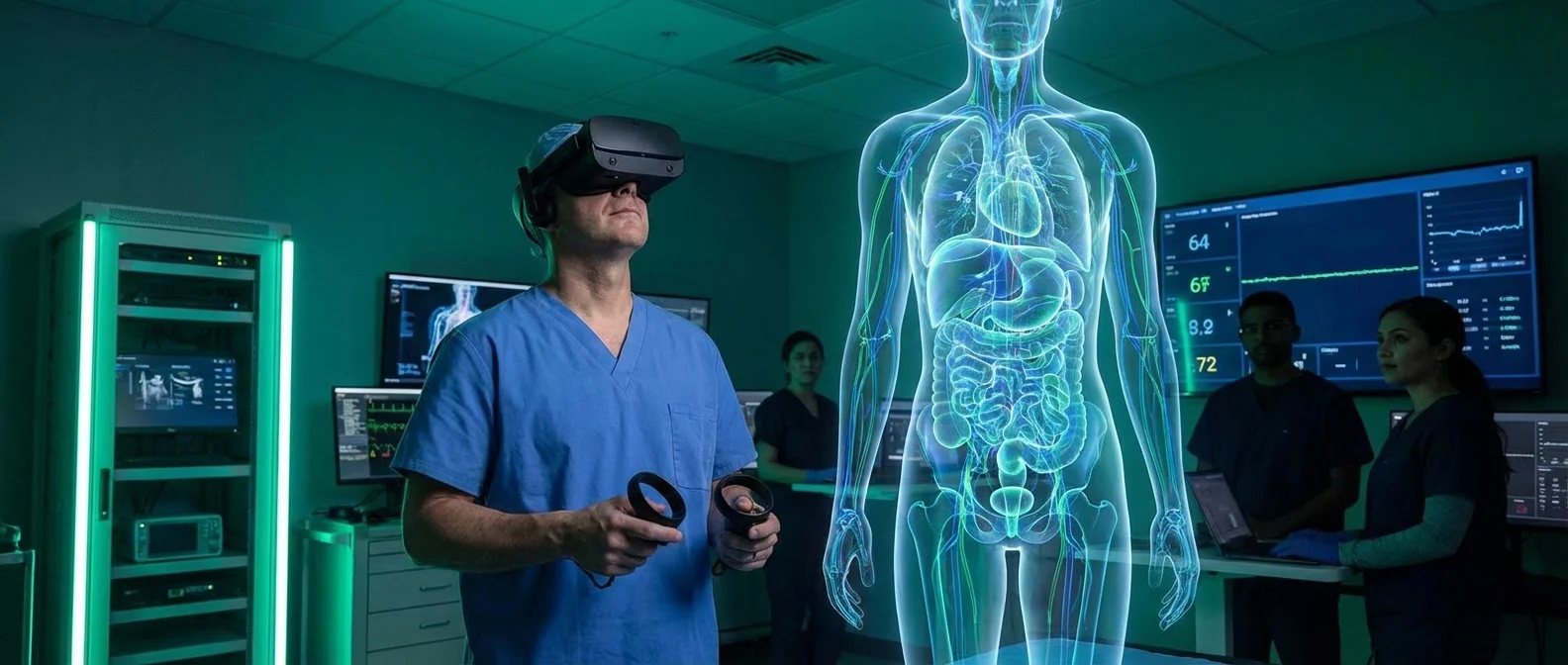
Virtual reality is fundamentally transforming how surgeons are trained worldwide. Instead of practicing exclusively on cadavers or observing operations as bystanders, new doctors can now “operate” on virtual patients in fully realistic environments — with zero risk to anyone. In 2026, VR technology in medicine is no longer experimental: it is an integral part of the training curriculum at dozens of top universities and hospitals.
📖 Read more: VR Controllers: Complete Buying Guide 2026
📊 Medical Training by the Numbers
The statistics paint a clear picture of why VR surgical training has become a necessity, not a luxury. Every year, medical errors claim thousands of lives, while traditional training faces serious constraints in terms of access, resources, and standardization.
🏥 How VR Surgical Training Works
VR surgical training employs sophisticated simulators that replicate the conditions of a real operating room with remarkable fidelity. Trainees wear VR headsets and use specialized controllers or even real surgical instruments paired with haptic devices, feeling the resistance of tissues and the movements each procedure demands.
In a 2022 study, participants used a touch-screen monitor, two surgical handlers, and two foot pedals designed to emulate a real-world laparoscopic simulator. Those trained with VR demonstrated significantly better performance compared to the control group, while also showing reduced cognitive load — meaning they learned more effectively with less mental strain.
Haptic Feedback
Modern haptic gloves and controllers provide realistic tactile sensation — surgeons feel the tissues, resistance, and textures just like in an actual procedure.
Full 3D Immersion
A hyper-realistic operating room in 360°, complete with three-dimensional patient anatomy, virtual surgical table, instruments, and support team.
Performance Tracking
Every movement is recorded: completion time, accuracy, errors, tissue pressure. AI-powered assessment delivers feedback in real time.
Remote Access
VR training from anywhere in the world. Ideal for hospitals in remote areas without access to specialized instructors.
🔬 Clinically Proven Results
The effectiveness of VR surgical training isn’t based on speculation but on dozens of clinical studies. According to a landmark study published in the Annals of Surgery (Seymour et al., 2002), VR training significantly improves operating room performance — in a randomized, double-blinded trial, surgeons who trained with VR made fewer errors during laparoscopic cholecystectomy compared to the control group.
Why This Matters
The traditional training method “See One, Do One, Teach One” (SODOTO) faces serious limitations due to a shortage of instructors and resources. VR offers a safe, repeatable practice environment with automated assessment, eliminating any risk to real patients.
🧠 VR in Neurosurgery
Neurosurgery represents one of the most demanding fields, where even minor mistakes can have catastrophic consequences. VR technology has evolved to the point where it offers fully immersive training models for specialized neurosurgical procedures. According to a publication in Surgical Neurology International, simulations for ventriculostomy catheter placement, endoscopic, and endovascular procedures are now used at neurosurgical training centers across the globe.
Experts consider VR training an essential component of the future neurosurgery curriculum. A 2020 study on spinal surgery showed that novice surgeons who underwent VR training were able to identify and correct errors more effectively than those who relied solely on traditional methods.
Preoperative Planning
VR generates a three-dimensional representation of a specific patient’s anatomy, enabling neurosurgeons to plan the entire procedure in advance.
Ventriculostomy Simulation
Ventricular catheter placement in a virtual environment with realistic anatomy and haptic feedback — one of the most critical neurosurgical skills.
Endoscopic Training
Complete simulation of endoscopic brain procedures using real surgical instruments and videoscopic recording capabilities.
🌍 The First Collaborative VR Surgery
In June 2022, the first collaborative surgical operation using virtual reality took place. Pediatric surgeon Noor Ul Owase Jeelani of Great Ormond Street Hospital in London worked alongside Dr. Gabriel Mufarrej, head of pediatric surgery at Instituto Estadual do Cerebro Paulo Niemeyer in Brazil, in a “virtual reality room” to plan the separation of conjoined twins.
“Virtual reality allowed us to plan the surgery together, even though we were on different continents. It felt like we were in the same operating room.”
This milestone demonstrates that VR is not just a training tool but also a medium for international surgical collaboration. Surgeons from different countries can jointly study a complex case, test different approaches, and arrive at the optimal surgical plan.
🦠 The Impact of COVID-19
The COVID-19 pandemic served as a catalyst for VR adoption in medical education. Opportunities for clinical training were drastically reduced due to social distancing requirements, a shortage of clinical educators, and restrictions on in-person interaction. Many institutions developed VR simulations to bridge the educational gap.
A notable example is the DEVICE program (Diabetes Emergencies: Virtual Interactive Clinical Education), which enabled non-specialist clinics to train their staff in recognizing and treating diabetes patients. This urgent need drove a significant increase in funding for VR medical solutions.
COVID-19 & VR Training
Before the pandemic, fewer than 30% of medical schools used VR training tools. Today, the majority of leading institutions worldwide incorporate some form of VR simulation into their educational programs.
⚖️ Comparison: VR vs Traditional Training
VR Training vs Traditional Methods
🔮 Leading VR Medical Training Platforms
Several companies are pioneering VR surgical training platforms, each with a distinct approach and area of specialization.
Osso VR
Specializes in orthopedic surgery. Full simulation of total hip arthroplasty, arthroscopy, and implant placement. Used at over 100 medical schools.
FundamentalVR
Industry-leading haptic feedback in VR surgery. Users experience realistic tissue resistance. Supports multiple surgical specialties.
Surgical Theater
Specializes in neurosurgery and cardiac surgery. Creates a “digital twin” of the patient for detailed preoperative planning.
Touch Surgery
Accessible platform on mobile & VR for fundamental surgical skills. Ideal for medical students and junior residents.
⚠️ Challenges & Limitations
Despite the impressive results, VR surgical training still faces some significant challenges that need to be overcome.
VR Nausea
A 2017 study comparing Oculus Rift and Samsung Gear VR platforms found that the Gear VR group experienced up to 40% more issues (nausea, blurred vision). The technology is improving, but this remains a concern.
Initial Cost
While VR saves resources long-term, the initial investment in headsets, software, haptic controllers, and infrastructure can be substantial for smaller institutions.
Scenario Realism
Incorporating stress factors, time pressure, and unpredictable complications remains challenging. Real surgery is still more complex than any simulation.
🚀 The Future: 2026 and Beyond
The evolution of VR medical training is not slowing down — it’s accelerating. The World Health Organization (WHO) recommends high-fidelity simulation for health professional education, recognizing that it leads to better acquisition, retention, and transfer of both technical and non-technical skills.
In the coming years, AI integration will automatically adjust difficulty based on the trainee’s level, while the arrival of next-generation headsets (Meta Quest 3, Apple Vision Pro, Samsung Galaxy XR) will make VR medical training even more accessible and realistic.
What’s Coming Next
The next generation of VR surgical simulators will combine AI assessment, full-body haptics, eye tracking for foveated rendering, and multi-user collaborative surgery spaces. Imagine a virtual operating room where 5 specialists from 5 countries collaborate in real time on a complex case. This is no longer science fiction — it’s tomorrow’s reality.