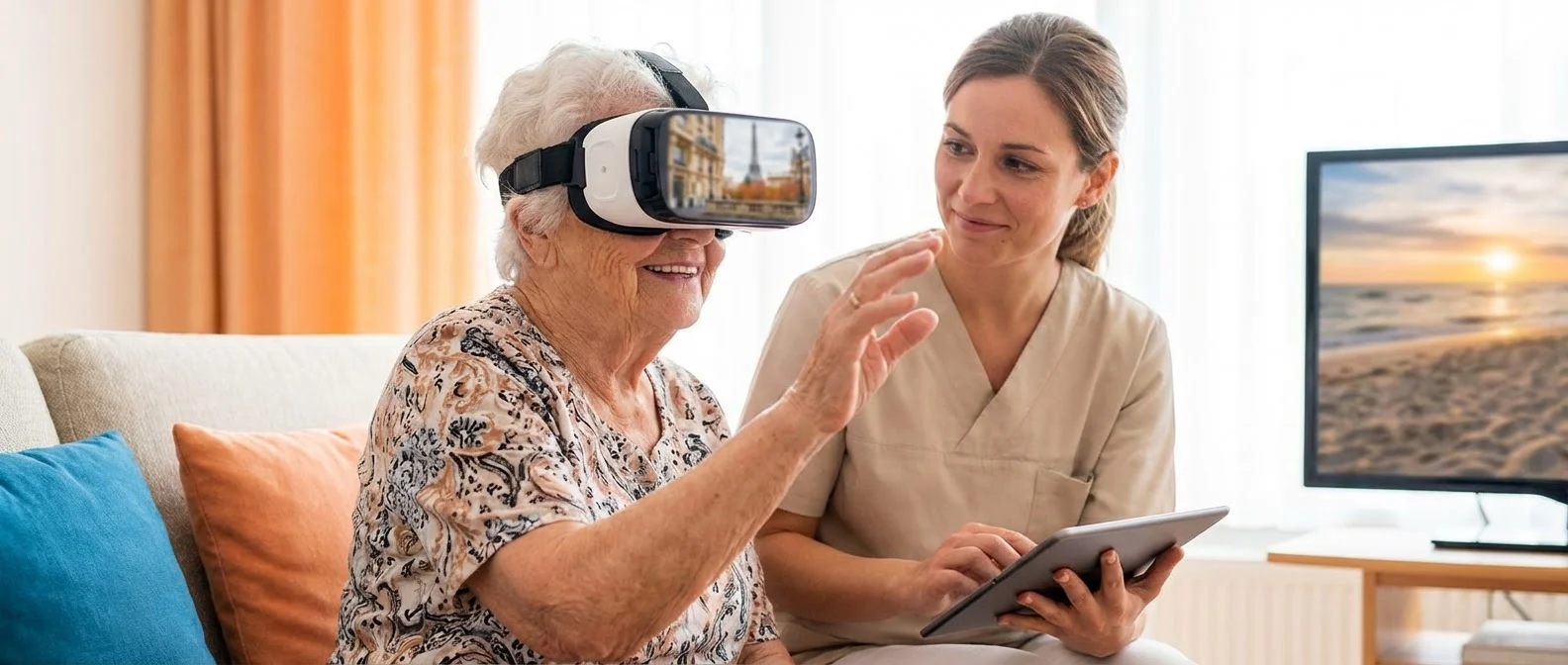
Aging by the Numbers
According to the United Nations, by 2050, 33% of the developed world's population will be over 60. In the United States, citizens aged 65+ grew from 3 million (1900) to over 50 million (2020). Loneliness, cognitive decline, and falls represent the biggest challenges — and VR can address all three.
VR Cognitive Stimulation: Shield Against Dementia
Cognitive decline begins gradually after age 60: memory weakens, the ability to learn new information decreases, and dementia prevalence ranges from ~10% at 65 to ~50% at 85+. Alzheimer's disease accounts for 50-80% of all dementia cases.
This is where VR comes in as a neurocognitive training tool. Applications like MindMaze and Rendever create three-dimensional environments requiring users to solve puzzles, recognize spatial patterns, and navigate virtual maps. Studies show that regular use of VR cognitive exercises can slow cognitive decline progression by 15-25%.
Spatial Navigation
Virtual mazes and city maps activate the hippocampus — the brain's memory center — delaying cognitive deterioration.
Fine Motor Skills
VR exercises with controllers improve hand-eye coordination and fine motor skills, particularly important after age 75.
Gamification
Scores, rewards, and levels keep seniors engaged — compliance increases by 60% compared to traditional exercises.
VR Music Therapy
Three-dimensional musical environments trigger songs from youth, stimulating autobiographical memories even in patients with moderate dementia.
VR Reminiscence Therapy
Reminiscence therapy is a recognized psychotherapeutic method, first introduced by Dr. Robert Butler in 1963, which asks elderly patients to recall and share memories from their past. This method:
- Significantly reduces depression symptoms in institutionalized elderly
- Improves self-esteem and life satisfaction (12-week study of veterans, Wu 2011)
- Enhances cognitive function in patients with vascular dementia (Tadaka & Kanagawa, 2007)
- 97.3% of participants enjoyed the experience (Fujiwara et al., 2012)
Now imagine instead of photographs, the elderly person steps into a 3D recreation of the neighborhood they grew up in, the school they attended, or a café from their era. Platforms like Rendever Reminiscence recreate decades (the '50s-'60s) in VR, triggering powerful emotional responses — particularly in Alzheimer's patients. A 2007 study (Wang) of 102 elderly dementia patients showed significant improvement in both MMSE scores (cognitive function test) and the Cornell Depression Scale.
"Reminiscence therapy doesn't just change mood — it changes how the elderly person sees themselves. And VR makes this transformation more vivid than ever before."
VR Against Loneliness: Digital Social Worlds
One in four seniors over 60 in the developed world feels lonely. In the US, 11 million people aged 65+ live alone. Social isolation is directly linked to increased depression risk — and the 65+ age group has the highest suicide rate of any demographic.
Social VR platforms like vTime XR, Alcove VR (by AARP), and Meta Horizon Worlds allow seniors to:
Virtual Meetings
See loved ones as 3D avatars and interact in shared virtual spaces — far more meaningful than a video call.
Group Trips
Virtual tours of museums, beaches, and historical monuments alongside other seniors, building new friendships.
Discussion Groups
VR book clubs, hobby groups, and themed “rooms” for sharing experiences — combating the feeling of isolation.
VR Rehabilitation & Physical Therapy
Falls are the leading cause of injury and death among the elderly. Every year, 1 in 3 adults 65+ and more than half of those 80+ fall. Virtual reality offers safe balance, gait, and reaction training:
VR Rehabilitation vs Traditional Physical Therapy
Companies like XRHealth (virtual clinics) and AppliedVR (FDA Class II approved) already offer VR therapy covered by insurance in the US through the HCPCS E1905 code (since April 2023).
Virtual Travel: The World in Your Living Room
Mobility impairment affects 14% of adults aged 65-74 and 50% of those over 85. Many seniors can no longer travel — but the desire to see the world remains strong.
Virtual travel applications like Wander VR, Google Earth VR, and Brink Traveler transport seniors to:
Rendever, deployed in over 500 care facilities across the US, reports that elderly users who “travel” virtually show a 40% reduction in feelings of social isolation and increased participation in social activities.
VR Fitness & Senior Wellness
Physical exercise is critical after 65 — but injury risks deter many seniors. VR solves this problem by offering safe, guided exercise from the comfort of home:
Tai Chi VR
Guided balance and flexibility exercises in serene virtual landscapes. Ideal for fall prevention.
Relaxation & Meditation
360° nature environments — forest, beach, sunset — for reducing stress, insomnia (50%+ of seniors), and anxiety.
Cardiovascular
Gentle dance routines in VR (e.g., Supernatural on easy mode) keep the heart strong without excessive strain.
Barriers & Adoption Challenges
Integrating VR into senior care is not without obstacles. The main ones:
Key VR Adoption Barriers for Seniors
The solution: specialized "senior-ready" VR interfaces with large buttons, voice commands, automatic IPD adjustment, and short sessions (10-15 minutes) to prevent fatigue.
The Future: Gerontechnology & AI-VR 2026+
Gerontechnology — the field combining geriatrics with technology — is evolving rapidly. Trends for 2026 and beyond:
AI-Powered VR
Artificial intelligence that automatically adjusts difficulty, pace, and content based on each user's cognitive state.
Lighter Headsets
Pancake lenses and plastic polymers reduce weight below 300g — critical for fragile necks.
VR for Caregivers
VR apps that train caregivers/families on how to handle crises, dementia episodes, and psychological issues.
VR Telemedicine
The doctor “appears” as an avatar in the senior's living room — physical therapy, psychological support, remote monitoring.
Did You Know?
XRHealth already operates virtual clinics where seniors receive physical therapy, psychotherapy, and cognitive exercises through their VR headset — covered by Medicare/insurance in the US (HCPCS code E1905, since April 2023).
Conclusion: Technology as a Tool of Dignity
Virtual reality will never replace human love and care. But it can become a powerful complementary tool that gives back to the elderly something crucial: choice. The choice to travel, to remember, to exercise, to speak with a loved one, to feel alive.
From reminiscence therapy to fall prevention, from virtual travel to the fight against loneliness — VR proves that technology isn't just for the young. It's for those who need it most.