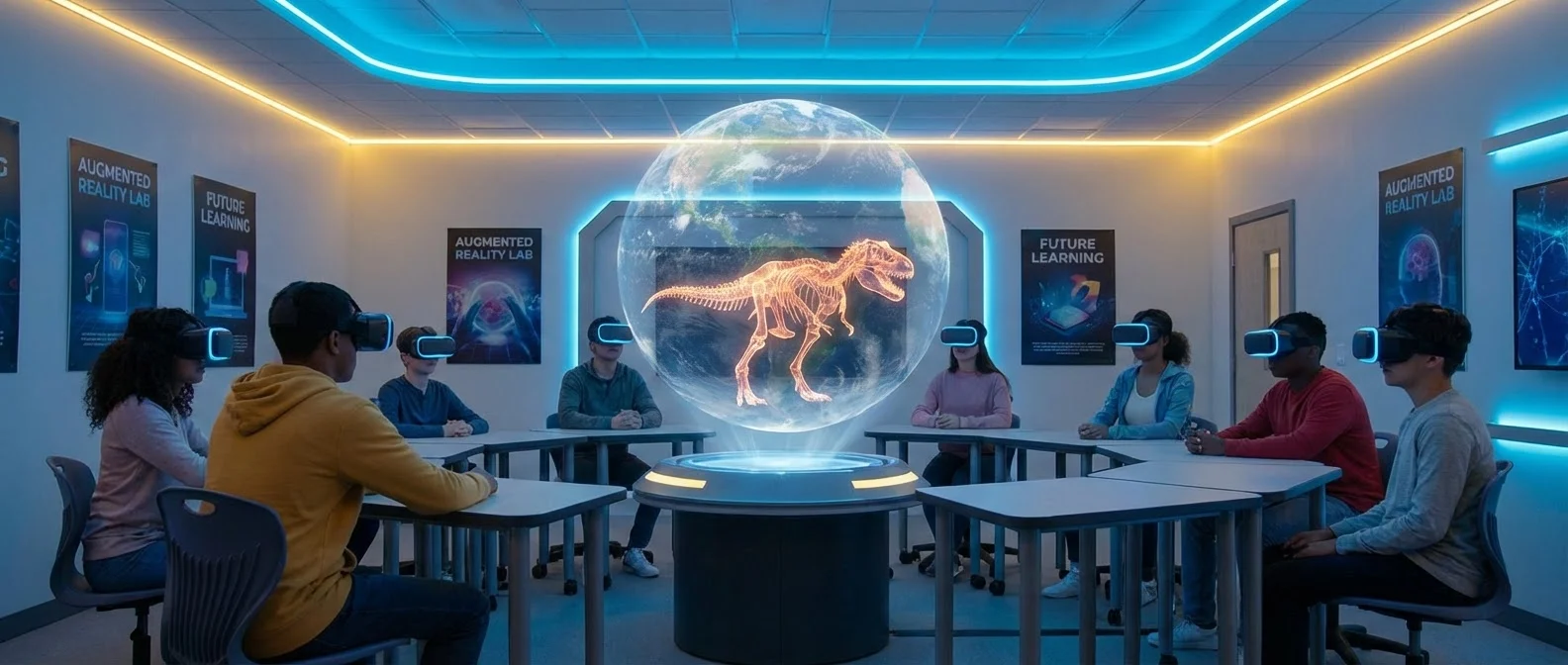
What Does VR in Education Mean
Virtual reality in education (VR Education) refers to using immersive digital environments — via headsets like Meta Quest 3 or specialized lab systems — for teaching purposes. Unlike traditional methods, VR places the student inside the lesson, creating the so-called “sense of presence.” Whether it's a standalone headset or a room-scale CAVE system, VR eliminates external distractions and focuses the learner's full attention on the subject matter.
Virtual Laboratories
Chemistry, biology and physics experiments with zero material costs or accident risk. Platforms like Labster offer 200+ virtual labs used by 5,000+ institutions worldwide.
Historical Reconstructions
Walk through Ancient Rome, watch the Pyramids being built, or visit Berlin in 1989. History transforms from abstract text into a lived experience that students never forget.
Virtual Field Trips
Schools in remote areas can “visit” museums, national parks and archaeological sites without any travel — just a VR headset per student is all it takes.
Social VR Learning
Multiple students connect to the same virtual space, collaborate on 3D projects and interact through avatars — even when they're in different cities entirely.
VR Education Platforms & Tools (2026)
Labster
The leading virtual lab platform. Over 200 STEM simulations (biology, chemistry, physics). Used by 5,000+ institutions globally, from MIT to local community colleges.
ClassVR
A dedicated VR headset designed for schools, with classroom management software. Teachers control what each student sees in real time. Deployed in 200+ UK schools.
zSpace
AR/VR workstations for STEM subjects. 3D visualization of molecules, anatomy and mechanical structures — uses a stylus instead of a headset for natural interaction.
VictoryXR
Digital Twin Campuses: virtual replicas of real university campuses in VR. Partnership with Meta across 150+ educational institutions — Morehouse College was the pioneer.
Google Arts & Culture
Virtual tours of museums, historical sites and cultural monuments. Free access with VR support. Successor to Google Expeditions (2015-2021, 1M+ students served).
Engage VR
Virtual classroom platform with presentation tools, whiteboards and 3D objects. Used in corporate training and universities around the globe.
Traditional vs VR Classroom
Teaching Methods Comparison
Schools Already Using VR
Case Studies from Around the World
- Morehouse College (USA): One of the first universities with a Digital Twin Campus via VictoryXR — students attend lectures in a full VR campus with avatar interaction.
- British Museum (London): Uses Samsung Gear VR in educational workshops for schools, transporting students to the Bronze Age through archaeological reconstructions.
- ClassVR Schools (UK): 200+ schools across Britain integrated ClassVR headsets into daily geography, history and science lessons with measurable engagement improvements.
- CAVE System — University of Illinois (1992): The pioneering Cave Automatic Virtual Environment was a room with projection screens — the world's first immersive educational installation.
- Google Expeditions (2015-2021): The first mass VR field trip program for schools — used by over 1 million students before being folded into Google Arts & Culture.
Challenges & Limitations
Equipment Cost
A standalone VR headset costs $300-500 per student. For a class of 25: $7,500-12,500 in hardware alone, not counting software licenses, IT infrastructure and maintenance.
VR Sickness
Dizziness, nausea and dry eyes — especially in students under 13. Meta recommends Quest use after age 10, while Apple Vision Pro targets ages 13 and up.
Teacher Training
Only about 15% of teachers feel “ready” to integrate VR into their lessons. Serious professional development programs are needed before mass adoption can succeed.
Infrastructure & Internet
Many schools in rural areas lack sufficient bandwidth. Cloud-based VR labs require stable connections of 50+ Mbps — still a luxury in many regions around the world.
The Innovation Trap
A notable study (Makransky et al., 2019) in Learning and Instruction found that immersion in a VR lab simulation increased the “sense of presence” but actually reduced learning compared to traditional video. The reason: students were distracted by the novelty of the technology rather than focusing on the content itself. Proper pedagogical integration — not just “putting on headsets” — is what makes the difference.
"Virtual reality doesn't replace the teacher — it gives them tools that no book, no video, and no test can replace: the experience of actually being there."
The Future: AI + VR = Personalized Learning
The integration of artificial intelligence (AI) into VR educational environments opens entirely new doors. Imagine an AI tutor inside a VR world that adapts in real time to each student's pace — increasing difficulty when progress is strong, repeating exercises when the student struggles, analyzing eye-tracking data to identify points of confusion.
Meta has already launched its “Meta Quest for Education” program with special pricing and device management software for schools. Apple Vision Pro brings “spatial computing” to education with mixed reality applications. While VR adoption in 2026 remains in its early stages, the trend is unmistakable: education is moving toward the immersive world.
"VR education isn't just about technology — it's about equity. A school in a rural area can now 'visit' CERN or NASA the same way a school in the heart of New York City can."
VR education stands at a critical inflection point. From the first CAVE system experiments at the University of Illinois in 1992 to today's standalone headsets and cloud VR labs, the technology is maturing steadily. The question is no longer “can it be done?” — but “how do we do it right, equitably, and effectively in every school on the planet.”