📖 Read more: VR Medicine: Surgeon Training in 2026
🎮 Meta Quest Touch Plus — Five Generations of Evolution
The story of Touch controllers began in December 2016, when Oculus released the first motion controllers as a $200 accessory for the Rift CV1. Those early controllers used infrared LEDs on external tracking rings and required external Constellation sensors in the room. Despite the setup hassle, they marked the first time a VR headset offered true hand presence — you could feel your hands existing inside the virtual world.
The evolution over the following decade has been dramatic. The 2nd generation (Quest/Rift S, 2019) moved the tracking rings to the top for inside-out tracking — no more external sensors needed. The 3rd generation (Quest 2, 2020) improved ergonomics, brought back the thumb rest, and upgraded haptics. The 4th generation — Touch Pro (2022) — was revolutionary: each controller gained a built-in Snapdragon 662 chip and self-tracking cameras, a pressure sensor for pinch gestures, and TruTouch haptics. The tracking ring was eliminated entirely.
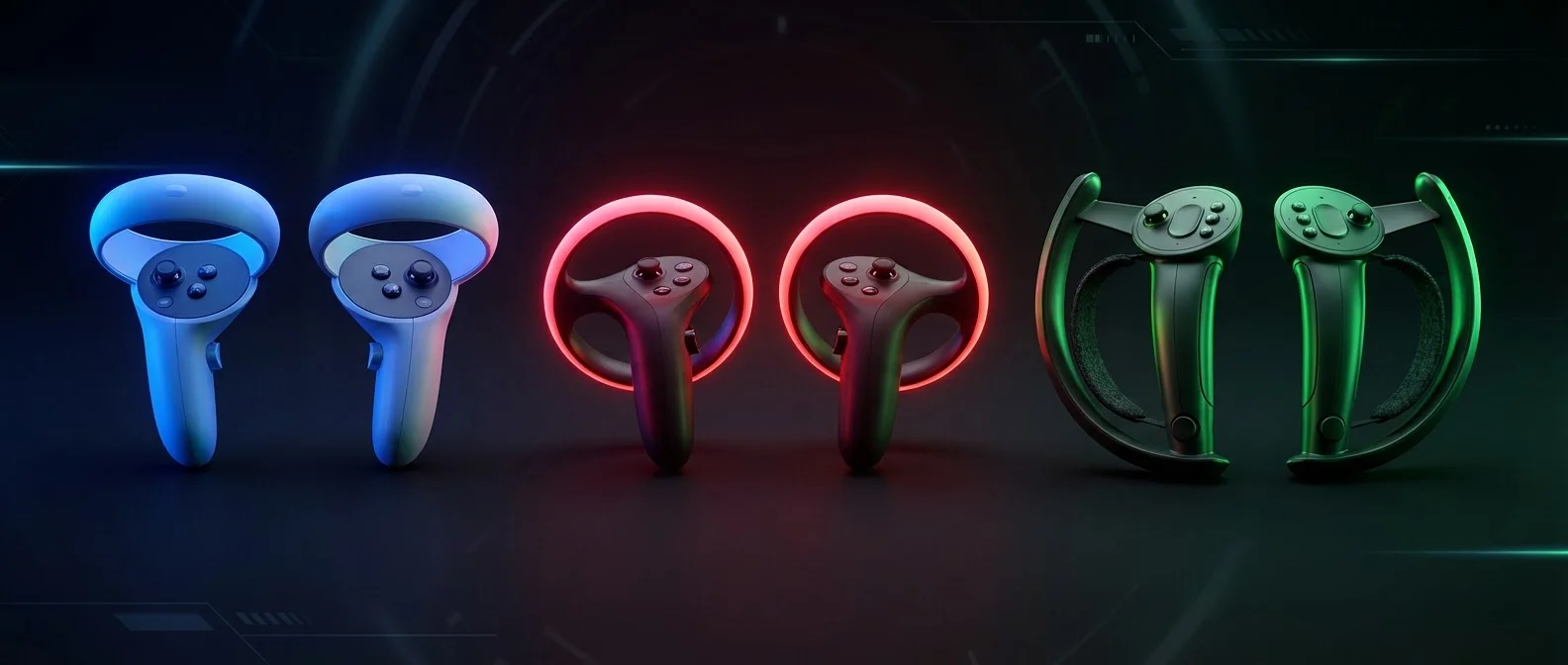
Today's Touch Plus (5th generation) ship with the Quest 3 ($500) and Quest 3S ($300). They keep the ring-free design but use simpler technology: infrared LEDs embedded in the body, combined with internal sensors and the headset's hand tracking system. They don't stand out in any single category, but they do everything remarkably well: accurate tracking, solid haptics, lightweight design. They use replaceable AA batteries — a practical advantage when you don't want charging downtime.
For professional use or maximum precision, the Touch Pro controllers (~$300 standalone) remain the premium choice in Meta's ecosystem. They work with Quest 2, Quest 3, and Quest Pro, with self-tracking that doesn't depend on the headset's line of sight — you can put your hands behind your back without losing tracking.
🕹️ Valve Index Knuckles — The Finger Tracking Legend
The Valve Index Controllers — known as “Knuckles” since their prototype days — are arguably the most ambitious VR controllers ever built. They launched in June 2019 alongside the Valve Index headset ($999 full kit, $279 controllers only) and remain unmatched in one critical area: full finger tracking.
Each controller houses 87 sensors that track hand position, individual finger placement, motion, and pressure. In practice, you can open, close, and move each finger in the virtual world with natural precision — wiggle your index finger, clench your fist, give a thumbs-up. No other commercial controller comes close to this level of granularity.
📖 Read more: PlayStation VR2: Complete Guide 2026 - Specs, Games, Price
Their signature innovation is the strap system: the controllers attach to your hand and detect when you open your palm. You drop objects in VR simply by opening your hand — no “throw” button needed. This natural interaction transformed games like Half-Life: Alyx, which was designed specifically for these controllers. Input options include a thumbstick, touchpad, 2 face buttons, menu button, trigger, and accelerometer.
Tracking uses SteamVR Lighthouse 2.0 — external base stations that emit infrared lasers. They deliver top-tier accuracy but require setting up external hardware in your room. In November 2025, Valve announced the discontinuation of the Index headset. The Knuckles still work with every Lighthouse-compatible system, but their long-term retail availability is uncertain — if they interest you, grabbing a pair sooner rather than later might be wise.
🆕 Steam Frame Controllers — A New Chapter for Valve
Alongside the Steam Frame — Valve's first standalone VR headset, launching early 2026 — come entirely new controllers. In stark contrast to the strap-based, finger-tracking philosophy of the Knuckles, the new controllers adopt a gamepad-style design, closer to a traditional game controller.
They use TMR (Thru-Magnetic Resonance) tracking, completely eliminating the need for external base stations. The philosophical shift makes sense: the Steam Frame is a streaming-first headset designed for flexibility — requiring Lighthouse didn't fit that vision. Valve hasn't revealed full specs yet, but the move to gamepad design suggests they're targeting a broader audience. For Knuckles nostalgics, it's worth noting the old controllers won't be compatible — different tracking system entirely.
📖 Read more: Meta Smart Glasses: Record-Breaking 7 Million Sales
🎯 PSVR2 Sense — Adaptive Triggers & Haptics Like Nothing Else
The PlayStation VR2 Sense controllers are in a class of their own. Designed in an orb shape, they incorporate two landmark PlayStation technologies: adaptive triggers with variable resistance and rich haptic feedback — inherited from the legendary DualSense.
Drawing a bow, you feel real tension. Pulling a trigger, you feel the mechanism engage. Breaking a rock? Resistance, then release. This technology creates a sense of touch that no other VR controller replicates — the haptics aren't simple “vibrations” but complex patterns that convey texture, weight, and motion.
Each Sense controller carries 14 IR LEDs in an orb ring for tracking via the headset's 4 cameras, plus 5 capacitive touch sensors: on the 4 buttons and the analog stick. These detect thumb, index, and middle finger placement, enabling natural gestures without pressing buttons. They don't match the full finger tracking of the Knuckles, but they cover essential gestures quite well.
PSVR2 Sense × Apple Vision Pro
In June 2025, Apple announced support for PSVR2 Sense controllers on the Apple Vision Pro via visionOS 26. For the first time ever, a major manufacturer's VR controller has gone cross-platform — paving the way for Sense controllers to be sold separately as standalone accessories, something that hasn't happened before.
That said, the Sense controllers aren't without complications. Sony appears to be reducing support for PSVR2 — headset production was paused after 2 million units, and many reviewers have expressed disappointment. PC support via adapter exists but has been described as problematic, with Bluetooth pairing issues and missing features (no eye tracking or HDR on PC). The controllers themselves, however, remain outstanding technology.
"I'm sorry I was wrong about PlayStation VR2."
📖 Read more: Pico 4 Ultra Review: Can It Challenge the Quest 3?
⚔️ Category-by-Category Winners
VR Controllers 2026 — Head to Head
🔍 Which Controller Is Right for You?
For Casual VR Gaming
Meta Touch Plus — The most well-rounded controllers in a bundle package. Zero setup, excellent tracking, AA batteries. If you just want to play VR without any hassle, you don't need anything more.
For Hardcore Immersion
Valve Knuckles — If maximum immersion is your priority, the 87 sensors and strap system are unrivaled. Perfect for Half-Life: Alyx, simulation games. Require Lighthouse hardware setup.
For Tactile Feedback
PSVR2 Sense — The adaptive triggers and haptics deliver a sense of touch that nothing else approaches. If you want to truly “feel” your games in your hands, these are the only option.
🔮 What Does the Future Hold?
2026 marks a transitional period for VR controllers. Meta is expected to unveil new controllers for the Quest 4 (codename “Pismo High”), likely featuring sEMG (surface electromyography) technology in their neural interface wrist band. Valve has just introduced TMR tracking. And Sony is exploring new paths by opening the Sense controllers to Apple Vision Pro.
Long-term, the trend points toward controller-free hand tracking — Meta is already pushing it, and PSVR2 added hand tracking in 2024. But physical controllers aren't disappearing anytime soon. Haptic feedback, adaptive triggers, the feeling of weight from a virtual object in your hand — these are experiences that bare hands simply can't replicate. Controllers are evolving, not retiring. The question isn't “controllers or hand tracking” — it's “when will they be perfectly combined?”