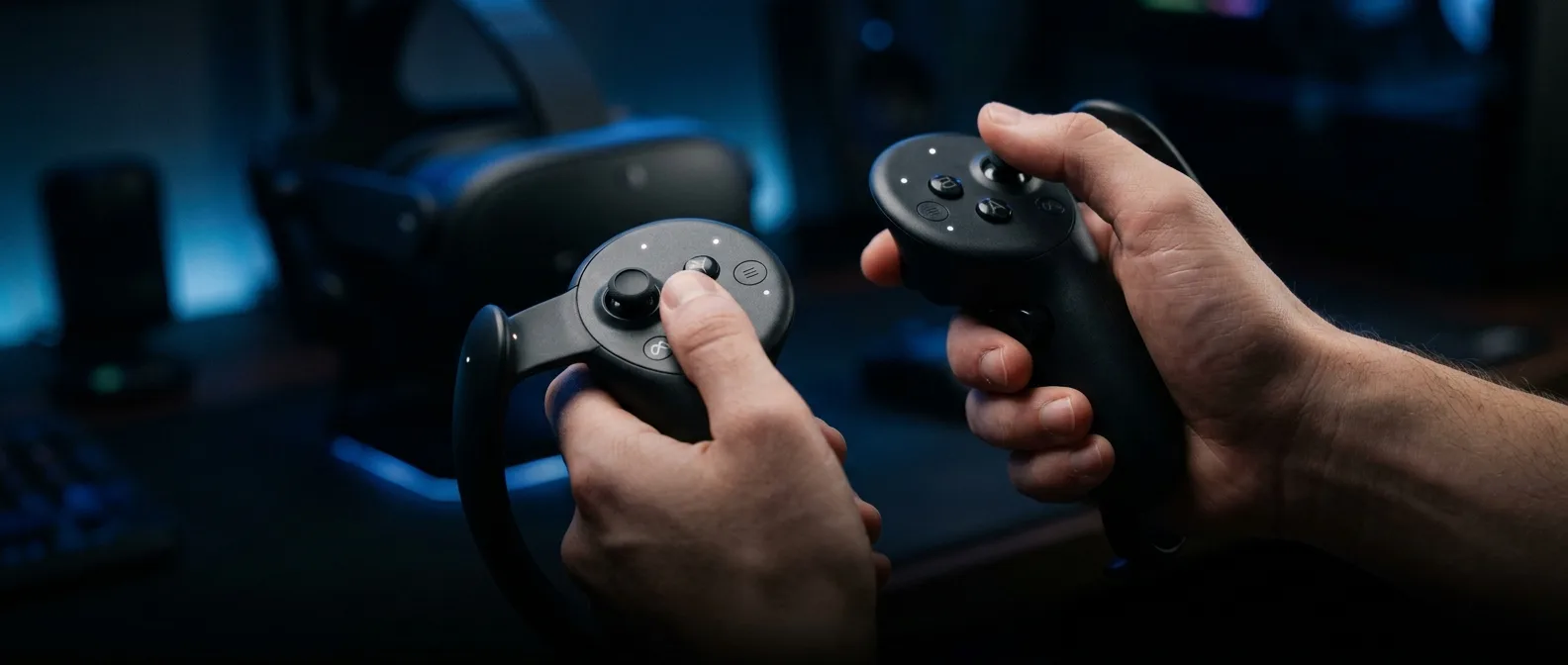
Late summer 2023: Meta's Andrew Bosworth drops into an Instagram AMA and casually nukes a decade of VR controller design. The new Touch Plus controllers for Quest 3 have no tracking rings. Instead, they fuse infrared tracking with AI hand tracking in real time. This isn't just a design tweak — it's a complete rethink of how VR input works.
🔬 Where the Tracking Rings Went and What Replaced Them
For the first time since 2016, Meta has completely abandoned tracking rings on consumer controllers. The technology that dominated from the original Rift — a ring packed with infrared LEDs that "lit up" the headset's cameras — gives way to something far more complex.
Touch Plus controllers move the IR LEDs from the ring to the controller's faceplate, adding an extra LED at the base. That means fewer consistently visible markers — but here's where it gets clever.
Meta's Hybrid Tracking Solution
When the controller's IR LEDs get blocked by your hand or turn away from the cameras, Quest 3 automatically kicks in controller-free hand tracking. Both systems run simultaneously and "fuse" to deliver the final tracking result.
This isn't a fallback system — it's active fusion. Every frame, the controllers' accelerometers and gyroscopes combine with optical data from IR LEDs and AI algorithms from hand tracking. The result? Theoretically more reliable tracking in environments where either system alone would struggle.
⚡ Why Beat Saber Expert+ Mode Remains the Benchmark
When Bloomberg reported that Quest 3 "might have controller tracking issues in some games," the VR community panicked. But Jaroslav Beck, co-founder of Beat Saber, was blunt: "It's good. Don't worry."
Why does this matter? Since the first Quest's development, Beat Saber's Expert+ difficulty mode has served as Meta's internal benchmark for controller tracking. If a controller passes the "Expert+ test," it's considered ready for release.
Meta's Misha Davidov confirmed that Touch Plus controllers "pass the Expert+ test" as well. If true, this means the new system's precision reaches the levels needed for rhythm games with insane velocities and direction changes.
How AI Hand Tracking Boosts Precision
Quest 3's hand tracking has significant improvements, mainly thanks to the depth sensor. When the controller's IR LEDs disappear from the cameras' field of view (like during wrap-around gestures or bringing hands close to your body), the AI system can predict controller position based on finger placement.
This isn't entirely new — Quest Pro's Touch Pro uses self-tracking cameras. But Touch Plus does something different: it uses headset-based hand tracking as a backup/fusion layer instead of dedicated hardware on the controller.
📊 Tracking Volume Changes — Less Overhead, More Behind-the-Back
Quest 3 has the same total tracking volume as Quest 2, but with a different shape. Meta strategically shifted the coverage area.
"Quest 3's cameras don't cover the space above the user's head as well as Quest 2. But the trade-off is we have more coverage around the torso — especially behind the user."
Meta Connect 2023
Why this choice? Because players rarely hold their hands above their heads for extended periods — but they frequently make behind-the-back movements in shooters, sports sims, or when reloading weapons.
Smart Estimation for Blind Spots
When controllers leave the tracking area for brief moments, the headset estimates their position based on last known location and IMU data. This works for under one second — enough for brief occlusions, not extended movements outside the field.
Better Behind-the-Back Coverage
Perfect for reloading mechanics and over-the-shoulder movements
Fusion Hand Tracking
AI backup when IR LEDs aren't visible to cameras
🎯 Haptics and Hardware: What You Gain, What You Lose
Touch Plus has "definitely better haptics than Quest 2's Touch v3, but not at Touch Pro levels." They feature one voice coil actuator instead of the Touch Pro's multiple haptic motors (separate ones in the trigger and thumbstick).
However, they add a "little secret" no other Touch controller had: a two-stage index trigger. Once you pull the trigger fully, you can apply extra force that registers as a separate value. Think variable-pressure aiming in shooters.
What's Missing from Touch Pro
Touch Plus lacks the pinch sensor on the thumbpad and pressure-sensitive stylus tip from Touch Pro. These features were mainly used in creative applications and mixed reality interactions — not gaming.
But losing the tracking ring brings immediate benefits: you can bring controllers much closer together at any angle without risk of hitting plastic you can't see in VR. This opens up entirely new hand-to-hand interactions.
💡 How Quest 3 Changes VR Input
The shift from ring-based to hybrid tracking isn't just evolution — it's a major shift. For the first time in a mainstream VR headset, we have active fusion of two different tracking methodologies in real time.
This sets the stage for mixed reality experiences where hand tracking and physical controls coexist naturally. You can switch from gesture-based interaction to button/trigger input without transition lag.
What This Means for Developers
Meta provides the Haptics Studio tool that lets developers design haptic effects that work across all the company's controllers — from Touch v3 to Touch Pro — without separate development for each hardware generation.
For users, the change is transparent in daily use. For developers, it opens new possibilities in mixed reality applications where seamless switching between hand gestures and controller input becomes the rule, not the exception.
🔮 Where Controller Tracking Is Heading
Touch Plus looks like an intermediate step toward a future without physical controllers. Meta is investing heavily in hand tracking — but admits that for precision gaming and haptic feedback, we still need hardware.
The 2026 solution? Probably controllers that combine ultrasonic haptics with computer vision tracking so advanced that physical buttons become optional. Touch Plus tests the fusion logic that will lead there.
For now, Quest 3 tracking's success will be judged by practical use. If Beat Saber speedrunners don't complain about missed hits and VRChat users can make complex gestures without glitches, Meta will have won its bet. If not — there's always Touch Pro as a backup option.
Sources: