📖 Read more: Meta Ray-Ban Display: Smart Glasses with a Built-In Screen
📱 From Camera Glasses to AR Platform
The Spectacles story begins in December 2014, when the then-Snapchat Inc. acquired Vergence Labs for $15 million. Vergence Labs, founded by Erick Miller in 2011, had created Epiphany Eyewear — a pair of smart glasses before Google Glass was even announced. Miller and his team dreamed of glasses that would give people “what would previously be called superpowers,” but limited resources forced them to ship a simpler video-recording product first.
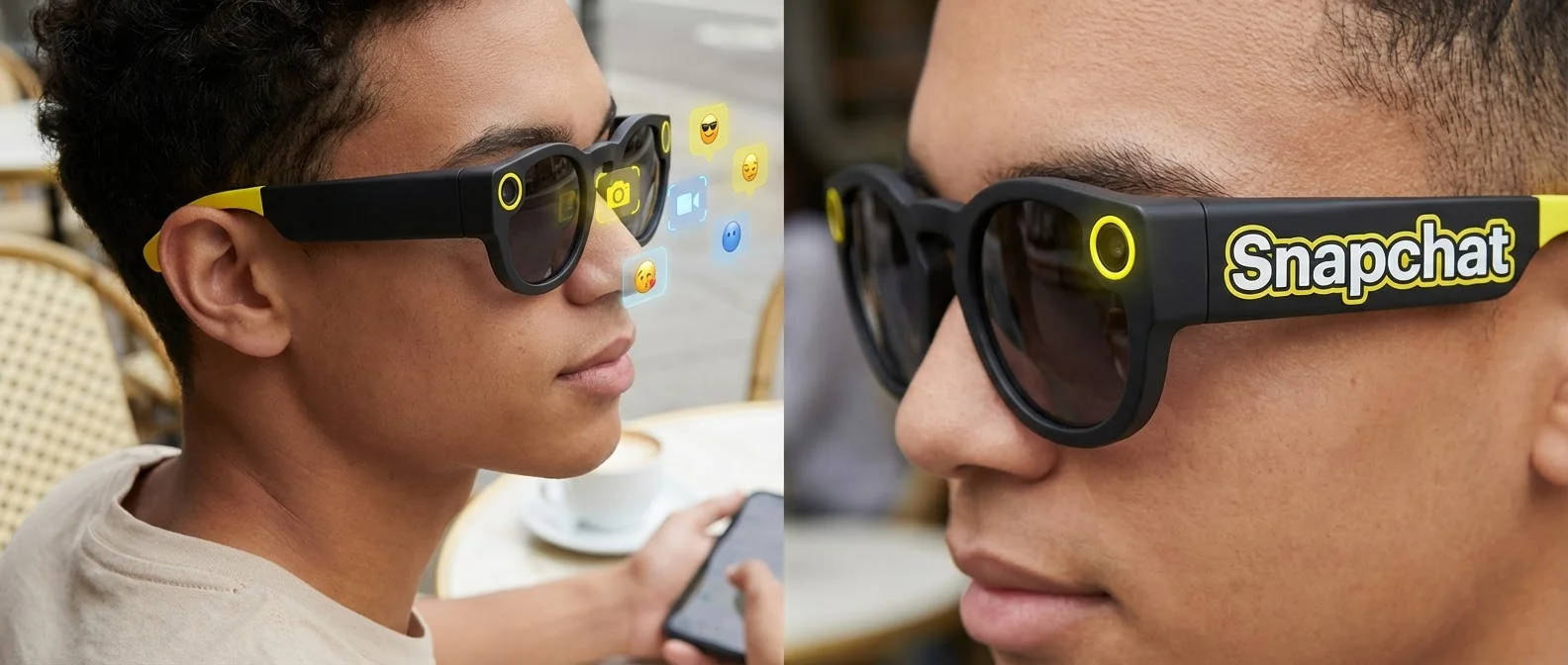
In September 2016, the company rebranded to Snap Inc. and unveiled Spectacles: $130 sunglasses with a built-in camera that recorded 10-second circular videos, auto-syncing to the user's Snapchat account. They were sold through “Snapbots” — yellow vending machines that popped up in random locations, starting from Venice Beach near Snap's headquarters.
📊 The Generation-by-Generation Evolution
Each Spectacles generation marked a significant step forward:
Spectacles Generation History
The first generation sold just 220,000 pairs — far fewer than initially expected. In late 2017, Snap wrote off $40 million in unsold Spectacles inventory. This didn't stop the company — instead, it invested even deeper in AR technology.
The fourth generation was the real turning point: for the first time, an AR display was integrated that could run Lenses directly in the glasses. It featured a dual 3D waveguide display, Qualcomm Snapdragon XR1 chip, 2 RGB cameras, 4 microphones, and 2 stereo speakers. However, it was available only to developers.
🔥 5th Generation: The First True AR Glasses
On September 17, 2024, CEO Evan Spiegel unveiled Spectacles 5 at the Snap Partner Summit — what Snap describes as its first fully standalone AR glasses. Unlike previous generations, they require no phone tether or cable connection.
Display & Optics
Stereoscopic display with a 46° diagonal field of view and 37 pixels-per-degree resolution. See-through lenses that automatically adjust tint based on ambient lighting.
Hand & Voice Tracking
Four cameras power spatial understanding, machine learning, and full hand tracking. Alternatively, control via voice commands.
Snap OS
New proprietary operating system designed exclusively for Spectacles. Runs AR Lenses in real-time, supporting both single and multi-person experiences.
Standalone Design
Built-in battery, no phone or external hardware required. Fully autonomous AR device for the first time in Spectacles history.
Spectacles 5 are available (as a developer kit) in 6 countries: the US, Austria, France, Germany, the Netherlands, and Spain. Snap reports over 250,000 Lens creators who have built 2.5 million Lenses in total — a massive AR app ecosystem.
📖 Read more: AR Apps: 15 Must-Have Apps 2026
🚀 6th Generation & Specs Inc.: The Consumer Pivot
In June 2025, Snap revealed plans to sell a consumer version of its AR glasses in 2026, branded as “Specs.” In January 2026, the company established the subsidiary Specs Inc. — according to CNBC — exclusively for AR glasses, marking this as a standalone business unit.
Wikipedia states: "Snap announced it will be releasing a sixth, consumer-focused generation of Spectacles in 2026." This move signals that Snap now has enough confidence in its technology to bring it to the mass market — something it didn't dare with generations 4 and 5.
Snap Inc. by the Numbers (2025)
The company reported $5.93 billion in revenue in 2025, though with an operating loss of $532 million and net loss of $460 million. It employs 5,261 people, and the stock (NYSE: SNAP) sits below its 2017 IPO levels. Despite financial pressures, Snap continues to invest steadily in AR hardware as a long-term bet.
⚔️ How They Stack Up Against the Competition
Spectacles don't exist in a vacuum. Competition in AR glasses is intensifying significantly:
Meta dominates commercially with Ray-Ban Meta (7+ million units sold), while the Ray-Ban Meta Display (September 2025) brought an AR screen to stylish sunglasses. Meta Orion, presented as a prototype in September 2024, uses holographic waveguides. Apple is working on lightweight AR glasses beyond the Vision Pro, but launch isn't expected until after 2027. Samsung is developing Project Haean glasses in partnership with Google/Android XR. And XREAL already offers consumer-facing AR glasses with 3D displays.
Snap's advantage is its software ecosystem: 250,000+ Lens creators, millions of AR experiences, and an audience of 800+ million monthly Snapchat users. No other AR glasses maker has this creator count.
"Each generation of Spectacles brings us closer to our original ambition: glasses that overlay the digital world onto the physical one. Spectacles 5 are the most complete expression of that vision yet."
🔮 What to Expect
2026 will be the pivotal year for Spectacles. The establishment of Specs Inc. signals serious intent: this is no longer an experimental project, but a standalone business unit targeting commercial release. Questions remain: what will the price be? (Spectacles 5 developer kit costs $99/month by subscription). How lightweight will they be? Will they run the same Lenses or new ones? Will they be available outside the US?
One thing is certain: Snap Inc. — despite laying off 20% of staff (2022) and another 10% (February 2024), despite negative financial results — never abandoned AR hardware. Instead, it spun up a dedicated company for it. That persistence, combined with the world's largest AR creator ecosystem, makes Specs 2026 one of the most anticipated tech launches of the year.