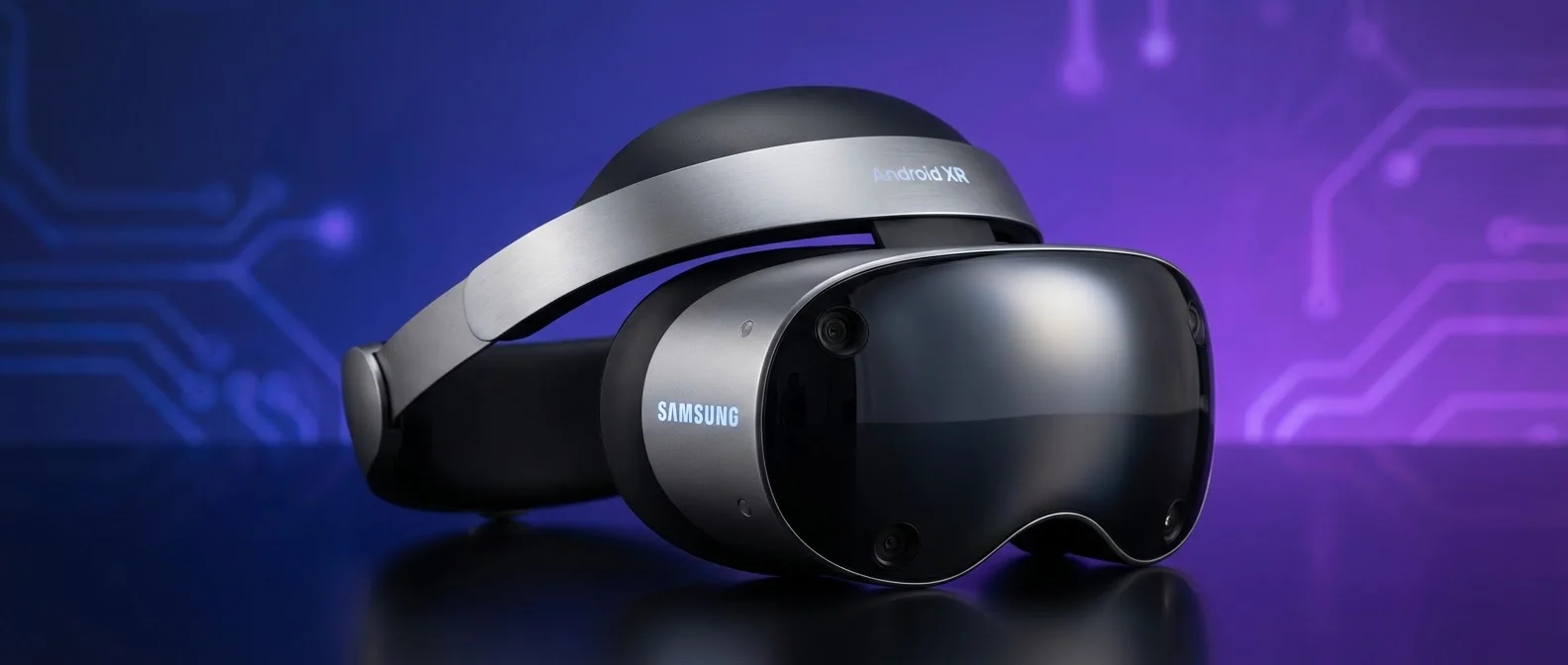
🤝 The Three-Way Partnership That Changed the Game
The Galaxy XR isn't just another VR headset. It's the product of a strategic partnership between three tech giants: Samsung designed the hardware, Google developed the Android XR operating system, and Qualcomm built the specialized Snapdragon XR2+ Gen 2 processor. The collaboration was first announced in December 2024, with “Project Moohan” (Korean for “infinity”) as the codename.
After early prototypes at Google I/O in May 2025 and two appearances at Galaxy Unpacked events, Samsung officially unveiled the Galaxy XR on October 21, 2025. First shipments began on October 31, 2025, in the US and South Korea. The mission was clear: create an open mixed reality platform as an alternative to Apple's closed Vision Pro ecosystem and Meta's Horizon OS.
🔧 Top-Tier Hardware
The Galaxy XR impresses across every spec category. At its core lies the Snapdragon XR2+ Gen 2 with 16GB of RAM — double the Quest 3's memory — and 256GB of storage. This processing power enables true multitasking with multiple apps running simultaneously, something Samsung emphasized repeatedly during demos.
The real standout is the displays: dual micro-OLED panels with 3,552 × 3,840 pixels per eye — 27 megapixels combined — supporting 96% DCI-P3 color gamut and refresh rates of 60, 72 (default), or 90Hz. The field of view reaches 109° horizontal and 100° vertical, with IPD adjustment from 54 to 70mm — the widest range on any mainstream headset.
The sensor suite is equally impressive: two 6.5MP passthrough cameras, six world-facing tracking cameras, four eye-tracking cameras, a depth sensor, five IMUs, and a flicker sensor. Audio comes from two-way speakers (separate woofer and tweeter per ear) with a six-microphone array supporting Dolby Atmos. Connectivity includes Wi-Fi 7 and Bluetooth 5.4.
For design, Samsung opted for an external battery pack (302g) connected via cable, keeping the headset at 545g — a solution similar to Apple Vision Pro. The battery lasts roughly 2 hours of general use or 2.5 hours of video playback. The controllers (Galaxy XR Controllers) are sold separately for $249 — a controversial decision for an already premium package.
🖥️ Android XR: The Software That Makes the Difference
If the hardware specs impress, it's the software that truly sets the Galaxy XR apart. It's the first device to run Android XR — a variant of Android designed exclusively for mixed reality. The significance of this cannot be overstated: every Android app on the Google Play Store works from day one, displayed in resizable windows within your three-dimensional space.
Every previous mixed reality headset has suffered from an app drought. The Meta Quest Pro failed despite decent hardware precisely because it lacked sufficient apps. Even the Apple Vision Pro faces this challenge. The Galaxy XR solves this out of the box: you don't need to wait for developers to build spatial apps — everything from Google Docs to Spotify already works.
Google's Gemini AI integration is ubiquitous. It opens apps via voice commands, provides context-aware information based on your environment, translates in real time, and acts as a personal assistant within the headset. During demos, Samsung showcased Gemini serving as a 3D tour guide in Google Maps, offering gameplay tips during Stardew Valley sessions, and even translating NPC dialogues in real-time in a Gemini-powered game called Asteroid.
Streaming & Media
The Galaxy XR is the only XR device with an official Netflix app. It also supports YouTube in 180°/360° VR, AI-conversion of 2D videos to 3D, and Dolby Atmos. It can play video up to 8K (7,680 × 4,320 @ 60fps). Early buyers who purchased before 2026 received 12 months of YouTube Premium, Google AI Pro, Play Pass, and NBA League Pass.
🎮 Gaming & Productivity
On the gaming front, the Galaxy XR doesn't aim to directly compete with the Quest ecosystem. It supports Unity and OpenXR, with titles like Walkabout Mini Golf and NFL Pro Era already available. However, its real strength lies in cloud gaming — Samsung demonstrated No Man's Sky via streaming while simultaneously running music and video in side windows, proving the 16GB of RAM can handle heavy multitasking with ease.
Productivity is the true focus. Samsung positions the Galaxy XR as a “laptop for your face” — a wireless workspace spanning hundreds of inches that replaces multiple external monitors. With support for mouse, keyboard, Bluetooth gamepads, hand tracking, eye tracking, and voice commands, it offers the most flexible interaction model of any headset available. Think Samsung DeX on a tablet, but your workspace extends hundreds of inches instead of 13.
Samsung also emphasized enterprise applications: medical training (practicing intubation before performing it in real life), retail planning via ShapesXR (placing products on virtual shelves), and team collaboration through Google Meet with lifelike eye-tracking-powered avatars.
💰 Is It Worth $1,799?
That's the tough question. At $1,799 (controllers not included), the Galaxy XR costs $1,500 more than a Quest 3S and only $700 less than an Apple Vision Pro. The pricing places it firmly in the premium/prosumer category — this isn't aimed at casual VR gamers.
Compared to the Vision Pro, however, the Galaxy XR offers one enormous advantage: full access to the Android ecosystem. You don't need to wait for “Made for XR” apps — everything on the Play Store works. And Gemini AI provides a level of intelligence that no other XR device can match right now.
If you're looking for a VR gaming headset, consider the Quest 3 or Quest 3S — you'll get far more games for far less money. But if you want a productivity-first mixed reality headset with class-leading displays, full Android compatibility, and AI integration at every level, the Samsung Galaxy XR is the most complete offering on the market as of February 2026. Whether enough consumers can justify this significant investment — especially in an XR headset market that hasn't yet found mainstream traction — remains to be seen.