📖 Read more: Foveated Rendering: How Eye Tracking Transforms VR
📊 What Is the Pimax Crystal Super
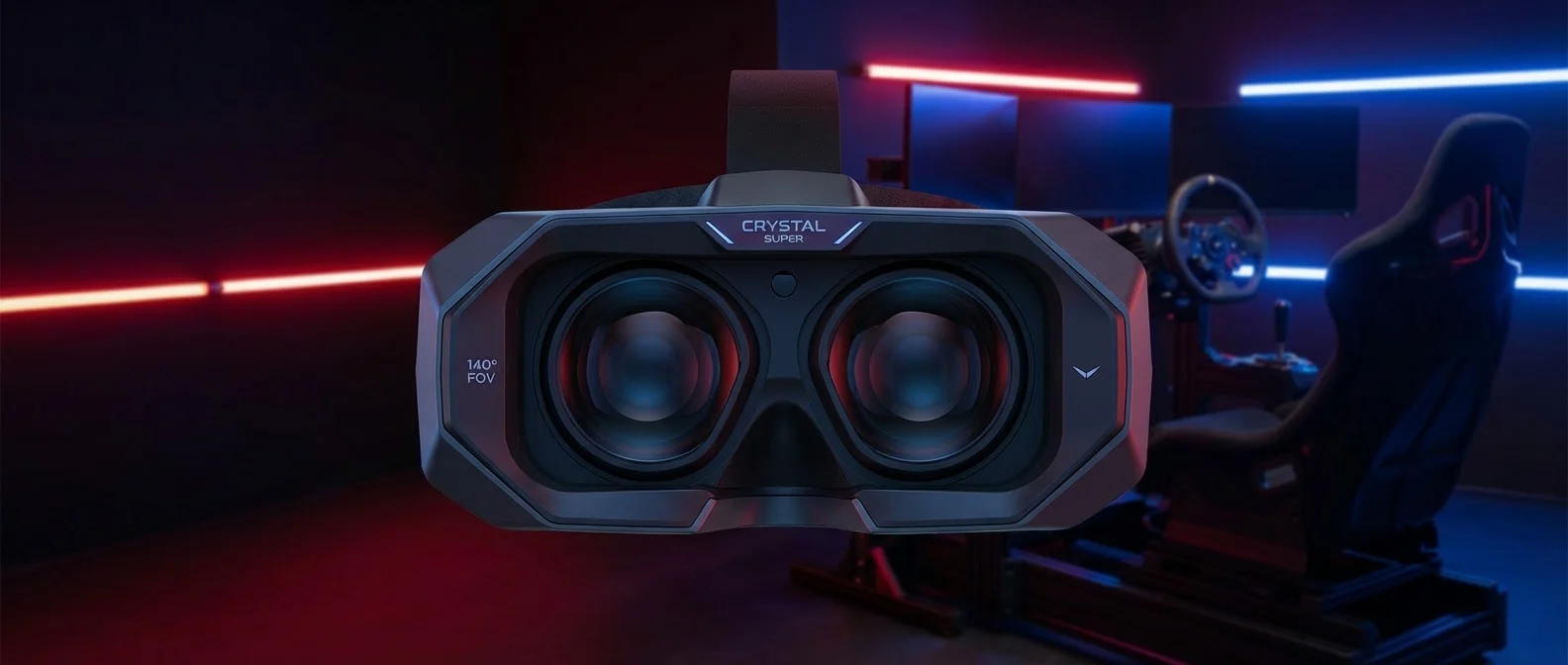
Pimax — a Chinese company specializing in high-end VR hardware — doesn't target the average consumer. They target VR enthusiasts who want everything maxed out: resolution, field of view, lens quality. The Crystal Super is the most mature expression of that philosophy — a PC VR headset with 3840 × 3840 pixels per eye on QLED panels, aspherical glass lenses with 99% light transmission, and a modular system of interchangeable optical engines.
With built-in eye tracking, inside-out tracking (no external base stations), Dynamic Foveated Rendering and upscaling, Pimax promises that even mid-range PCs can drive this resolution. The high pixel density allows reduced anti-aliasing, saving system resources. The headset ships with controllers and DMAS headphones included.
Modular Design — The Key Innovation
Pimax uses a system of swappable optical engines. You buy the headset and can change the lenses/panels to match your needs. Maximum FOV? Ultrawide engine. Maximum clarity? 57 PPD QLED. Lighter weight? Micro OLED. No other VR headset offers this kind of modularity.
🔬 The Four Optical Engines
What makes the Crystal Super unique isn't just the specs — it's that you can change the specs based on your use case. Pimax offers four optical engines:
Standard 50 PPD QLED
The base engine. 3840×3840 per eye, 127° FOV (138° in labs mode), 50 PPD. Aspherical glass lenses, 280 nits brightness. Included with the headset.
Ultrawide 140° FOV
The newest engine (July 2025). Pushes FOV to 140° without sacrificing sharpness (50 PPD), reducing stereo overlap to 90°. Same QLED panels and lenses.
57 PPD QLED ($399)
The sharper option. 57 pixels per degree for retina-level clarity, but with a narrower 120° FOV. Ideal for simulators and text-heavy applications. Available June 2025.
Micro OLED ($699)
The lighter option — around 700 grams. 105° FOV, true OLED blacks and colors. Built for extended sessions without neck fatigue. Expected summer 2025.
📖 Read more: PlayStation VR2: Complete Guide 2026 - Specs, Games, Price
🖥️ Resolution, Local Dimming & Brightness
At 3840 × 3840 pixels per eye, the Crystal Super delivers nearly triple the resolution of the Quest 3 (2064 × 2208). In practice, this means you can read fine text, spot details in aircraft cockpits, or watch movies without any screen-door effect. At 50 PPD, individual pixels are invisible — something very few headsets achieve.
The Local Dimming 2.0 system uses 1,000 zones per eye to independently control brightness across the display. This creates deeper blacks and greater contrast — approaching (without quite reaching) OLED quality from QLED panels. Peak brightness hits 280 nits.
🆕 Ultrawide Engine — The 140° That Changes Everything
The latest addition to the modular system, announced in May 2025 with shipments beginning July 2025. It increases horizontal FOV from 127° to 140°, without sacrificing pixels per degree — maintaining 50 PPD, according to Pimax.
How? By repositioning the QLED panels and lenses while reducing stereo overlap from 105° to 90°. Less overlap means slightly less 3D crossover between eyes in the center — something that may subtly affect depth perception, but delivers noticeably wider peripheral vision.
For sim racers, flight sim pilots, and anyone who wants to feel like they're “seeing” rather than “looking through binoculars,” 140° is a game changer. Most mainstream headsets (Quest 3, Valve Index, PSVR2) hover between 100-110°.
⚔️ Crystal Super vs The Competition
Spec Comparison
💰 Pricing & Financing
Pimax sets the price at $1,695 (reduced from $1,799 at initial announcement). This includes the headset with the standard 50 PPD QLED engine, controllers, and DMAS headphones. Additional optical engines cost extra: $399 for the 57 PPD QLED, $699 for the Micro OLED.
📖 Read more: Valve Steam Frame: The New VR Headset of 2026
Pimax also introduced a financing system called "Pimax Prime": pay $999 upfront, then either $696 as a lump sum or 24 monthly installments of $32.99. Original Crystal owners receive a $399 discount on the membership. At the end of the period, you own the hardware outright.
Who Is This For?
Ideal for: Sim racers, flight sim pilots, VR enthusiasts who demand top-tier clarity and FOV. If you're running DCS World, MSFS, iRacing, or Assetto Corsa on a powerful PC, this is your headset.
Not for: Casual gamers, users without a powerful PC, anyone wanting standalone VR, or buyers with a budget under $1,000.
⚠️ Issues & First Impressions
The Crystal Super didn't launch without problems. In April 2025, following initial shipments, several bugs were reported — issues with color profiles, speaker audio, microphone performance, and controller tracking stability. Pimax responded with a series of software updates and hardware improvements: face inserts were upgraded with stronger magnets and new foam, while the Pimax Play app gained a live customer support chat.
This won't surprise Pimax veterans: the company has a track record of ambitious specs but problematic launches. The difference this time is that the response was faster — but spending $1,700 on a headset with launch-day bugs isn't ideal. If you're considering a purchase, Pimax offers a trial program: pay a small deposit plus shipping, test the different optical engines, and only commit to buying if you're satisfied.
"The Pimax Crystal Super achieves retina-level resolution at 57 pixels per degree — it should therefore offer unmatched clarity."
🔮 Is It Worth the Money?
The Pimax Crystal Super doesn't compete with the Quest 3 or PSVR2. It plays in an entirely different league — one where the last degree of clarity, wide peripheral vision, and the ability to swap optical engines based on use case actually matter. If you're a sim racer who wants to check mirrors without turning your head, or a flight sim pilot who wants a realistic cockpit view, there's nothing better on the market right now.
But if you want a headset that “just works” without tweaking, or don't have a powerful PC, look elsewhere. The Crystal Super is an enthusiast-grade tool — impressive, but demanding at every level.