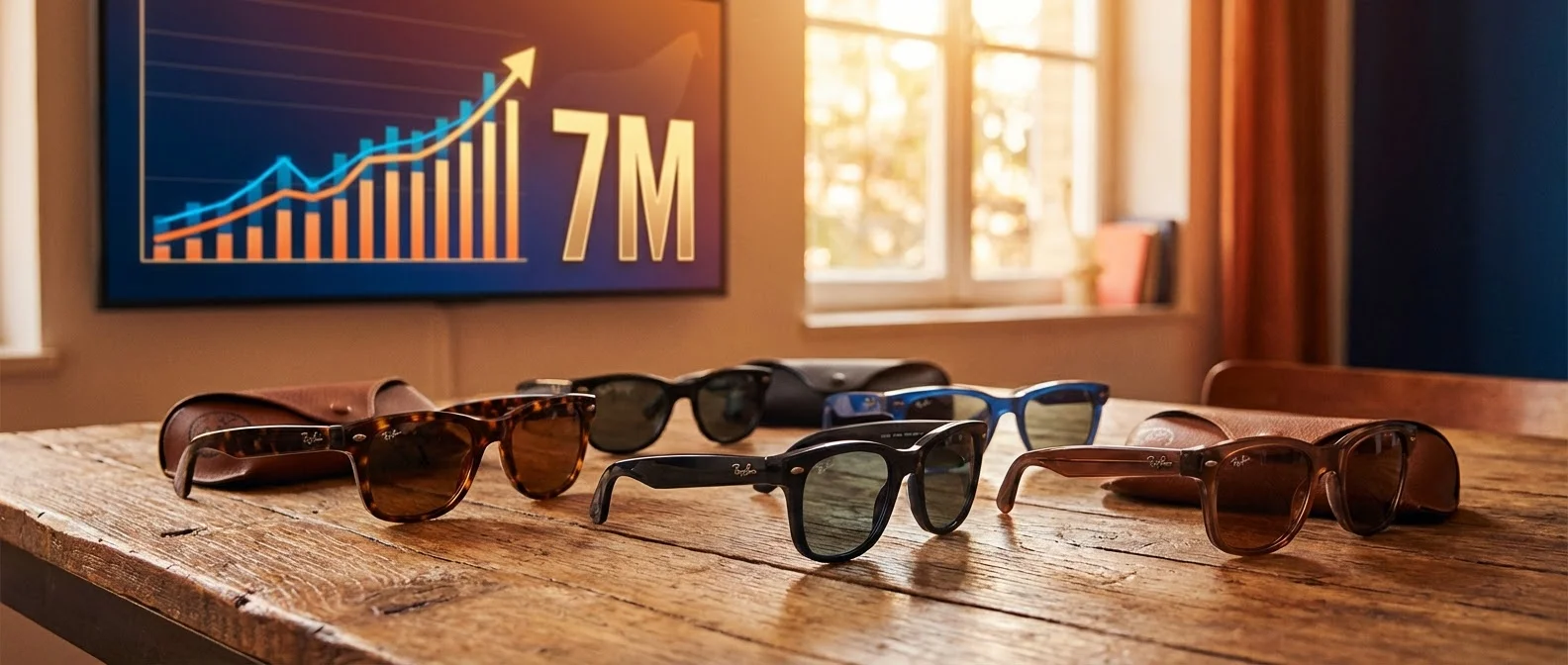
The Ray-Ban Meta smart glasses have achieved something nobody expected: selling over 7 million units by the end of 2025, shattering every previous record in the smart glasses category. From Google Glass to Snap Spectacles, no wearable had ever touched those numbers. How did Meta pull it off with a device that doesn't even have a screen?
📖 Read more: AI and VR: Artificial Intelligence in the Metaverse
The Story Behind the Glasses
The story begins in September 2020, when Mark Zuckerberg announced the partnership between Facebook (now Meta) and EssilorLuxottica, the world's largest eyewear company and parent of Ray-Ban. The goal was to create smart glasses that actually look like real glasses — not like science fiction prototypes à la Google Glass.
In September 2021, Ray-Ban Stories launched as the first generation. With two 5MP cameras, speakers, and microphones built into the temples, the glasses could take photos, record 30-second videos, and play music. Sales were relatively modest — the market wasn't quite ready yet — but the foundation had been laid.
The Second Generation: A Game Changer
In October 2023, Meta released the second-generation Ray-Ban Meta. The upgrade was massive: 12MP camera, five-microphone array, improved speakers, water resistance, longer recording times, and — most importantly — Meta AI integration. For the first time, you could ask your glasses what they see, request translations, or use voice commands for a wide range of functions.
Three models launched: Skyler, Wayfarer, and Headliner. The $299 starting price positioned them within the range of a premium pair of Ray-Bans — a brilliant strategy. You're not buying “another tech device,” you're buying a stylish pair of Ray-Bans that happens to include AI.
In April 2024, a critical update arrived: multimodal AI input via computer vision. The glasses could now “see” what you see and respond based on the image — e.g., “What plant is this?” or “Translate this sign.” This capability was the turning point: sales skyrocketed.
Why 7 Million Is a Massive Number
To grasp the significance of this figure, consider some comparisons. Google Glass (2013) sold a few thousand units before being discontinued. Snap Spectacles never exceeded 200,000 pairs annually. Even popular VR headsets took years to reach comparable numbers. Ray-Ban Meta hit 7 million in less than four total years, with the bulk of sales concentrated in 2024-2025.
According to Barclays, EssilorLuxottica holds a 60% market share in smart glasses — a remarkable figure considering that until recently, the category barely existed at commercially meaningful scale. Smart glasses contributed over four percentage points to EssilorLuxottica's nine-month sales growth, triggering a 14% stock rally for the 140-billion-euro company — despite representing just 2% of total sales.
As Ross Gerber, CEO of Gerber Kawasaki Wealth Management, put it: "Instead of trying to make something cool, Meta partnered with people who know what's cool." That exact philosophy — technology meets fashion — proved to be the secret formula.
The Third Generation: Oakley and Display
2025 brought two major developments. In June, Meta announced its partnership with Oakley (an EssilorLuxottica subsidiary) for sports-focused glasses. The Oakley Meta HSTN shipped in August, followed by the Vanguard in September — glasses designed for athletes and outdoor activities.
The big announcement, however, came at Meta Connect 2025 on September 18: the Meta Ray-Ban Display. For the first time, Ray-Ban-form smart glasses feature an integrated display. It's a monocular display in the right lens with 600×600 pixel resolution, 20-degree field of view, up to 5,000 nits brightness, and a 90Hz refresh rate. The glasses weigh just 69 grams.
Bundled with the glasses is the Meta Neural Band, an sEMG (surface electromyography) wristband that translates wrist muscle movements into control commands. Weighing only 42 grams with 18-hour battery life, it uses on-device machine learning to convert EMG signals into digital commands — scroll, navigate, interact without touching the glasses. The technology was developed using data from nearly 200,000 consenting research participants.
The Meta Ray-Ban Display launched on September 30, 2025 in the US, priced at $799, which includes both the glasses and the Neural Band. Battery life reaches 6 hours of mixed use, with an additional 24 hours from the charging case.
📖 Read more: Deadpool VR: Review, Gameplay & Impressions
Privacy: The Big Challenge
Ray-Ban Meta's success hasn't come without backlash. One of the most significant issues is privacy. The glasses were designed to look like regular Ray-Bans — the very thing that makes them so popular is also what concerns critics. Someone can record video or take photos without anyone around them noticing.
There's a small white LED that lights up during recording, but many question whether it's visible enough, especially in low light. In fact, 404 Media revealed that a $60 modification kit can disable the recording LED entirely. In January 2026, the BBC reported cases of men using the glasses to secretly film women and uploading the footage to TikTok without consent.
In the European Union, regulators in Ireland and Italy have been raising questions since 2021. Digital rights organization NOYB sent Meta a cease-and-desist letter in May 2025, alleging unlawful use of European personal data for AI training. With the EU AI Act (full obligations by 2026), certain AI features may be classified as “high-risk,” requiring fundamental rights impact assessments.
A particularly revealing 2024 study at Harvard showed how students used the glasses combined with PimEyes (a facial recognition tool) to identify people in real time — finding names, phone numbers, and even home addresses from just an image.
"AI smart glasses raise significant privacy concerns. The main issues are linked to the use of people's personal data to train AI models and transparency for bystanders."
Competition Heats Up
Meta's dominance won't go unchallenged. In November 2025, Alibaba launched its own Quark AI glasses in China, a market where Ray-Ban Meta glasses aren't sold. Apple is expected to unveil its own smart glasses in 2026, with a release potentially in 2027, according to Bloomberg. Google is working on its own model in partnership with Warby Parker.
Nonetheless, EssilorLuxottica holds a powerful advantage: a global network of 18,000 stores, brands like Prada, Armani, and Chanel, and decades of expertise in eyewear manufacturing and distribution. Bernstein analyst Luca Solca warns that the first-mover advantage may fade as competitors launch better products — but so far, no one comes close to the technology-meets-fashion combination achieved by Meta and EssilorLuxottica.
As EssilorLuxottica itself stated: "A vibrant ecosystem will help us drive market growth, fuel innovation, and expand consumer choice."
What to Expect in 2026
The outlook for 2026 is particularly exciting. Meta Ray-Ban Display availability is expected to expand to Canada, France, Italy, and the United Kingdom. EssilorLuxottica has already held exploratory talks with Prada about a potential smart glasses collaboration — imagine Prada × Meta AI glasses.
CEO Francesco Milleri is steering the group toward health tech, with smart glasses serving as a central strategic pillar. Meanwhile, the assistive technology functionality — AI that describes your surroundings, reads text via OCR, and provides turn-by-turn navigation — opens the glasses to an entirely new user category: people with visual impairments.
EssilorLuxottica's stock gained 28% in 2025, overcoming tariff shocks and hitting all-time highs as investors rallied behind Ray-Ban Meta's momentum. If the company can fully leverage its brand portfolio — and Apple doesn't fundamentally disrupt the market — 10 million units sold may not be far off.
Ray-Ban Meta proved something important: that technology can become part of our everyday appearance without looking “techy.” And that, perhaps, is their most significant innovation — not the specs, but the perception.