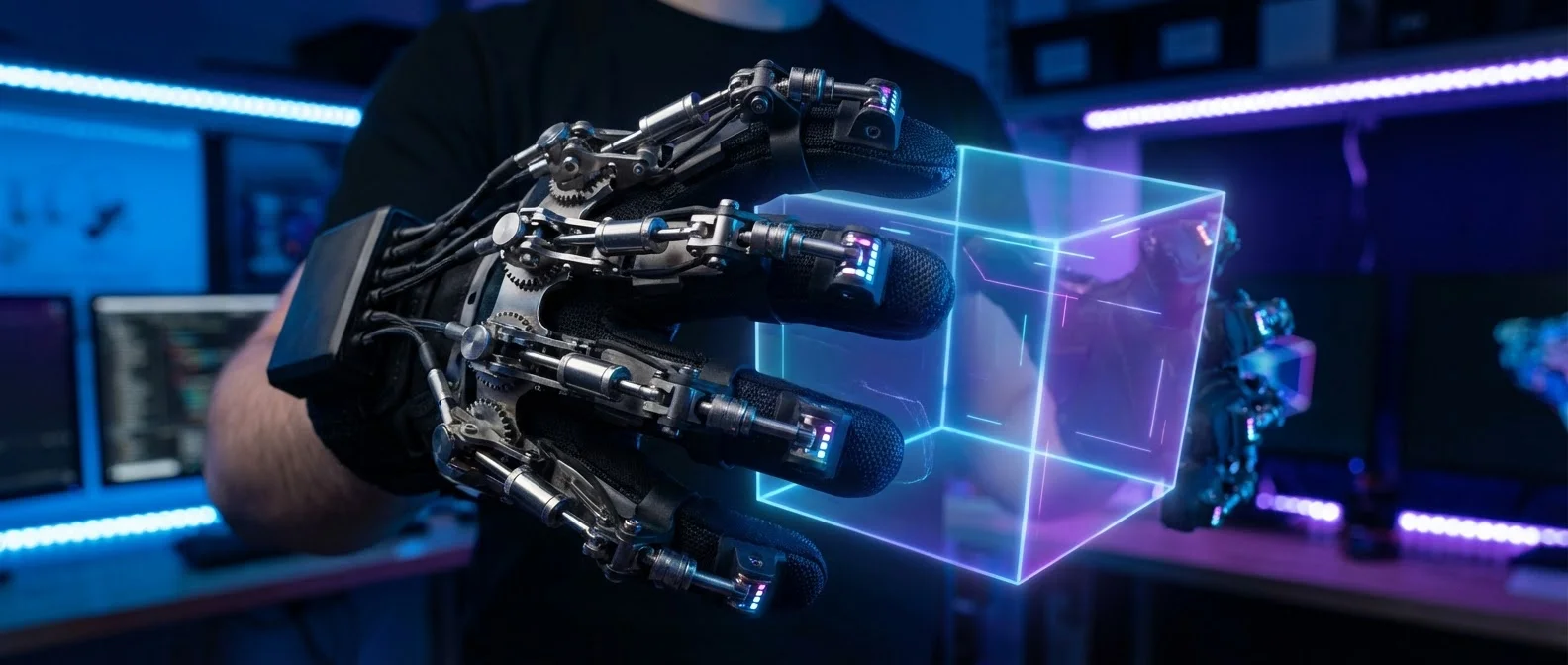
Haptic gloves are arguably the most ambitious VR accessory: wearable devices that let you feel objects inside digital worlds. From rapidly evolving vibration sensors to pneumatic force-resistance systems, touch technology is transforming the way we interact with virtual environments. In this article, we explore how haptic gloves work, who builds them, and why they're considered a critical piece of VR's future.
📖 Read more: VR Art: Creating Works and 3D Worlds
What Are Haptic Gloves
Haptic gloves — also called tactile feedback gloves — are wearable input/output devices worn on the user's hands. Unlike standard VR controllers, haptic gloves track each finger individually while simultaneously generating physical sensations — vibrations, pressure, force resistance — that simulate the touch of real objects.
The concept is far from new. Back in 1977, the Electronic Visualization Laboratory created the “Sayre Glove,” the first wired glove. In 1987, Nintendo's legendary Power Glove followed, and the 1990s brought the CyberGlove, CyberTouch, and CyberGrasp — systems that could already simulate gripping objects. Today, companies like HaptX, bHaptics, SenseGlove, and Manus VR have taken the technology to an entirely new level.
How Touch Gloves Work
Modern haptic gloves combine multiple technologies to create convincing touch sensations. Each approach has its strengths and limitations, and leading manufacturers often blend two or more methods into a single glove.
Vibrotactile
Small vibration motors (ERM or LRA) placed on each finger produce vibrations of varying frequency and amplitude. It's the most affordable solution — ideal for touch notifications and textures — but doesn't reproduce a sense of weight or resistance.
Force Feedback
Mechanical exoskeletons or tendon-driven cables on the fingers resist movement, creating the feeling of grasping something solid. HaptX uses pneumatic microfluidic actuators for realistic resistance.
Pneumatic
Microscopic air bladders inflate and deflate beneath each finger, creating impressively realistic sensations of pressure and texture. This technology is used in professional-grade gloves.
Electrical Stimulation (EMS/TENS)
Low-intensity electrical signals stimulate the muscles or nerves of the hand. Companies like Teslasuit and bHaptics are experimenting with this method for lighter, more compact gloves without mechanical parts.
Beyond haptic feedback, these gloves also incorporate motion-tracking sensors. Modern models use inertial measurement units (IMUs), magnetic tracking systems, or even capacitive stretch sensors that precisely measure the bend, rotation, and pressure of each finger.
📖 Read more: VR Education: How Schools Are Changing
Top Manufacturers in 2026
The haptic gloves market is evolving rapidly, with companies from different industry segments competing for market share. Let's look at the key players:
Haptic Gloves Comparison 2026
HaptX currently holds the title of the most realistic haptic glove on the market. The G1 model uses over 130 microfluidic actuators per hand, creating perceptible pressure at every point on the palm and fingers. Meanwhile, two exoskeletal mechanisms per finger resist closure, generating the sensation of physically gripping an object.
On the opposite end, bHaptics offers a more accessible alternative with the TactGlove. Featuring 6 LRA (Linear Resonant Actuator) motors per hand and priced under $300, it targets gamers and developers who want basic haptic feedback without a major investment.
Applications in VR and Beyond
Haptic gloves aren't limited to gaming. Their applications extend across fields that could fundamentally change the way we work, learn, and communicate:
Medical Training
Surgeons practice virtual operations feeling tissue resistance, organ pressure, and bone consistency. Haptic feedback transforms theoretical practice into hands-on experience.
Industrial Design
Engineers touch digital prototypes before 3D printing. Sensing size, weight, and texture enables faster design evaluations.
Robot Teleoperation
The gloves serve in remote control of robotic hands in hazardous environments — nuclear plants, deep sea, or even space missions. Force feedback protects operators from errors.
Gaming & Social VR
Handshakes in social VR, feeling textures on virtual objects, the weight of digital tools. Haptic gloves transform immersion into a complete sensory experience.
"Touch is the last frontier in VR. We can already see and hear the virtual world — now we need to feel it."
📖 Read more: VR Horror Games: The 10 Scariest Games of 2026
Technological Challenges
Despite impressive progress, haptic gloves still face significant hurdles before becoming a mainstream product:
Weight and comfort: The most realistic gloves weigh 300–500 grams per hand and require external air tubes or cables. Extended use (over 30 minutes) causes hand fatigue.
Sweat: One of the biggest practical issues. Sweat affects sensor performance, degrades materials, and creates hygiene concerns — especially in shared systems. Researchers are developing breathable fabrics and antimicrobial coatings as countermeasures.
Cost: The price range is enormous: $299 for basic vibrotactile gloves up to $5,495+ for professional force-feedback systems. The average gamer remains priced out of premium models.
Standardization: There's still no unified API standard. Each manufacturer uses its own SDK, making compatibility with games and applications limited. OpenXR is working on haptic extensions, but full adoption is still a ways off.
The Future of Touch in VR
The next generation of haptic gloves promises dramatic improvements. Meta's research prototype experiments with a lightweight pneumatic system embedded in a flexible glove that resembles regular clothing. Ultraleap's ultrasound haptics technology creates touch sensations in mid-air, without even wearing a glove — paving the way for zero-weight systems.
Meanwhile, electrical muscle stimulation (EMS) is evolving as a mechanical-parts-free alternative. Electrodes embedded in thin fabric stimulate specific muscles, creating a sense of resistance without a mechanical exoskeleton. While still in early stages, researchers believe this technology will bring haptic gloves down to a size and weight lighter than a pair of ski gloves.
Cost reduction will also play a major role. As the technology matures and demand grows — particularly in enterprise training and teleoperation applications — affordable force-feedback gloves priced under $500 are expected by 2028.
Key Takeaways
- Haptic gloves use vibrations, pneumatic pressure, force feedback, or EMS to simulate touch
- The HaptX G1 offers 130+ actuators per hand — the most realistic sensation on the market
- bHaptics' TactGlove costs just $299 — the most affordable option available
- Applications beyond gaming: medical training, industrial design, robot teleoperation
- Weight, sweat, and cost remain the main barriers to consumer adoption
- Ultrasound haptics and EMS promise zero-weight gloves within the coming years